Banda Aceh
"Every city carries its history somewhere. Banda Aceh carries a chunk of it as a beached ship in a neighborhood two kilometers from the sea."
A city that was nearly erased by the 2004 tsunami and rebuilt itself around remembering — mosque minarets, a beached power-plant ship, and a resilience I didn't fully understand until I stood in the museum's dark, water-loud hallway.
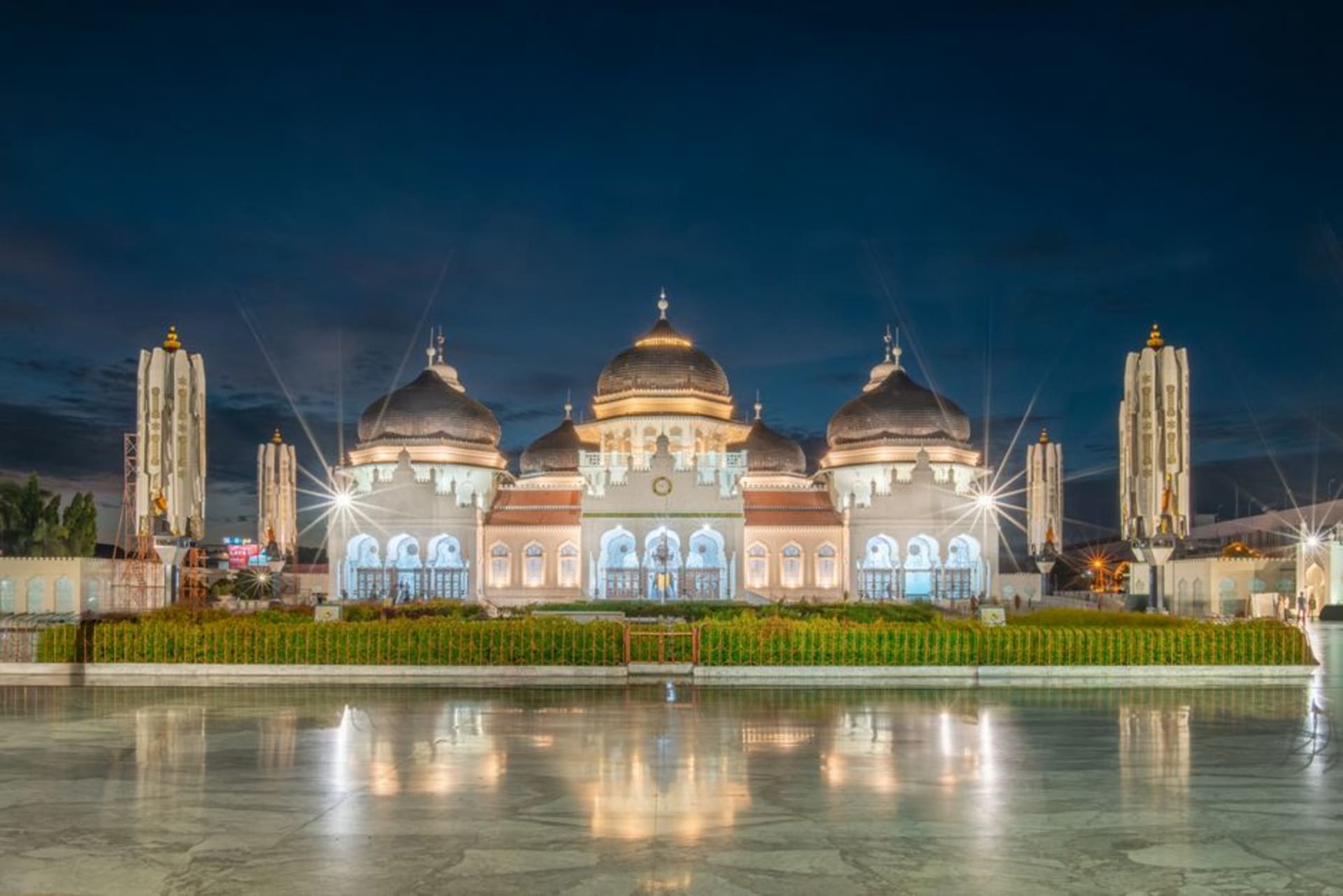
The first thing you register in Banda Aceh, before any of the history sinks in, is the Baiturrahman Grand Mosque — its black onion domes and brilliant white minarets rising over the low city skyline like something transplanted from Mughal India, which in a sense it was, since the current structure dates to Dutch colonial reconstruction in 1879 after the original 17th-century mosque burned during the Aceh War. It’s the spiritual center of a region that calls itself Serambi Mekkah, the “Veranda of Mecca,” a nickname earned from Aceh’s centuries-long role as the entry point for Islam’s spread through the archipelago and as a waypoint for pilgrims heading onward to the Hajj. Aceh operates under its own version of sharia law, distinct from the rest of secular Indonesia — a special autonomy granted after decades of a separatist conflict that only ended in 2005, and visitors notice it quickly in the modest dress expected in public and the segregated prayer areas within the mosque itself.
I’d come to Banda Aceh mostly for what happened on the morning of December 26, 2004. Banda Aceh was the closest major city to the epicenter of the magnitude 9.1 earthquake that triggered the Indian Ocean tsunami, and it absorbed the single greatest loss of any city on earth that day — waves reported over 30 meters high in places, more than 60,000 dead in Aceh province alone, entire coastal neighborhoods erased down to their foundations within minutes. The Tsunami Museum, designed by Ridwan Kamil and opened in 2009, handles that scale of loss with a restraint I wasn’t expecting: you enter through a narrow, dim corridor with water running down both walls and the sound of rushing water piped in, disorienting on purpose, before arriving at a soaring central space — the Chamber of Blessing — with the names of victims spiraling up toward an oculus of light. I stood in that room longer than I’ve stood anywhere in a museum.

The ship that didn’t go back to sea
A few kilometers from downtown, in the Punge Blang Cut neighborhood, sits a diesel-powered electricity generator ship — PLTD Apung — a vessel weighing over 2,600 tons that the tsunami picked up from the harbor and deposited nearly three kilometers inland, where it remains to this day as a memorial. Walking up to it, incongruous among ordinary houses and a school playground, does something that statistics can’t: it makes the physical force of that wave suddenly, viscerally legible. Locals I spoke with near the site had, without exception, lost family members that morning, and yet the way Banda Aceh has folded the memorial sites into ordinary neighborhood life — kids playing near the ship’s hull, vendors selling snacks by the entrance — spoke to a place that chose to live alongside its grief rather than cordon it off.
Beyond the tsunami’s imprint, Banda Aceh carries older layers worth slowing down for: the Gunongan, a whimsical white pleasure garden built by a 17th-century sultan for his Malay wife, homesick for the hills of her homeland; the Aceh State Museum with its traditional Rumoh Aceh stilt house; and a food scene built around mie Aceh, a rich, spiced noodle dish — heavy on cumin and coriander, often with goat or seafood — that tastes like nothing else I ate in Indonesia and reflects the Indian and Arab trading influences that have shaped Acehnese cuisine for centuries.
When to go: May to September brings the driest, most comfortable weather for walking the city; December 26 draws memorial ceremonies if you want to witness how the city marks the anniversary, though it’s understandably a heavier time to visit.