
Balikpapan
"The most functional city in Kalimantan, and functional turned out to be its own kind of honest."
An oil town on Kalimantan's east coast that never bothered dressing itself up for tourists, which is exactly why I liked it.
Nobody goes to Balikpapan for Balikpapan. It’s the gateway — the airport you fly into on your way to the orangutans of Kutai National Park, the jump-off point for the Mahakam River, and, more recently, the closest major city to Nusantara, Indonesia’s new capital rising out of the jungle a short drive north. I landed expecting exactly that: a layover with a hotel attached. What I found instead was a genuinely likeable mid-sized city that has spent a century built around oil and has never pretended otherwise, and there’s something almost refreshing about a place in Indonesia that isn’t performing for you.
Dutch colonial surveyors struck oil here in 1897, and Balikpapan has been an energy town ever since — the refinery that still dominates the bay was a strategic enough target that Japanese and Allied forces fought one of the more brutal battles of the Pacific War over control of it in 1945, and there are still war-era bunkers and the remains of coastal defenses scattered around the city if you know where to look. That industrial backbone gave Balikpapan something rare among Indonesian cities its size: real infrastructure, wide roads, and a cosmopolitan mix of Bugis, Banjar, Javanese, Dayak, and expat oil-industry residents that shows up most clearly in the food.
The coast that isn’t for swimming
Melawai Beach sits right in the middle of the city and it’s not a swimming beach — the water’s too close to shipping lanes and refinery outflow for that — but at sunset it becomes the city’s living room. Families set up mats, vendors push carts of grilled corn and pisang goreng, and the whole waterfront faces west toward Makassar Strait, so the sun goes down directly into the water while the silhouettes of tankers wait offshore for their turn at the port. I sat there with a bag of amplang, the crunchy fish crackers that are a Balikpapan specialty made from local mackerel, and watched kids fly kites in a wind that smelled faintly of salt and diesel — an odd combination that somehow captured the whole city.

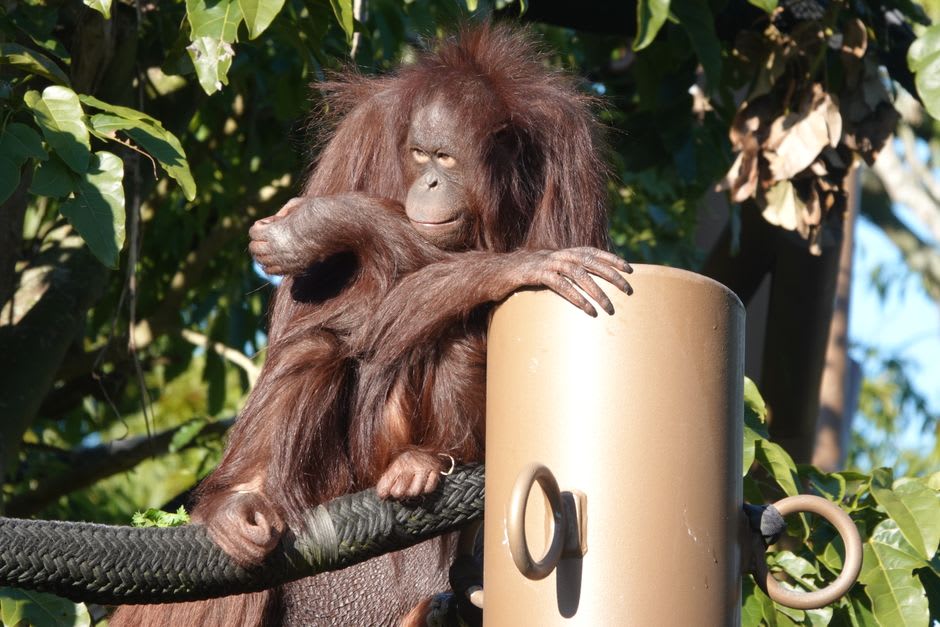
The real reason to linger, though, is as a base for the Mangrove Center at Margomulyo and the Karang Bolong marine area nearby, but the trip I’d actually recommend is inland: Balikpapan is the standard launch point for visits to the Wanariset orangutan rehabilitation center and, further out, Kutai National Park, one of the last strongholds of wild Bornean orangutans alongside proboscis monkeys and hornbills. I spent a day at Wanariset watching semi-wild orangutans being prepared for eventual release, and the staff there — mostly local Kalimantan biologists — were candid in a way I appreciated about how much habitat the island has lost to palm oil and logging, and how much is riding on projects like this one.
There’s a bigger story unfolding around the city right now, too. Nusantara, the planned capital meant to eventually replace Jakarta, is going up about seventy kilometers north, and Balikpapan has become its unofficial support city — construction crews, government advance teams, and a fair number of curious Indonesians pass through here on their way to see the new capital taking shape. It gives the city an odd, in-between energy right now, half oil town, half staging ground for the next chapter of the country’s political geography. I don’t know what Balikpapan looks like in ten years. I suspect it looks a lot more important than it does today.
When to go: Kalimantan’s dry season, roughly April to September, gives you the best odds for wildlife spotting inland and calm evenings on Melawai Beach; avoid the peak of the wet season (December–January) if you’re heading to Kutai National Park, since trails can become impassable.