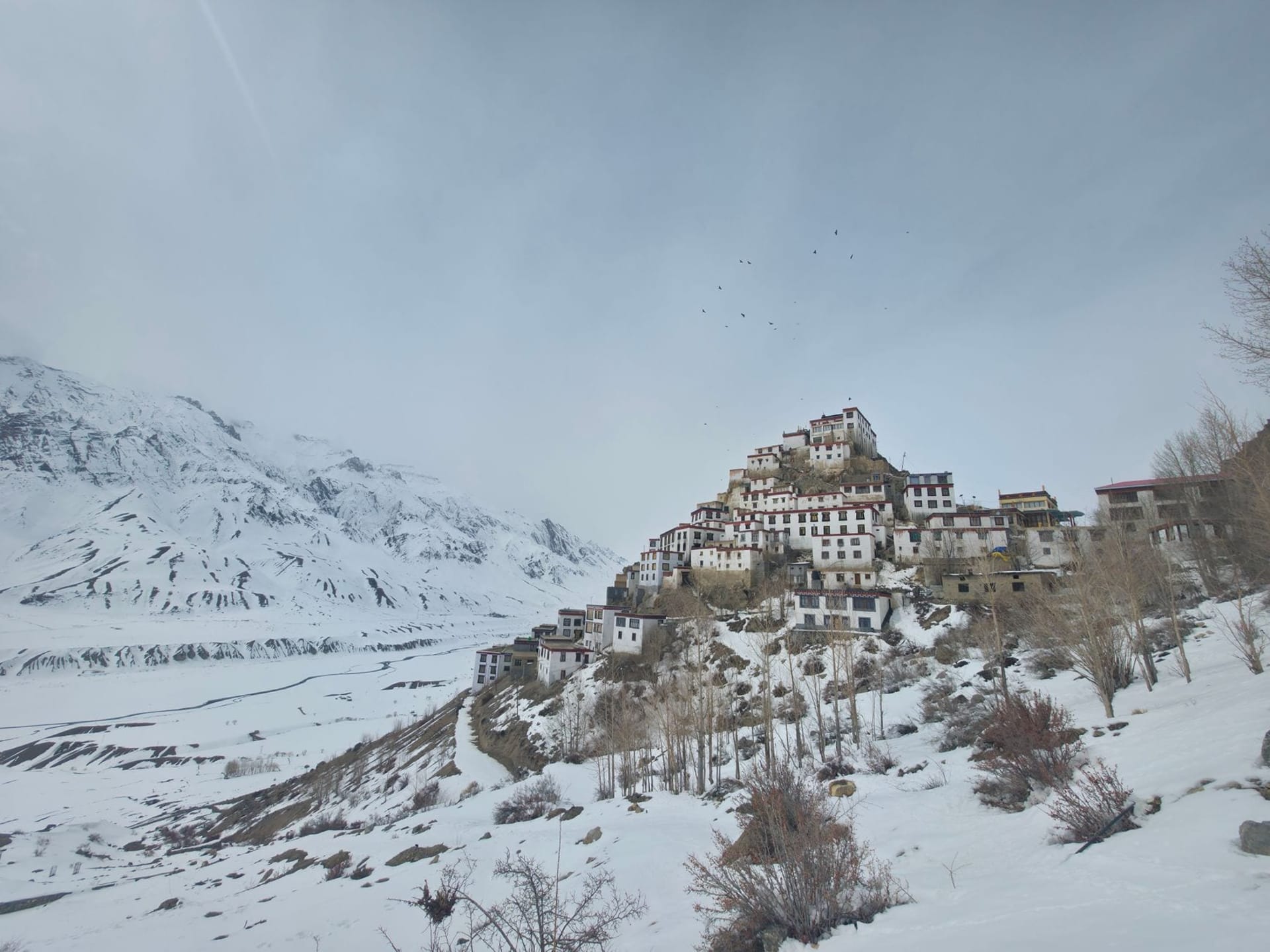
Spiti Valley
"Spiti strips travel down to its bones: altitude, silence, and a monastery perched where it has no right to be."
Cold desert valley at 4,000m with white-plastered monasteries clinging to ochre cliffs.
The road into Spiti from Shimla takes two days and several lifetimes. By the time the Hindustan-Tibet Highway narrows to a single crumbling lane above the Sutlej gorge, you have already left behind the idea that travel is comfortable. The air thins. The trees disappear. The rock turns rust and ochre and a deep, oxidized red, and then the valley opens and you understand why people build monasteries at four thousand meters — not in spite of the austerity, but because of it.
The Weight of Altitude
Kaza, the valley’s largest town, sits at 3,800 meters along the main bazaar road. It has a handful of dhabas serving thukpa and butter tea, a petrol pump that is sometimes dry, and a quality of morning light I have never encountered anywhere else — thin and silver, falling on whitewashed walls without warmth, as though the sun itself is conserving energy. My first morning there I sat outside our guesthouse with a cup of chai going cold faster than I could drink it and watched a monk in burgundy robes cross the empty lane without hurrying. He had nowhere else to be. Neither, suddenly, did I.
The headaches come on the second day if you ascend too quickly from Manali. Lia and I had taken the slower route over the Rohtang Pass, acclimatizing in Kaza for two nights before attempting the road up to Ki Monastery. It was the right call. Ki sits at 4,166 meters on a conical hill above the river — nine centuries of whitewashed stone stacked in layers that seem to defy both gravity and logic — and when we arrived on foot along the switchback trail, lungs working harder than legs, the effort felt proportionate to what we found.
A Monastery That Has No Right to Be There
What surprised me at Ki was not the monastery itself but the sound inside it. I expected silence. What I found was a low, continuous vibration — dozens of monks in a side hall reciting prayers in unison, the sound bouncing off thick mud walls until it felt less like chanting and more like the building itself breathing. We sat in a small anteroom for twenty minutes without speaking. A teenage monk brought us salt tea in metal cups. We drank it.
The walls were covered in thangka paintings darkened by centuries of butter-lamp smoke. The faces of bodhisattvas looked through the haze with expressions I could not name — not serene, exactly. Patient, maybe. As though they had watched empires arrive and dissolve and were prepared to watch a few more.
Going Deeper: Dhankar and the Lake Above
The less-visited villages reward the bad roads required to reach them. Dhankar, perched above the confluence of the Spiti and Pin rivers, has a crumbling fort-monastery that conservation money has not yet reached. The trail above it climbs another four hundred meters to Dhankar Lake — a small, impossibly blue pool ringed by scree — where I sat alone for an hour watching clouds move across peaks that had no names on any map I carried.
When to go: The valley is accessible by road from late May through October, with July and August bringing some rain to the Pin Valley but leaving Kaza and the upper reaches largely dry. June and September offer the clearest skies and the fewest other travelers.