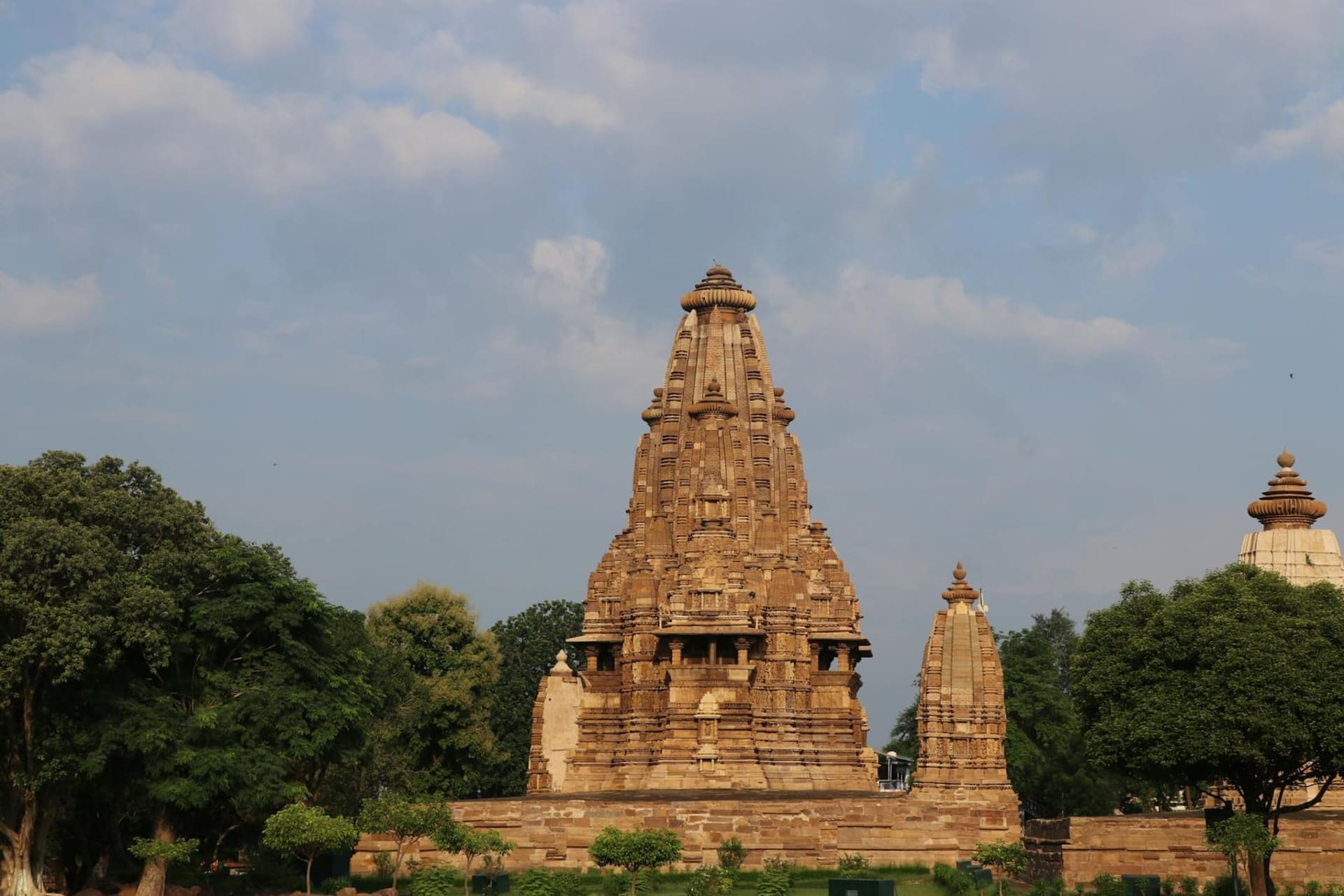
Khajuraho
"Khajuraho's stone carvings are so honestly human that after an hour, the shock dissolves into admiration."
Chandela temples whose intricate erotic carvings are, against all expectation, a meditation on human joy.
I came to Khajuraho half-expecting to feel awkward. I had been warned — by guidebooks, by a grinning guesthouse owner in Varanasi, by Lia, who raised an eyebrow and said “so we’re going to the sex temple town.” We got off the overnight bus near the main square, drank chai from clay cups that left a fine red dust on our fingers, and walked the ten minutes to the western enclosure before the tour groups arrived.
Nothing prepares you for the scale.
Stone That Breathes
The Lakshmana Temple stops you at the gate. The entire exterior — a tower of pale amber sandstone rising maybe thirty metres above the manicured lawn — is alive with figures. Apsaras adjusting their anklets. Warriors on horseback. Couples entwined in postures that would make a yoga instructor pause. But what strikes me first is not the explicitness. It is the tenderness. A woman applying kohl to her eye with her little finger. A man leaning into a kiss with his eyes closed. The erotic panels occupy perhaps twenty percent of the carvings; the rest is simply life, rendered with an intimacy that no museum exhibit could replicate. The Chandela sculptors of the tenth century were not making pornography. They were insisting that the body is not separate from the sacred.
I stood in front of one frieze for longer than I expected — a scene of musicians and dancers framing a couple, every figure’s expression specific, individual — and felt the discomfort I had carried in from the bus dissolve into something quieter. Admiration, I think.
The Detail You Almost Miss
We nearly walked past the Chitragupta Temple without entering. It faces north, away from the main path, and by ten in the morning the shadow had already moved off the porch. Inside, Lia spotted what I had missed entirely: a panel carved so fine that the thread of a necklace, no thicker than a fingernail, still held its original curl. Eight centuries of monsoon and dust, and that thread had not blurred. The stone here is from Panna, a region known for its diamond mines — dense, close-grained, reluctant to erode. It explains everything. The precision was not only skill; it was material.
Temple Town After Dark
Khajuraho itself is small and manageable in a way Varanasi never is. In the evening we ate dal baati churma at a place on Airport Road whose name I cannot translate but whose smoke I can still recall — mustard oil and dried red chilli, the baati arriving in a clay bowl with a thumb-sized dent of ghee pooling in the centre. The town empties early. By nine the lanes near the Raja Cafe were dark and quiet and cool, the stone towers lit amber against a sky going purple over the fields.
When to go: October through March, when temperatures in Madhya Pradesh drop to something navigable. February is ideal — the light is clean and flat, the crowds manageable, and the annual Khajuraho Dance Festival fills the temple lawns with Kathak performers who look, at a certain angle, like the carvings come down from the walls.