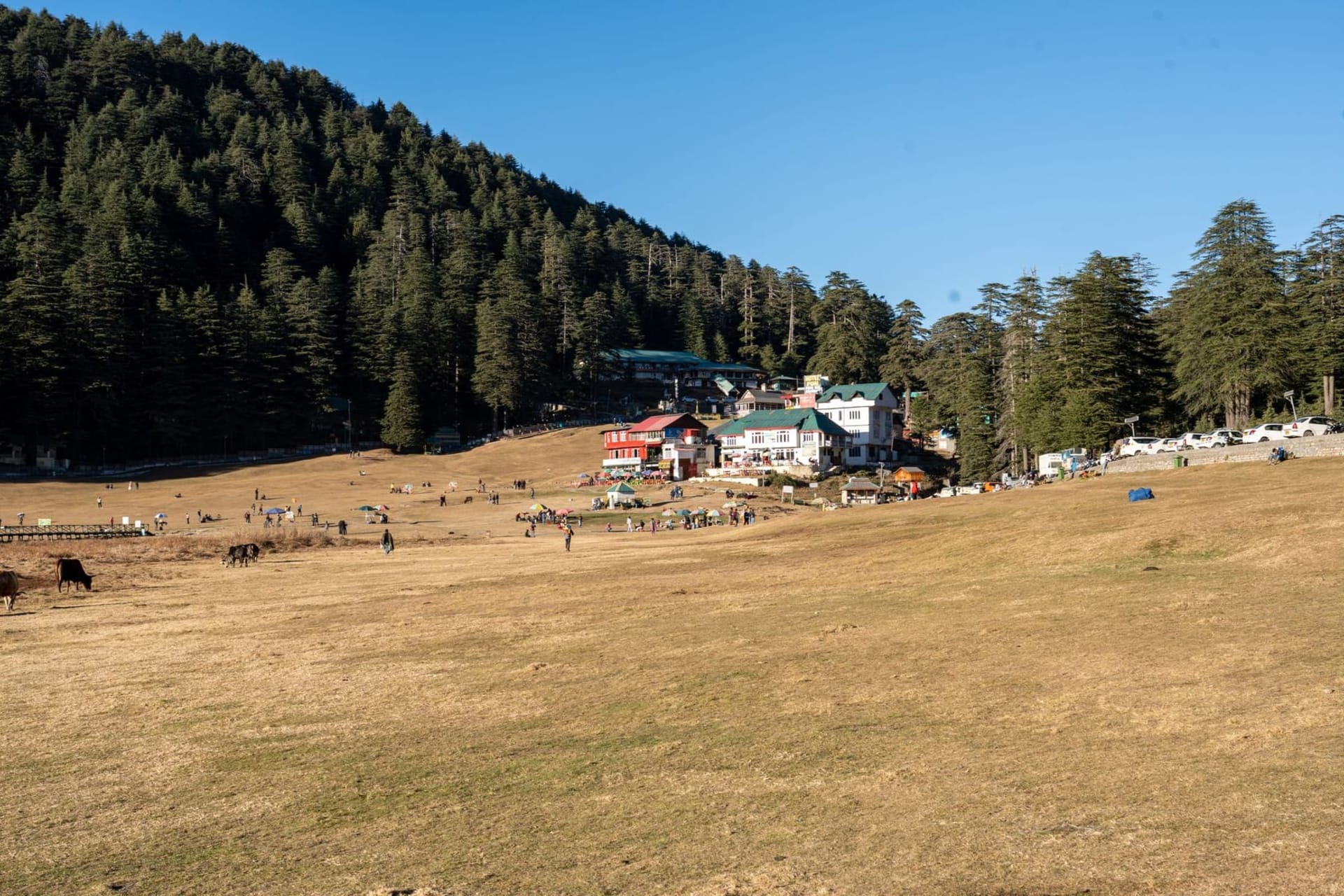
A high-altitude meadow ringed by deodars in Himachal Pradesh, called the mini-Switzerland of India by the Swiss consul in 1992.
The road from Dalhousie climbs through switchbacks so tight the driver crosses himself before each one, and then the trees open and you see it: a disc of impossible green, perfectly flat, ringed by deodar cedars standing so straight they look assembled rather than grown. I had read the word “meadow” and pictured something modest. Khajjiar is not modest.
The Diplomat’s Meadow
In 1992, the Swiss consul-general to India stood somewhere on this grass — probably right where the families are now having their photographs taken — and said, officially, that it reminded him of Switzerland. Someone thought to commemorate this, and so there is a small signboard near the edge of the meadow that records the comparison in both Hindi and English. Lia found it before I did and called me over. There is something genuinely strange about standing at 2,000 metres in Himachal Pradesh reading a plaque that validates a European feeling. The meadow does not need the validation. It is extraordinary on its own terms.
The lake at the center is small and tannin-dark, ringed by a floating island of grass that drifts with the wind. Local ponies — thick-necked, patient animals — stand at the water’s edge and ignore the tourists. The light at midday comes through the cedars at a long angle even in summer, the kind of light that makes everything look like it has just been washed.
What Surprised Me
I expected the meadow to be the whole story. I was wrong about the Khajji Nag temple at its edge, which is old enough that no one agrees on exactly how old — 10th century is the conservative estimate, but the priests I spoke to gestured vaguely at centuries in a way that suggested they found the question slightly beside the point. Inside, silver cobras coil around the main shrine, offerings of marigold and mustard oil giving the air a dense, warm sweetness that mixes with pine resin drifting in from outside. The contrast — that damp temple interior against the cold clarity of the meadow — is the thing I keep returning to when I think about Khajjiar.
Getting There and Eating Well
The nearest town is Dalhousie, about 24 kilometres and 45 minutes of mountain road away. Most travelers come as a day trip from there, which is fine, but arriving early before the tour buses from Pathankot means you have the meadow nearly to yourself in the morning mist. A small cluster of dhabas along the approach road serves rajma chawal — kidney beans braised until they are almost a sauce, served over rice with a knob of ghee — and it is exactly what the altitude calls for.
When to go: May through June before the monsoon arrives, or September through October when the rains have cleared and the deodars are at their deepest green. Avoid July and August when the meadow turns muddy and the roads through Chamba district can close without warning.