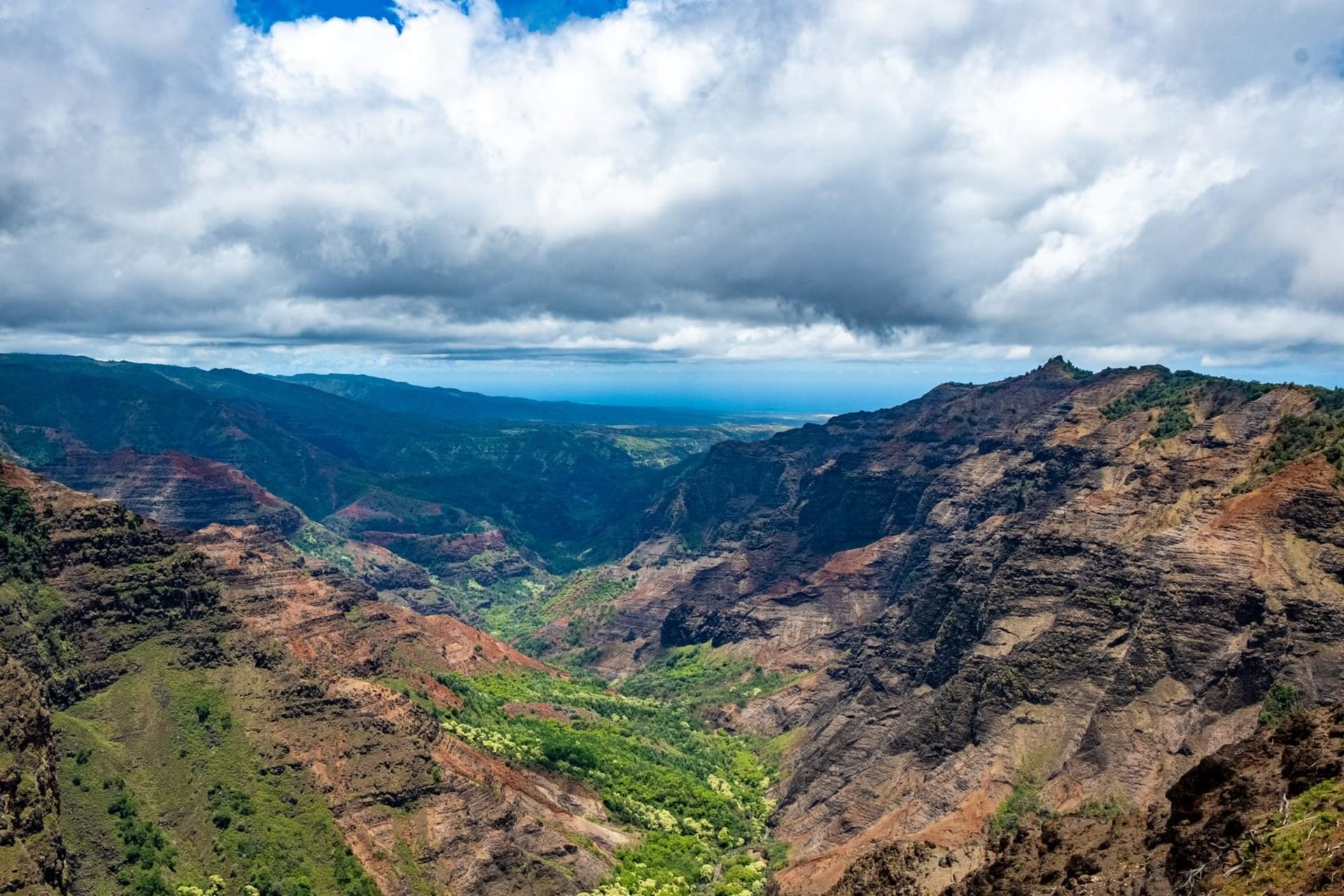
The 'Grand Canyon of the Pacific' — a 3,600-foot-deep red-rock gorge carved by rain on a volcanic island.
I had been warned about the clouds. Everyone on Kauai mentions them as a kind of island weather disclaimer — especially up on the plateau, especially near Waimea. We drove the canyon road in near-zero visibility, the rental car fogged on the inside, Lia’s map app announcing turns into nothing but white. I had almost talked myself into turning back when the clouds broke sideways, and there it was: three thousand six hundred feet of red earth falling away into a canyon so violent in its color and scale that I laughed out loud, which is not something I do often.
Red That Has No Business Being This Red
The drive along Waimea Canyon Drive from the town of Waimea on the south shore climbs steadily for roughly twelve miles before the first proper lookout appears. What hits you first is not the depth — it’s the color. The basalt has oxidized over millions of years into this implausible shade of iron red, almost maroon in the shadows, shifting toward rust and then burnt sienna in direct sun. The canyon walls are not uniform. They’re stratified in bands — each layer a different eruption, a different era of cooling and exposure. Geologists read time in those bands. I just stood at the Pu’u Hinahina Lookout and felt appropriately small.
The Na Pali Coast is visible on clear days from the higher viewpoints. We saw it briefly — that serrated green coastline disappearing into sea haze — before the clouds closed in again. Kauai gives and takes. You learn to be fast with a camera.
The Trail Down to Waipo’o Falls
We hiked the Canyon Trail toward Waipo’o Falls, about four miles round-trip from the Halemanu-Koke’e trailhead off Kokee Road. The trail descends through native ‘ohi’a forest — those gnarled red-blossomed trees that smell faintly medicinal in the humidity — before opening onto a ledge above the upper falls. What I had not expected was the sound. The canyon amplifies everything. Wind moving through a gorge that deep creates a low, constant resonance, more felt than heard, somewhere in the chest.
Lia sat on a rock at the edge of the overlook and didn’t say anything for a long time. That’s how I knew it had gotten to her too.
The unexpected moment came on the way back: a Nene goose — Hawaii’s state bird, famously unbothered by humans — walked directly across the trail in front of us and stopped to regard us with what I can only describe as bureaucratic indifference. After the grandeur of the canyon, this small, ridiculous bird was exactly the right counterpoint.
After the Canyon
Back in Waimea town, we stopped at the Waimea Shave Ice stand near the pier and ordered lilikoi and coconut. The cold was absolute and necessary. The town is quiet, functional, not particularly set up for tourism, which I found refreshing. A plate lunch from a roadside window — teriyaki chicken, rice, macaroni salad — eaten in the car with the windows down and red dirt still on our shoes.
When to go: April through September brings drier, clearer skies to the canyon’s upper elevations — the odds of cloud-free views are significantly better in summer. Mornings clear fastest; arrive at the lookouts before ten if visibility matters to you.