Zhaoxing
"Five drum towers in one valley, each belonging to a different clan — the Dong build their politics in timber and put them in the sky."
The last leg into Zhaoxing was on the back of a motorcycle driven by a teenager who communicated exclusively through the angle of his acceleration. The road dropped into a valley through a series of switchbacks, and as we came around the final curve I saw the drum towers before I saw anything else — five of them, pagoda-shaped, their tiered eaves tapering upward like compressed gestures of reaching, rising from the wooden rooftops of the village below. I tapped the driver’s shoulder. He nodded once, as if he had seen this reaction before.
The Dong people are the great architects of Guizhou. While the Miao are known for their silver and their festivals, the Dong built things — drum towers, covered bridges, granaries, gates — using a timber joinery system that uses no iron nails, no binding wire, only interlocking wooden elements that have held together for centuries. Zhaoxing is the finest example of Dong village architecture that is still entirely inhabited, still entirely functioning, rather than preserved as a museum. The five towers belong to the five clan groups that make up the village, and each one is slightly different in proportion and in the carvings on its eaves.

The drum towers are not merely decorative. They are the social centers of each clan — gathering places for festivals, for communal decision-making, for the long winter evenings when the village elders sit under the tower’s shelter and the young people learn songs. The Dong are famous for their polyphonic choral singing, a form called grand song or Dage, which UNESCO added to its list of intangible cultural heritage in 2009. I heard it for the first time not at a performance but from behind a wall — women’s voices, four or five of them, practicing harmonies in a courtyard on a Tuesday afternoon, and the sound had a quality of natural acoustics that the drum tower’s wooden structure seemed designed to amplify and contain.
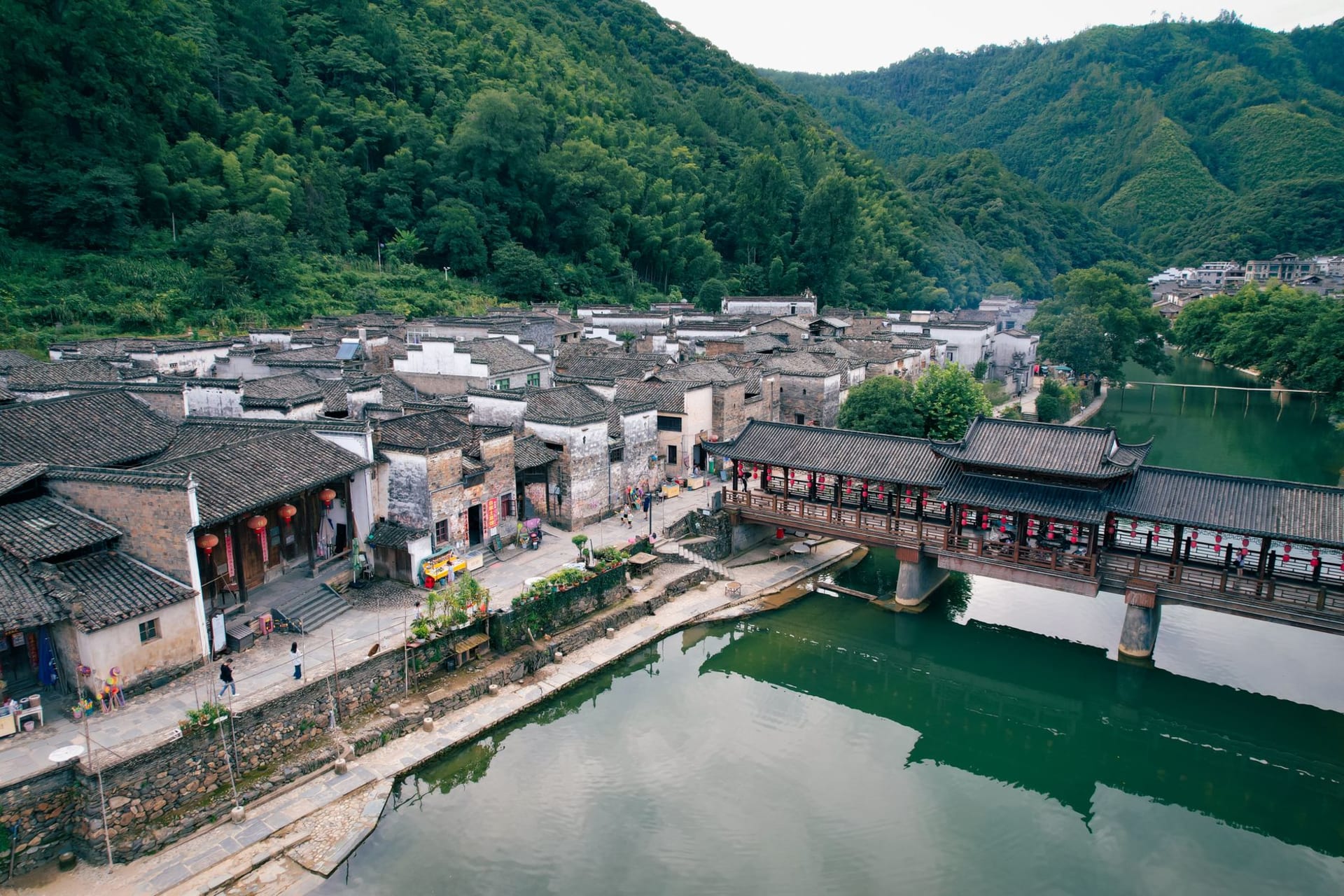
The covered bridge that crosses the river at the village’s edge is another exercise in effortless structural beauty. The Dong call these wind-and-rain bridges, which captures both their function and their feeling — they are designed to shelter, and they do, and walking through one in a downpour while the rain hammers on the tile roof above is an experience that is deeply, specifically comfortable.

The food in Zhaoxing is simpler than the Miao belt around Kaili — rice, river fish, pickled vegetables, sour soup — but prepared with an economy that suggests a culture that built its architecture not on excess but on exactness. I ate at the same family restaurant three times because the fish they served came from the paddy fields surrounding the village, a slightly muddy, deeply flavorful freshwater species that bears no resemblance to anything sold in a city market.
The access road has improved significantly in recent years, and Zhaoxing now appears on itineraries that run from Guilin through to Kaili. The tourism is still human-scale — small guesthouses, no chain hotels, no international menus — but the path toward development is visible in the new concrete guesthouses going up at the village’s edge. The older wooden structures at the center remain magnificent.
When to go: April and May, when the rice paddies are newly flooded and the surrounding hills are intensely green, offer the most striking landscapes. October brings harvest gold to the terraces. The Dong polyphonic singing festivals occur at various points through the year by the lunar calendar — ask locally about dates, which shift annually. Avoid the coldest months, January and February, when the valley is damp and the wooden buildings become very cold.