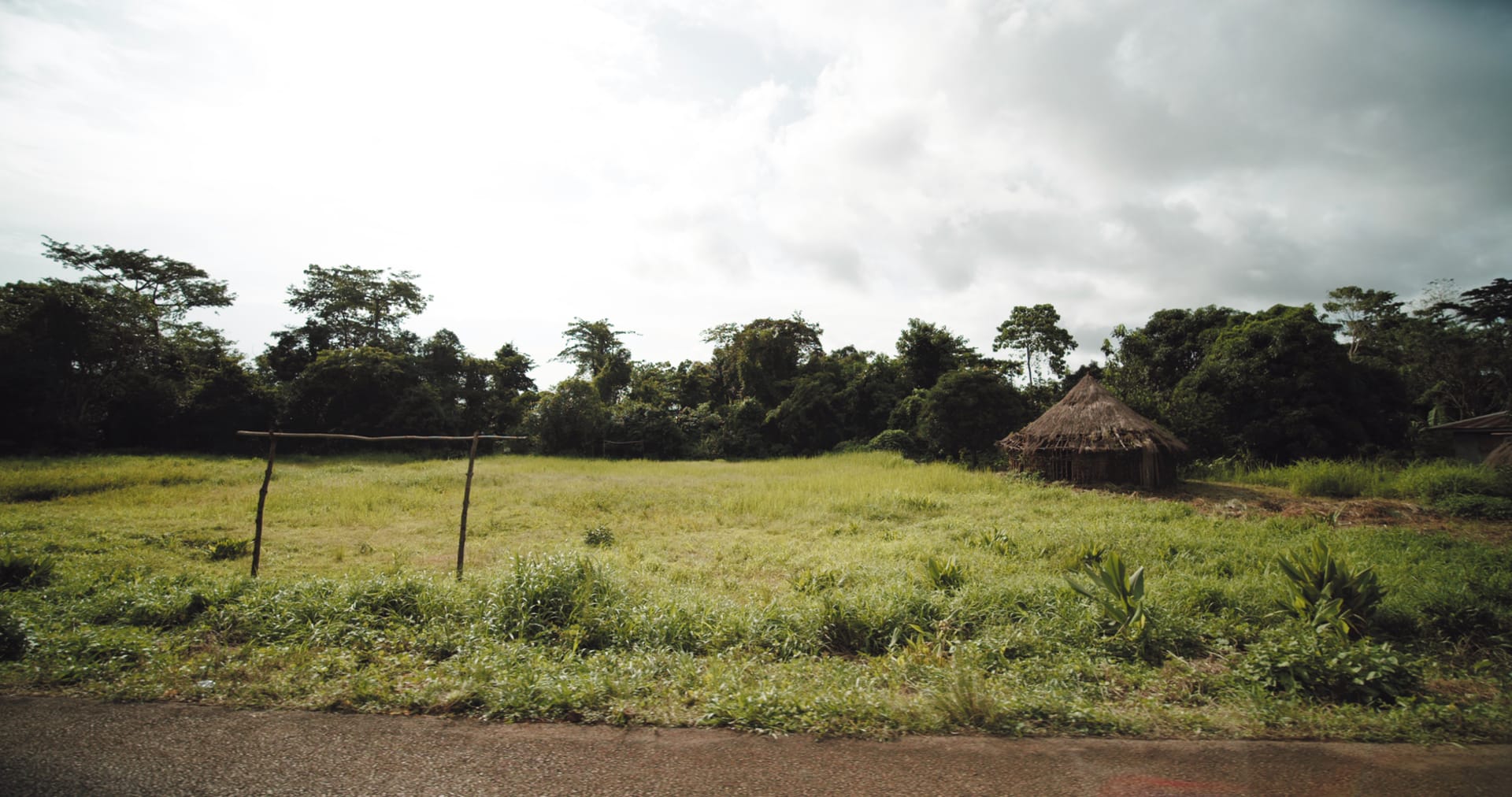
Bossou
"The chimps at Bossou do not notice you. They are too busy with more important things than being observed."
I expected to be nervous. You read enough about chimpanzee encounters — the warnings about maintaining distance, the advice about not making direct eye contact, the reminder that chimpanzees are extraordinarily strong and not always predictable — and you arrive in Bossou with your body in a state of low-grade readiness, which turns out to be entirely unnecessary. The first chimpanzee I saw was a female named Juru, according to my guide, who had been observed by researchers from the Institut de Recherche Environnementale de Bossou since before I was born. She was approximately eight metres away. She was using a stone to crack oil palm nuts on a flat rock. She was entirely absorbed in what she was doing and gave me the kind of glance that means the presence has been registered and filed under irrelevant.
Bossou is a village in the foothills of the Nimba Mountains, near the tripoint where Guinea, Liberia, and Côte d’Ivoire meet. The research station here has been monitoring a small community of chimpanzees since 1976 — one of the longest-running primate field studies in the world. What makes Bossou’s chimps unique is not just the length of observation but what has been observed: these chimpanzees use stone tools to crack nuts, a behaviour that they have maintained and transmitted across generations, which is, depending on your definitions, either the beginning of technology or the most humbling thing in the natural world.

The forest around Bossou is sacred in the traditional sense — the local Manon people have long considered it the home of ancestor spirits, and this belief has historically protected it from the agricultural clearing that has reduced forest cover throughout the region. The result is a fragment of old-growth forest surrounded by farmland, functioning as an island — and this island is where the chimpanzees live, perhaps thirty individuals, perhaps fewer. The researchers know most of them by name. The village knows them by reputation.
Walking through the sacred forest with a guide and a researcher is one of the more unusual experiences I have had in West Africa. The trail is narrow and the canopy is high and old, and the light comes through in specific columns that move as the trees move. The sounds shift as you go deeper — fewer birds, more insects, the occasional crack of branches overhead as something moves through the canopy that you can hear but not yet see. And then you come around a bend and there is a group of chimpanzees in a clearing, completely matter-of-fact about their presence, going about the morning’s business with a thoroughness that makes you feel, slightly, like an intrusion.

The village of Bossou itself is small and quiet and generous. I stayed with a family for two nights and ate what they ate — rice and sauce, sweet potato, fish from the market in Nzérékoré, three hours’ drive away. The conversations were in a mixture of French and Manon that my guide translated, and the questions they asked me were questions about Europe and what it looked like and whether it was cold, the kind of geographic curiosity that felt appropriate in a place where geography has had such profound consequences. The children were interested in the chimpanzees the way city children are interested in their own neighbourhood — familiarly, proprietorially, as something that belongs to the landscape and to them.
When to go: November through February is the dry season and the easiest window for reaching Bossou — the road from Nzérékoré is unpaved and becomes very difficult in wet conditions. Chimpanzee sightings are most reliable in December and January when the animals concentrate around food sources. Permits are arranged through the research station.