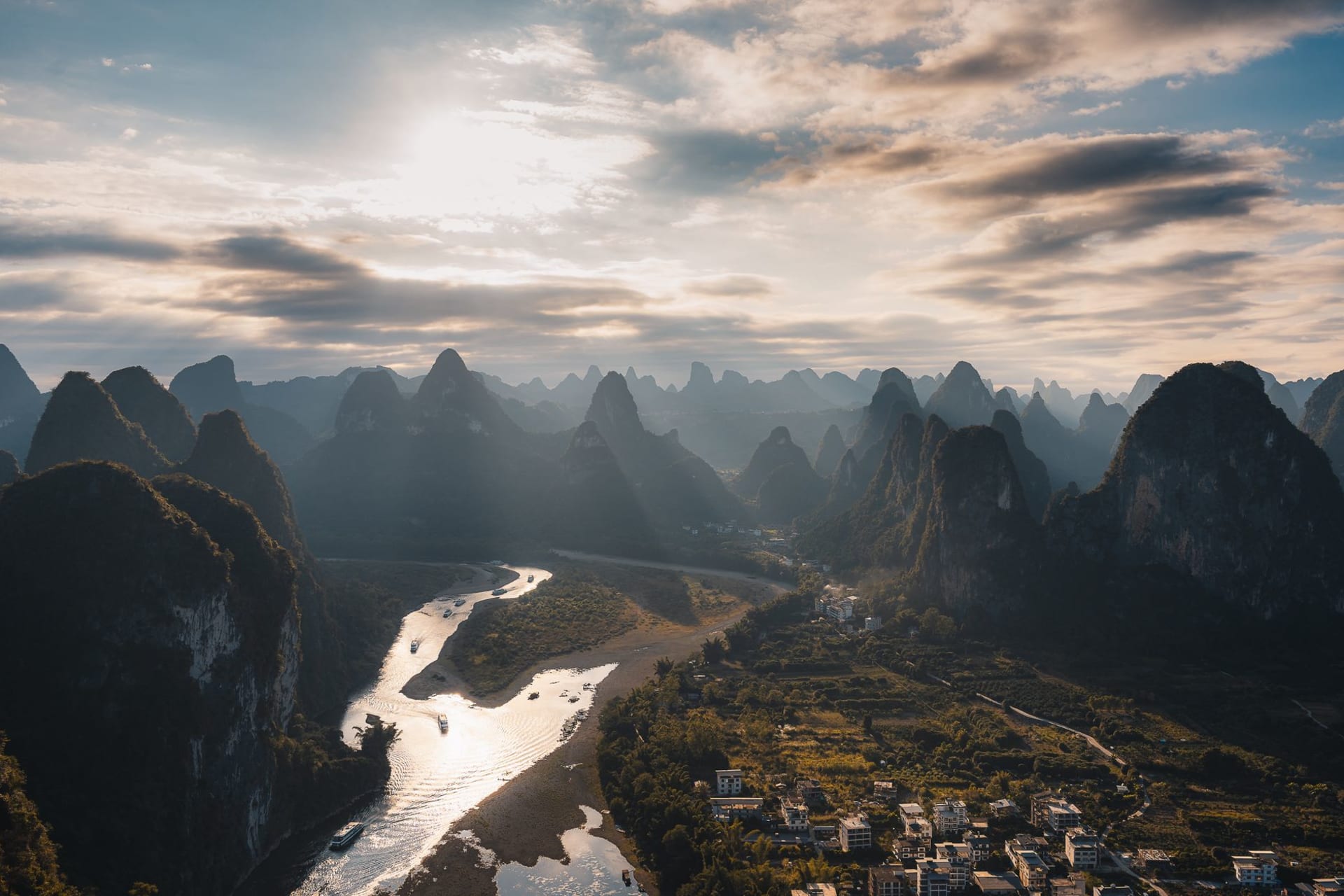
I found the Yulong River by accident, the way I find most things worth finding. I was cycling south of Yangshuo, following a road that appeared on no map I had, and I came around a curve and the river was simply there — jade green and still, maybe fifteen meters wide, with a limestone cliff going straight up from the opposite bank and a stone arch bridge spanning it that looked medieval and probably was. No tour boats. No commentary in three languages. A man on a bamboo raft was crossing from one bank to the other, poling slowly, and a white egret stood at the water’s edge pretending the man did not exist.
The Yulong is a tributary of the Li River, which means it shares the same geology but operates at a completely different scale and speed. Where the Li is broad and managed — cruise boats, designated viewpoints, timed photography — the Yulong is intimate. It fits in the landscape rather than dominating it. The water is the color of weak jade tea and cold even in September, fed by springs in the karst hills. In some places it runs fast over gravel beds that catch the light in patterns; in others it widens and goes still and the peaks above are perfectly doubled in the surface.
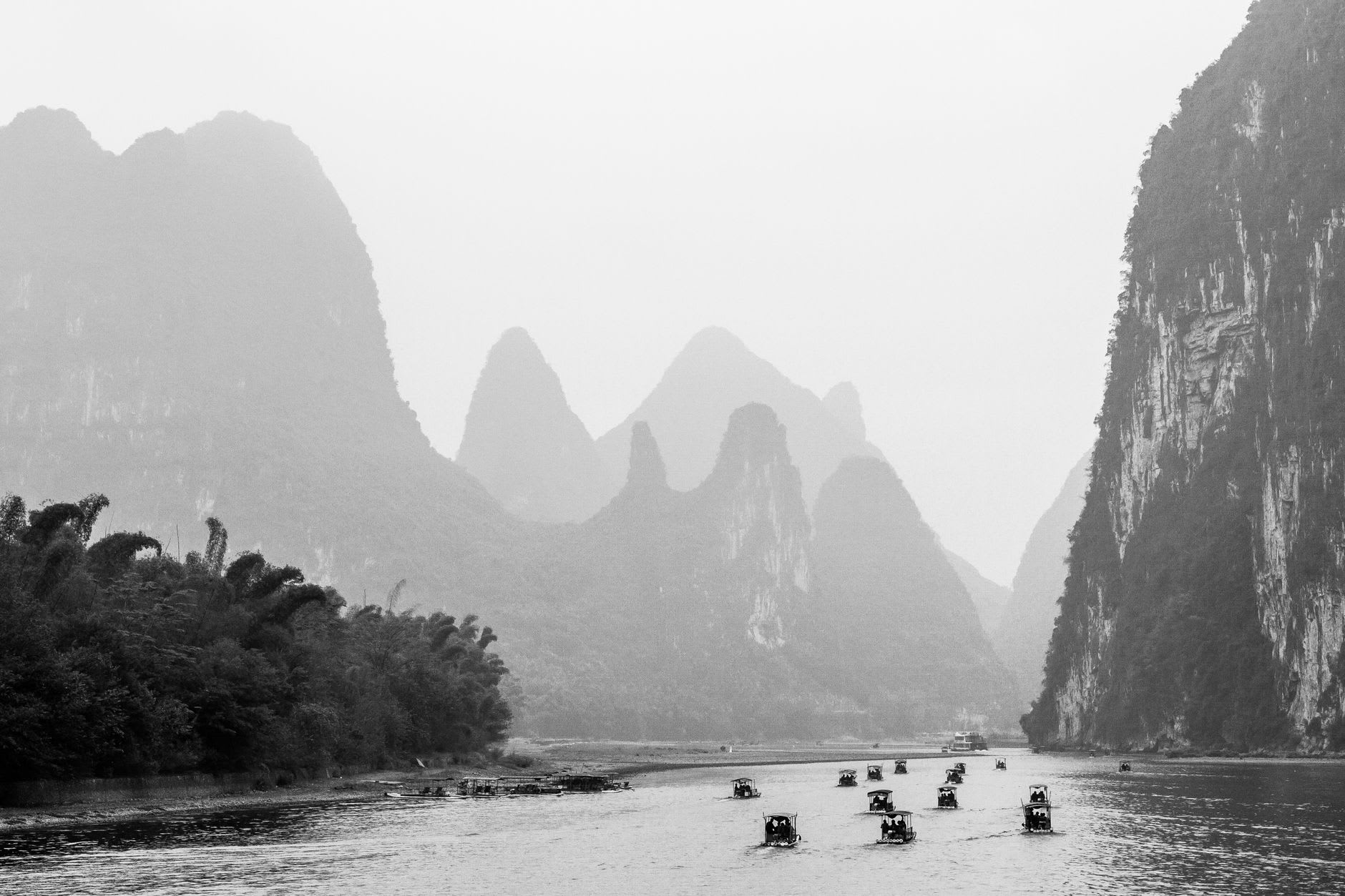
The bamboo raft rides are the main activity, and the guides who pole you downriver for a few kilometers are mostly farmers supplementing their income. My guide spoke no English and I spoke approximately forty words of Mandarin, and we got along perfectly. He pointed things out with his pole — a kingfisher on a branch, a place where the current eddied over a rock shelf into a natural pool, a section of cliff that caught the afternoon light and went briefly orange. I pointed at his cigarette and he offered me one and we both smoked and watched the karst go past. This is the kind of travel that cannot be booked in advance.
The river road between Yangshuo and the old bridge at Yulong is one of the most pleasant cycling routes in the whole region. It runs along the west bank of the river for about ten kilometers, flat the whole way, passing fields of pomelo and persimmon and small vegetable plots where farmers work in early morning and again at dusk. The pomelos here are remarkable — large as bowling balls, with thick green skin and flesh that is drier and less sweet than the Thai variety, with a faint bitterness at the finish. You buy them from roadside carts and eat them as you cycle, spitting seeds into the irrigation channels like everyone else.

Late in the afternoon, when the tourist cyclists have mostly gone back to Yangshuo for dinner and the light is getting long and golden, the river has a quality of complete peace that is rare in Guangxi and increasingly rare anywhere. Herons move between the gravel banks. Farmers drive their buffalo home along the river road, the animals’ hooves raising small puffs of dust. The karst peaks begin to hold shadow in their crevices while their upper faces stay lit, which makes them appear to be lit from within. I sat on the bank at this hour two days running and each time could not quite bring myself to leave until the light was entirely gone.
When to go: The Yulong is good in almost any season, but October offers the most dramatic light and the easiest temperatures for cycling. Avoid rainy season (June through August) when the river can run fast and brown after storms, and bamboo raft rides may be suspended for safety. December through February is cool but clear and completely uncrowded — bring a jacket for the early morning cycling.