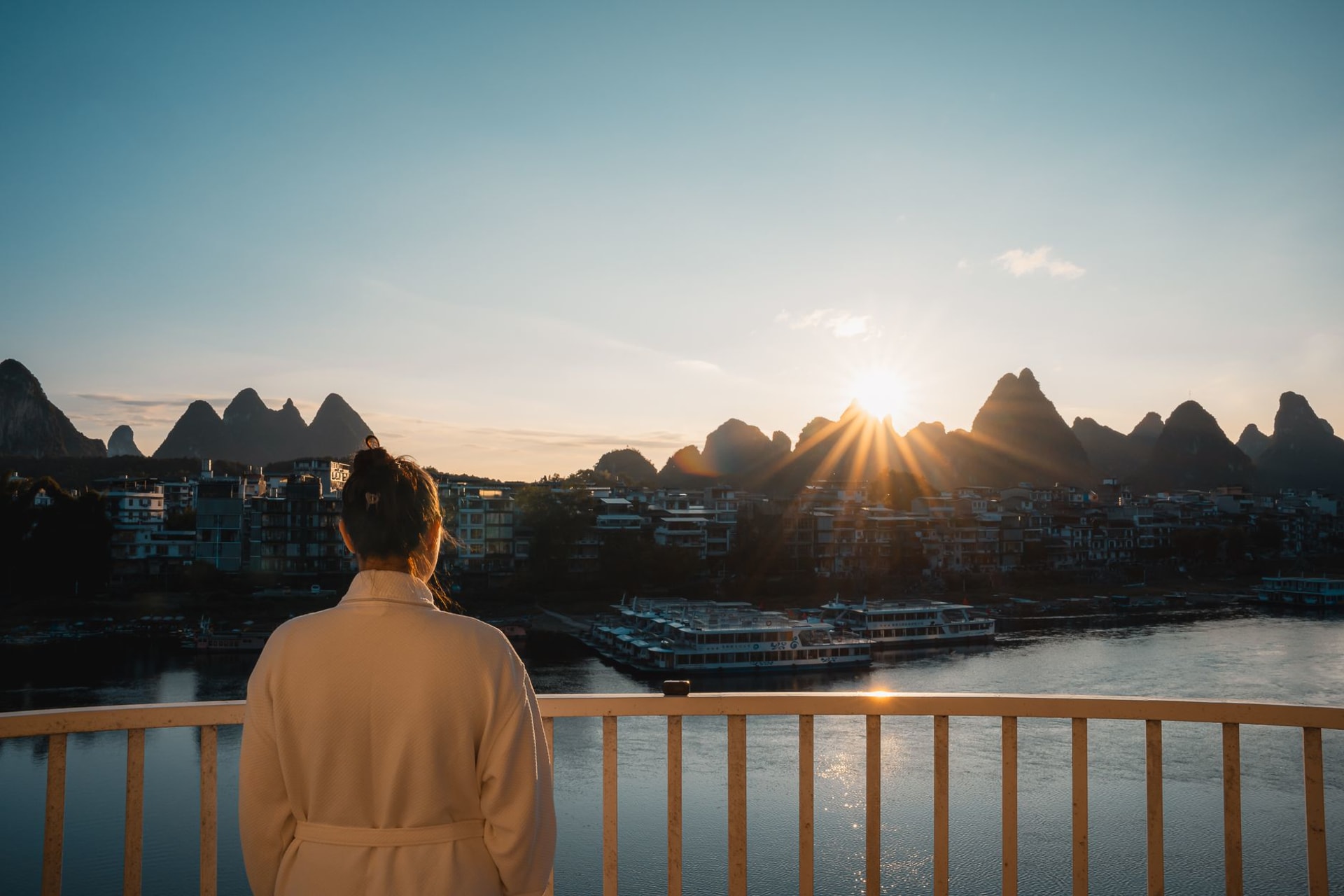
Yangshuo
"West Street will make you want to leave. The countryside will make you stay a week."
The Li River cruise deposits you at a dock and suddenly you are in Yangshuo, which announces itself with a wall of tour operators, souvenir stalls, and the particular smell of a place that decided to become a destination rather than remain a town. West Street — the main artery — is full of bars with English menus, tuk-tuks playing loud music, and young Chinese tourists taking selfies in front of establishments designed primarily to appear on social media. I spent approximately forty minutes feeling like I had made a mistake.
Then I rented a bicycle. A real one, from a small guesthouse on a side street, not one of the polished e-bike operations on the main drag. The woman who handed it to me pointed vaguely north and said something I took to mean: that way. Within ten minutes of pedaling, West Street was completely gone — replaced by a flat road flanked by karst peaks so vertical and improbable they seem to defy their own geology. Rice paddies ran between the towers in irregular green patchwork. Water buffalo stood in irrigation ditches with a patience bordering on philosophy.

The best discovery was accidental. Following a dirt track toward what looked like a gap between two peaks, I came out onto a bend of the Yulong River where a farmer was washing vegetables in the current and a cormorant bird sat on a bamboo pole drying its wings. Nobody else was there. The light was that specific late-afternoon gold that makes everything look like it was painted in the direction of beauty. I sat on the bank for a long time and ate the tangerine I had bought at a roadside stall and felt very lucky to be somewhere that still allowed you to find yourself somewhere alone.
Food in Yangshuo, away from West Street, is honest and good. The local specialty is beer fish — river fish braised in local Guilin beer with ginger, chili, and scallions until the sauce goes thick and sweet-sharp. There is a small restaurant past the night market, identifiable by its plastic chairs and a woman who shouts orders to the kitchen without looking up, where the beer fish costs almost nothing and arrives in a clay pot that stays hot through the whole meal. The local rice noodles in the morning — thin, slippery, served in a pale broth with minced pork and a ladle of chili oil — are eaten standing at carts near the vegetable market before dawn has fully broken.

The light changes fast in karst country. In the hour before sunset, the peaks take on a quality of depth — shadow and stone layering into something dimensional, the way mountains look in Song dynasty paintings that always seemed impossible until you stood in front of the real thing. I understood then why Chinese painters kept coming back here for centuries. It is not that the paintings look like the landscape. It is that the landscape looks like something worth painting every single day.
When to go: September and October hit the sweet spot — warm enough for cycling in a t-shirt, cool enough by evening to sleep well, and the paddies are either brilliantly green or just going gold before harvest. Avoid the week-long national holidays in early October when Yangshuo fills completely. Spring (April to May) is beautiful but wetter, with morning mist that clings to the peaks until mid-morning.