Moon Hill
"The arch looks improbable from below. The view through it looks impossible from inside."
The climb to Moon Hill starts at a roadside stall selling cold water and packaged snacks, which is appropriate because by the time you reach the arch you will have consumed both. The path goes straight up through scrubby secondary forest for about forty minutes, concrete steps giving way to worn rock, the air getting hotter as the trees thin out. There is no ambiguity about the destination: the arch — Yueliang Shan in Chinese — is visible from the road below as a hole punched through the peak, a circle of sky inside the limestone. You spend the whole climb knowing exactly what you are heading for, which is either reassuring or maddening depending on your mood.
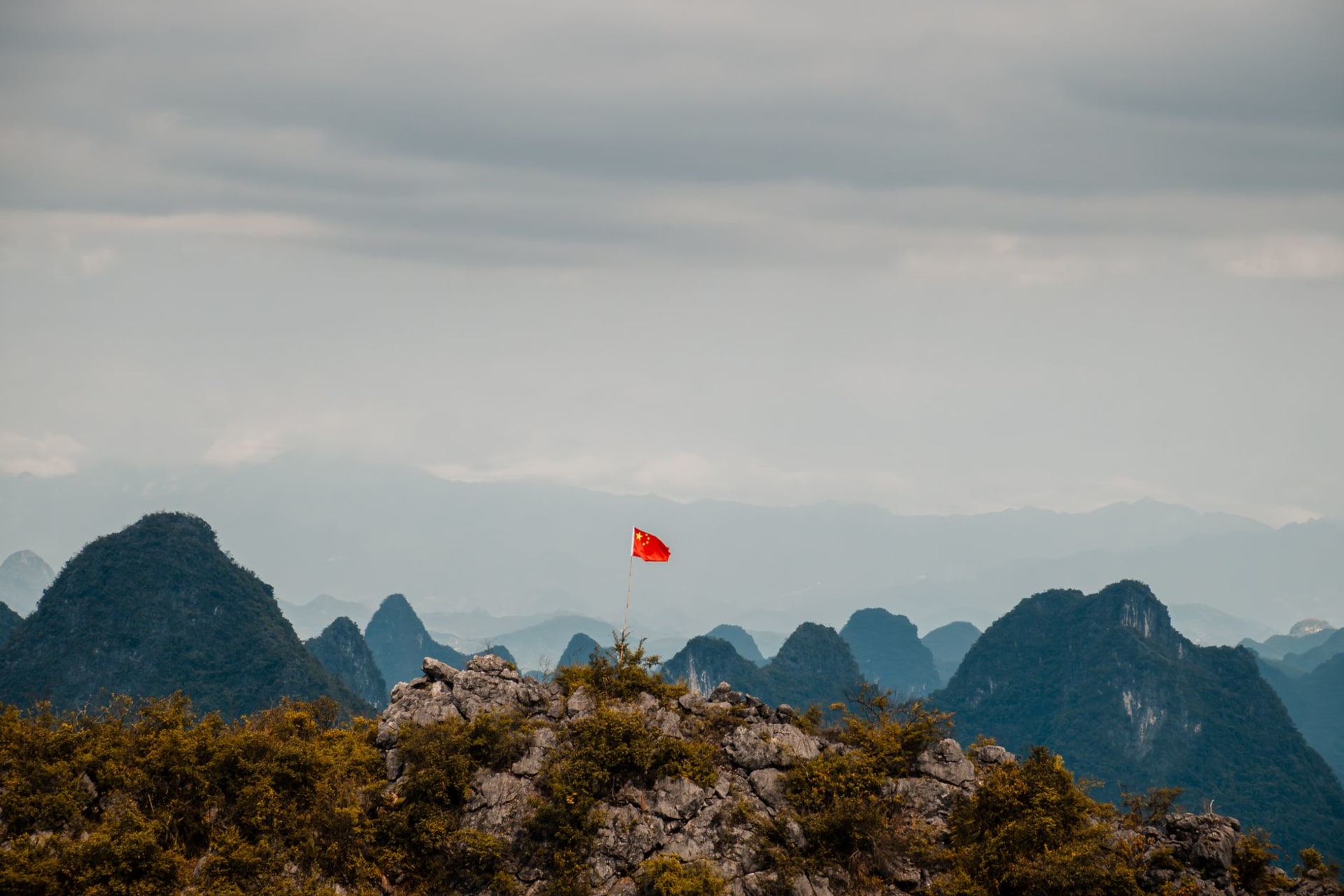
When you finally come out through the arch, the view is so large and so sudden that I stopped walking and just stood there for a moment, adjusting. The karst countryside of Yangshuo spreads in every direction below: the Yulong River winding silver through green paddies, the tops of other limestone peaks at eye level for the first time, the town itself small and inconsequential in the valley floor. The arch frames a portion of this view like a window, which was presumably what the mountain had in mind.

The arch itself is remarkable up close. The limestone has been worn smooth on its inner surface by weather and by the hands of the thousands of people who have climbed through it, and in morning light it takes on a bone-white color that makes it look chalky and organic at the same time. There are climbers who come specifically to work the cave routes inside the arch — Moon Hill has become something of a rock climbing destination, with bolted routes on both the arch and the surrounding faces. When I arrived a French couple was already on the rock, moving slowly up a route that traverses the underside of the arch in a way that looked terrifying and physically impressive in roughly equal measure.
The view changes throughout the day. In the morning the sun comes from the east and the paddies below hold water that catches the light in flashes. By mid-afternoon the peak casts a shadow west across the valley and the karst takes on the layered dimensionality I associate with Chinese ink painting. I went up in the morning and came down in the afternoon and the mountain felt different each time — which is most mountains, I know, but Moon Hill does it more obviously than most because the arch is such a clean frame, such a deliberate aperture through which the light and the landscape make their effects.

The village at the base of Moon Hill has a reasonable cluster of restaurants oriented toward the cyclists and climbers who stop here. I ate lunch at a place with bamboo tables set under a tarpaulin where a woman served rice noodles in a dark broth with pork ribs and a side of stir-fried morning glory that was hot, oily, and garlicky in all the right proportions. The cold beer that came with it was warm, but nobody complained. The French climbers came down around noon and ate at the next table and we talked about the routes on the arch while eating the same noodles and this seemed like exactly the right kind of afternoon to be having in Guangxi.
When to go: Avoid the middle of the day in summer — the climb is exposed and can be genuinely punishing in July and August heat. Early mornings in October are ideal: cool enough to climb comfortably, bright enough for clear valley views, and the paddies are at their most photogenic pre-harvest golden color. The arch is at its most dramatic in March and April when morning mist fills the valley below and the circle of stone floats above the cloud.