
Fuli Ancient Town
"The town paints six million fans a year and you can still walk through it in twenty minutes of genuine quiet."
I arrived in Fuli by bicycle from Yangshuo, following the Li River road east for about six kilometers until the town appeared on the bank — a cluster of dark timber buildings and tiled rooftops that looked different from the surrounding villages in the way old places look different: more deliberate, more layered, as if the stones themselves had been placed with the intention of outlasting whoever placed them. Fuli was established during the Ming dynasty and has been a market town and craft center for six hundred years. The particular craft is folding fans — Fuli produces millions of them annually — and the town’s main lane is lined with workshops where painters work at long tables covered in fans in various stages of completion.
The fans are made from bamboo ribs and paper or silk, and the painting is done with brushes so fine they are almost indistinguishable from needles. I watched an old man work for ten minutes from the doorway of his workshop, not wanting to interrupt the concentration. He was painting a scene of karst peaks and river on a panel the size of my palm, the brushwork so precise it left the paper with a faint scoring, and he was working without any preparatory sketch or reference image, pulling the landscape out of somewhere internal and depositing it on the fan with a steadiness of hand that suggested he had been doing this since before I was born. Which he probably had.
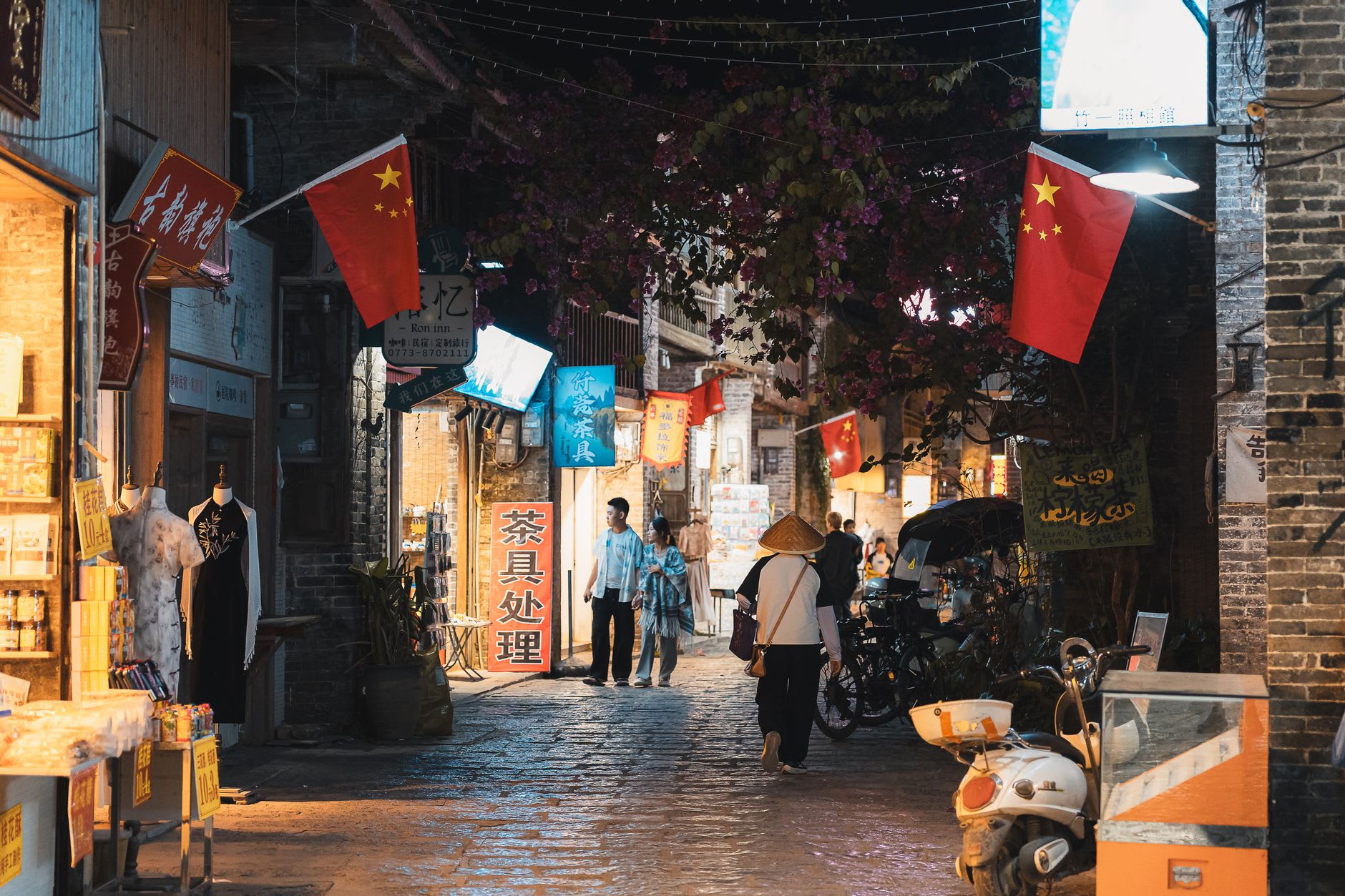
The main street of Fuli runs from the river up a gentle incline and is paved in large cobblestones that have been worn smooth and slightly concave by six centuries of market traffic. The shops along it sell the fans, obviously, but also marbled paper made by a local family, hand-dyed indigo cloth, ink stones from the nearby quarries, and small stone carvings. The prices are not dramatically lower than in Guilin’s tourist shops, but the quality is generally better because you are buying from the people who made the things. I spent too long and too much money at a paper shop where the owner showed me how the marbling pattern is made with a comb drawn through floating pigment — a technique the family has been using, she said, for four generations.
Lunch in Fuli was river fish and rice, eaten at a table on a wooden deck that extended over the Li on thin poles. The fish came whole and fried until the skin was lacquer-crisp, with a sauce of ginger, garlic, and pickled chili that cut through the richness perfectly. The river moved below the floorboards with a constant soft sound. Two children on the opposite bank were fishing with bamboo poles. A cormorant stood on a rock nearby looking supervisory.

What Fuli has that Yangshuo has largely lost is a sense of a town going about its own business. The market that operates in the early morning three days a week — produce, live animals, hardware, fabric — is primarily for the surrounding villages, not for visitors. I showed up for it on a Tuesday and stood at the edge watching a negotiation over a pig that went on for twenty minutes with an intensity that suggested the outcome really mattered. It did matter, presumably. That is the difference.
When to go: Fuli is worth visiting any time you are in the Yangshuo area. Market days (Tuesday, Thursday, Saturday mornings) are the most lively. The town is at its most beautiful in early spring when the peach trees along the river road are blooming pink. The fan workshops are open year-round, though some close in the heat of August. Come by bicycle — the river road from Yangshuo is flat and beautiful and passes through countryside the tourist buses skip entirely.