Hell's Gate National Park
"I cycled past a giraffe at three meters — neither of us made a fuss about it."
The thing nobody tells you about Hell’s Gate is how normal it feels, at first. You rent a bicycle at the gate — a real bicycle, the kind with gears that may or may not work, and a seat adjusted by someone who has a different sense of comfort than you do — and you set off down a red dirt track into what looks, initially, like open savanna. There are warthogs by the roadside. A family of zebras grazes thirty meters ahead. You slow down, you go around them, and you pedal on. The casualness of it, the complete absence of a vehicle between you and wild animals, takes about twenty minutes to stop feeling surreal.
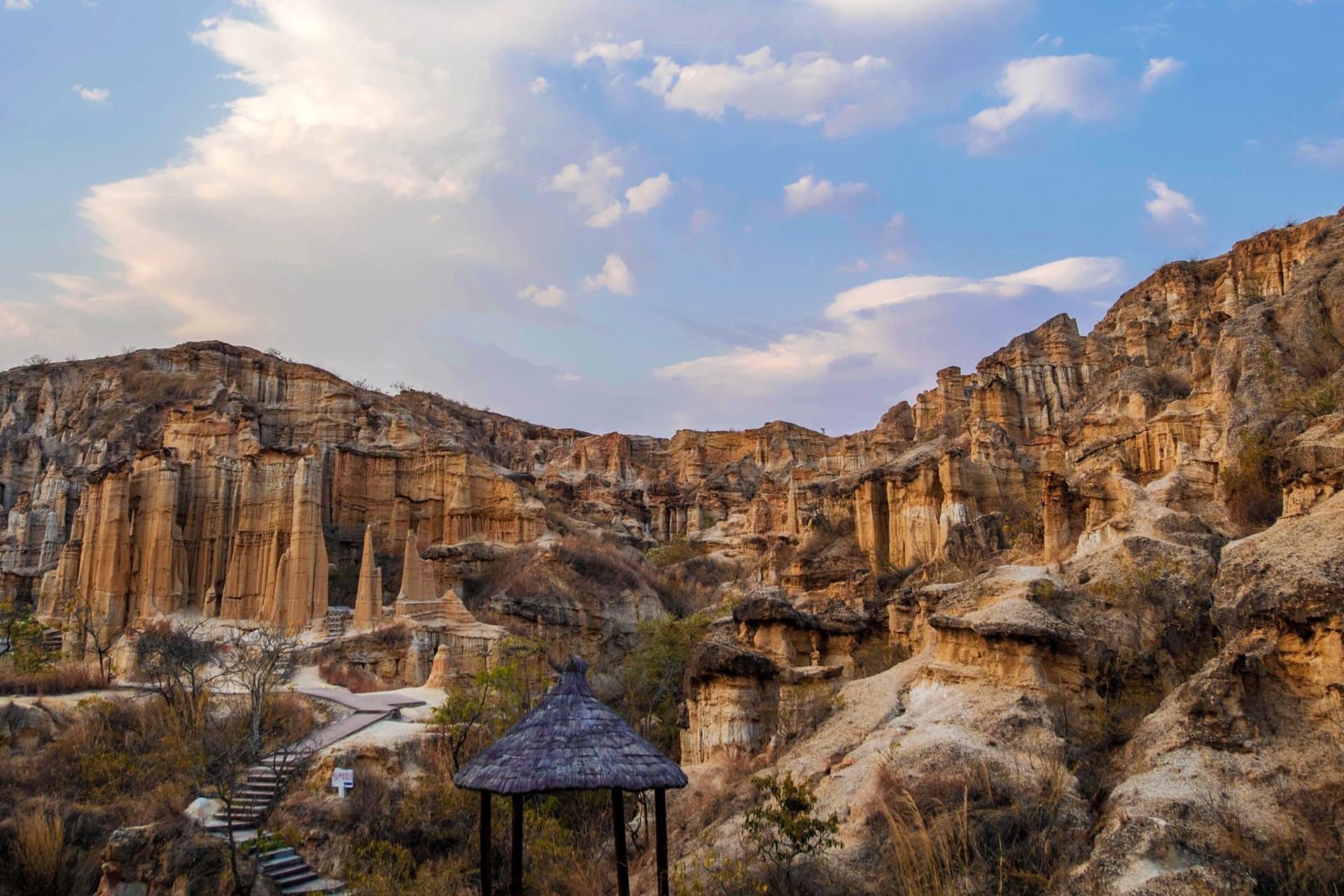
Then the gorge begins. Fischer’s Tower, a volcanic plug that rises about twenty-five meters from the flat valley floor, is the landmark that announces the transition. The rock is dark red basalt, worn smooth in places, with fig trees rooting impossibly in the cracks. Beyond it the track narrows and the walls of the gorge begin to rise on either side until you are cycling through a slot of volcanic rock with the sky reduced to a strip of blue overhead. The walls, if you touch them, are warm — not from the sun but from the geothermal activity below. The earth here runs hot.

The gorge continues for several kilometers into the park before it opens into a wider valley where the hot springs begin. I leaned my bicycle against a rock and walked into the gorge’s inner section on foot — a narrow passage where a seasonal stream has carved the walls into smooth organic shapes, slot-canyon curves in orange and grey and deep red. Steam rises from vents in the rock floor. The water in the pools runs from warm to scalding, depending on how far you put your hand in. I watched a school group from Naivasha doing this systematically, laughing when a child pulled back her hand from the hotter pool.
What I kept coming back to was the way this park inverts the normal logic of African wildlife viewing. In most places you are in a vehicle, the animals are outside, and the window mediates everything. Here you are the one outside, on a bicycle, at the same level as the zebras, sweating in the same heat. A buffalo stood on a ridge above the gorge and watched me with the patient, slightly contemptuous expression that buffalo reserve for everything they judge to be beneath them. A pair of klipspringers watched from a rock shelf. I watched back. At some point the transaction became mutual.

The park is also the location of one of Kenya’s larger geothermal energy plants — the Olkaria plant, which provides a significant portion of the country’s electricity. You can see the cooling towers and infrastructure as you cycle the central road, an industrial reality sitting alongside zebras and vultures. Kenya runs on the same geological violence that created this gorge. I found that unexpectedly reassuring.
When to go: Hell’s Gate is good year-round, but the red murram roads become slippery in heavy rain. June through October and January through February are the driest months and most comfortable for cycling. Start early — the park is best in the morning before the heat builds, and by midday the gorge walls trap warmth in a way that makes the inner sections genuinely uncomfortable.