Duluth
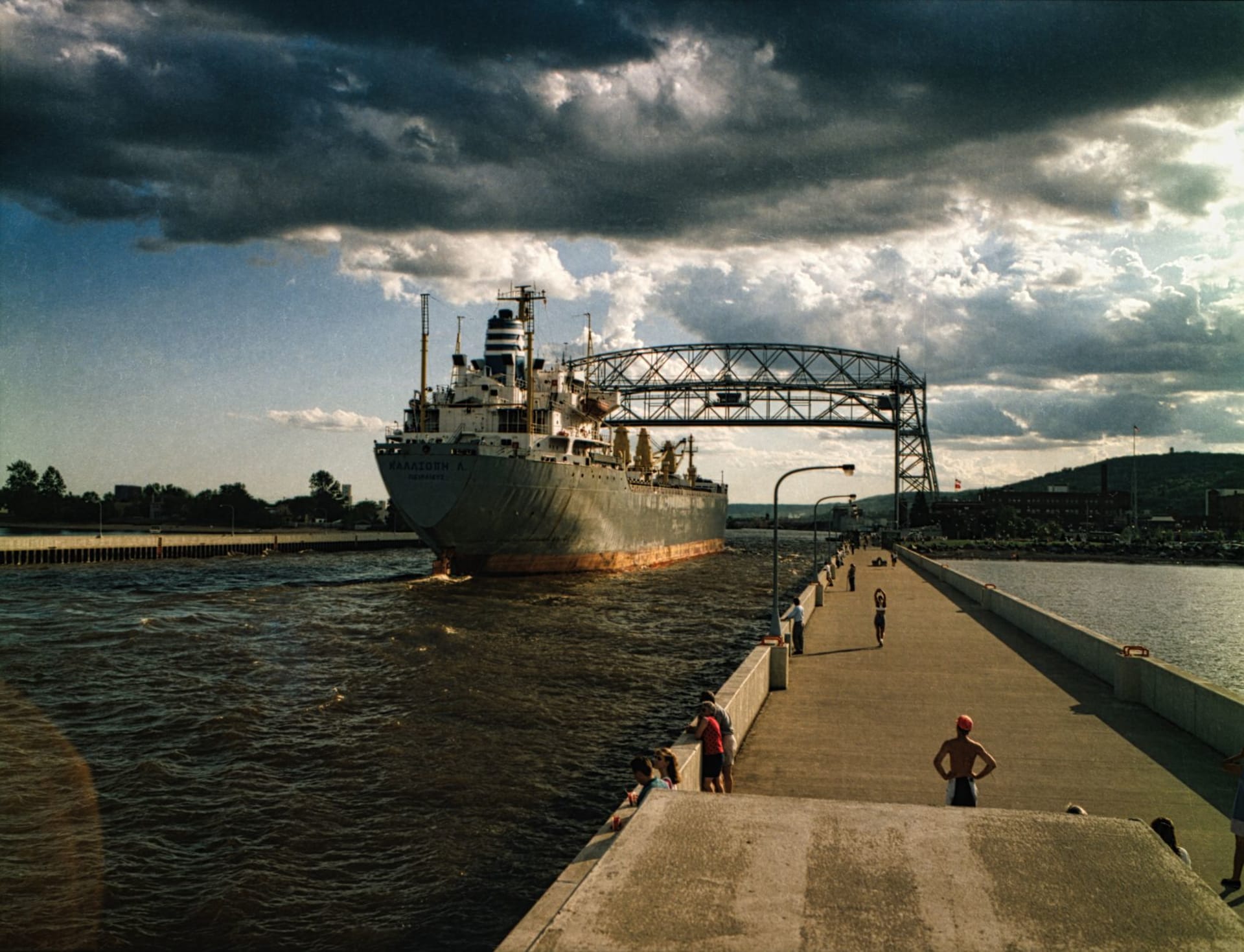
"The bridge went up, the freighter slid under, and a whole city stopped to watch a ship like it was still 1920."
Duluth sits at the far western end of Lake Superior, where the lake funnels into the St. Louis River, and it has the compressed, vertical quality of a city built where the land dropped sharply away to the water. The hillside neighborhoods cascade down in layers — Victorian houses, then converted warehouses, then the flat ground of Canal Park along the water’s edge, and finally the lake itself, grey-blue and infinite, visible from nearly every street. I’d been told to watch for ore freighters, and I understood why the moment the first one appeared through the Aerial Lift Bridge canal: it was enormous, longer than some city blocks, moving with the particular slow certainty of something that cannot be stopped once it’s in motion. The crowd on the Canal Park promenade gathered with the same energy people bring to fireworks — a sense that something uncommon was happening even though it happens every day.

The Aerial Lift Bridge is the city’s icon and it earns its status: when a freighter signals its approach, the roadway lifts on its towers to allow passage, and Duluth pauses. I watched three ships pass in one afternoon, standing in a light wind off the lake, and each time the bridge lifted I felt the same awareness — of the supply chains that built this country, still operating, still enormous, still dependent on this cold and deep water. The canal area has good restaurants. Vikre Distillery makes excellent aquavit and gin with a Nordic sharpness that fits the climate. The Vietnamese and Korean restaurants that came with Duluth’s recent immigrant communities are some of the better food in the region — I ate a bowl of pho in a small place on Superior Street that had no business being as good as it was, and then went back the next morning for the same thing.

Drive up the hill from Canal Park and the city’s character shifts. The residential neighborhoods have the worn dignity of old money that mostly left and working-class stability that mostly stayed. The Glensheen Mansion on London Road is a 1908 Jacobean Revival estate on the lake shore, preserved almost intact, famous locally for a 1977 murder that the house tours address with an admirable matter-of-factness. Above the city, Hawk Ridge is a raptor migration lookout where, on October mornings with northwest winds, thousands of broad-winged hawks, sharp-shinned hawks, and accipiters funnel along the ridge above the lake. I went on a late September afternoon and stood next to a retired biology teacher who named every bird without binoculars in a way that made me feel appropriately humbled, and appropriately glad I’d come.
When to go: Summer (June–August) for ore boat watching, kayaking, and the waterfront scene. October for fall color and hawk migration at Hawk Ridge — the best single reason to visit the city if you have to choose one. Winter brings snowshoeing on the Superior Hiking Trail and dramatic ice formations along the lake shore; Duluth does not fold under winter the way some places do.