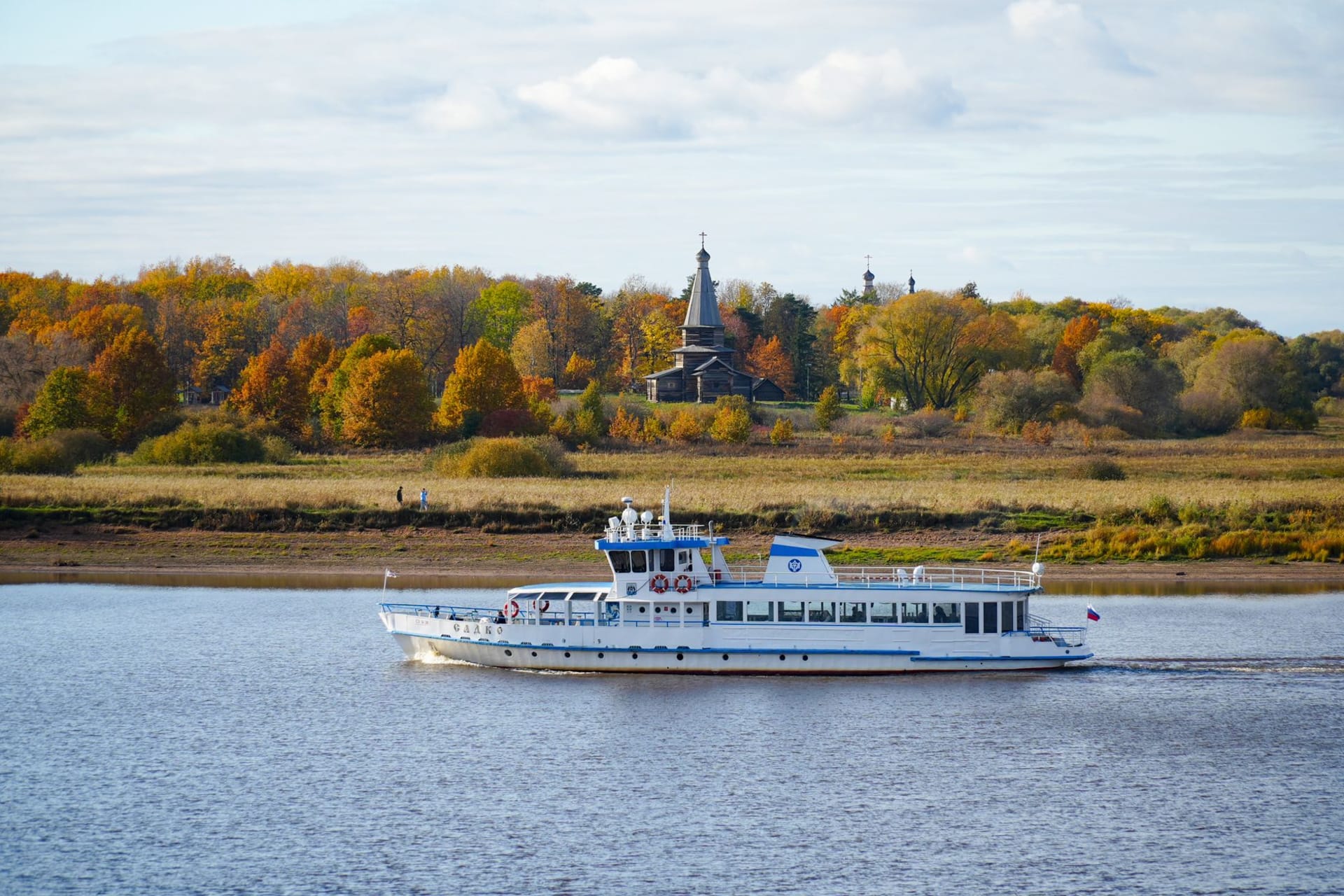
Rostov Veliky
"The kremlin sits on the edge of the lake and in winter the lake becomes the sky — you lose track of which way is up."
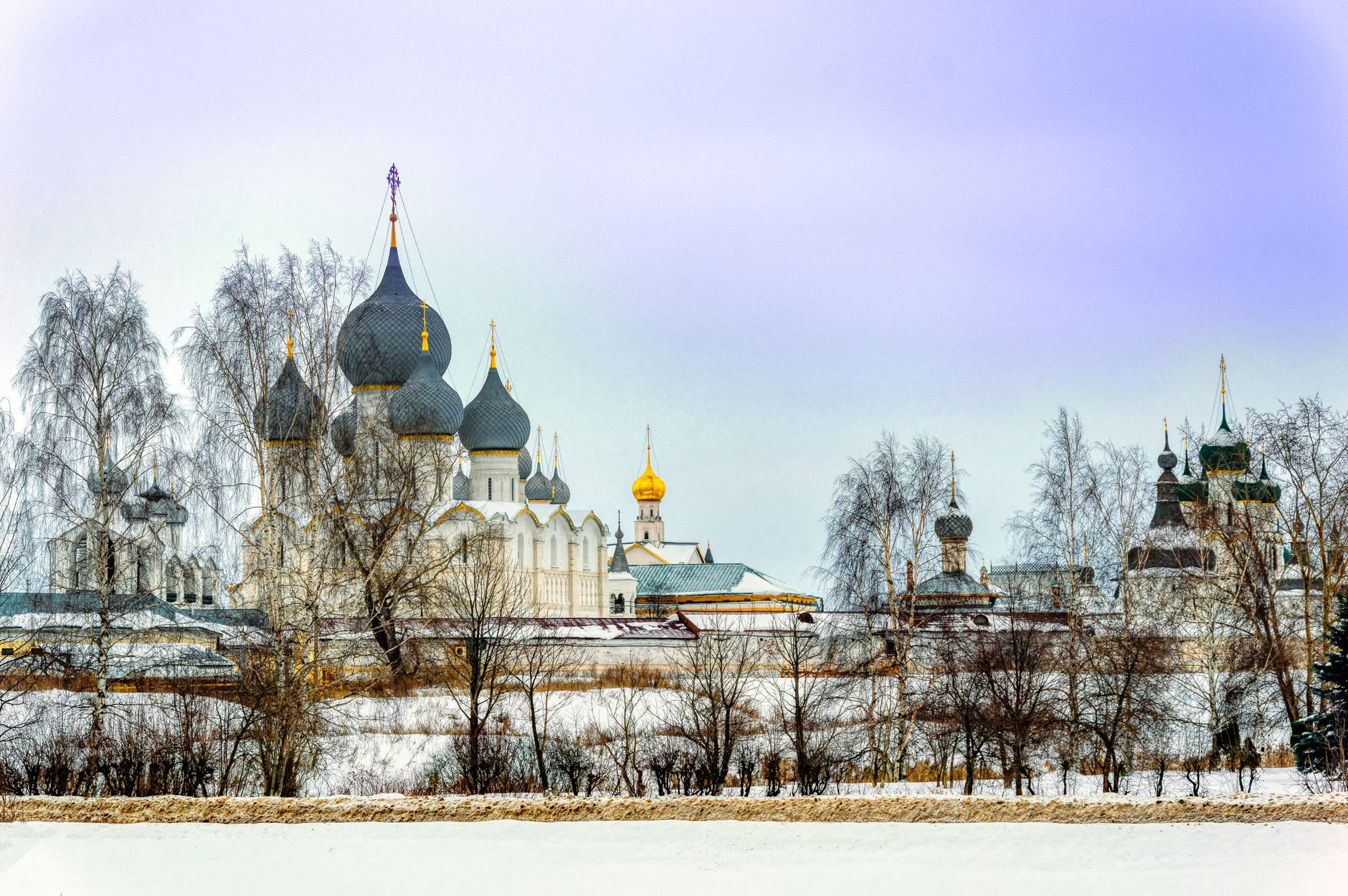
There is a moment, walking the path from Rostov Veliky’s train station toward the kremlin in winter, when you come through a gap in the trees and see it all at once: the white walls, the blue domes with gold stars, and then the lake behind them — or rather, below them, because from this angle the kremlin floats above Lake Nero in a way that makes no concessions to gravity. The lake was frozen solid when I arrived, and locals were crossing it on foot, small dark figures moving across an expanse of white that stretched to the horizon. The kremlin towers above them looked like they had been placed there by someone deciding the landscape needed a vertical statement.
Rostov Veliky means “Rostov the Great,” which is an ambition the town of thirty thousand no longer quite inhabits but wears with comfortable dignity. It is one of the oldest towns in Russia — first mentioned in chronicles in 862 — and it served as the capital of a principality long before Vladimir or Moscow became significant. What remains is the kremlin, the lake, and a handful of monasteries, and that is more than enough. The kremlin itself is seventeenth century, built as the residence of the Metropolitan of Rostov, and it has none of the military seriousness of Moscow’s version — it was built to impress rather than defend, and the proportions of the towers and the precision of the white stonework reflect a kind of princely vanity that has aged into something wonderful.

The bells of Rostov are famous throughout Russia, and they deserve to be. The bell tower holds fifteen bells, the largest weighing thirty-two tonnes, and the ringing style developed here in the seventeenth century — where the bells are played in complex harmonic patterns rather than simply swung — is unique enough that the Rostov Bell Ringing is considered an intangible cultural heritage. When a performance happens (you can check schedules at the kremlin entrance), the sound is not musical in any conventional sense — it is more like being inside weather, a resonance so deep and layered that you feel it in your sternum as much as you hear it with your ears. I stood in the courtyard for the full twelve minutes of one performance and afterward the silence felt wrong, like a room after a storm.
Across the lake — accessible by the ice path that locals use in winter, or by road in other seasons — the Spaso-Yakovlevsky Monastery sits on the far bank, its yellow and white walls reflected in the water in summer, buried in snow in February. I walked across the lake. The ice groaned once, a deep tectonic sound from somewhere below, and I stopped, and then it was silent, and I kept walking. A man fishing through a hole fifty metres away did not look up.
The town around the kremlin is quiet to the point of vacancy in winter, which is when I prefer it. There is a market near the Gostiny Dvor where vendors sell finift — Rostov’s distinctive painted enamel jewelry, a craft that goes back to the eighteenth century — alongside jars of local honey and the kind of fur hats that make genuine sense in the climate. I bought a small enamel brooch painted with a miniature of the kremlin, which seemed both exactly the right souvenir and the most tourist thing I did all week.
When to go: January and February are the most dramatic months — the frozen lake, the snow-dusted kremlin, the clarity of the low winter light. May is beautiful when the lake comes alive and the apple orchards near town bloom. Avoid peak summer; Rostov is quiet and absorbing in winter and spring, overwhelmed and self-conscious in July.