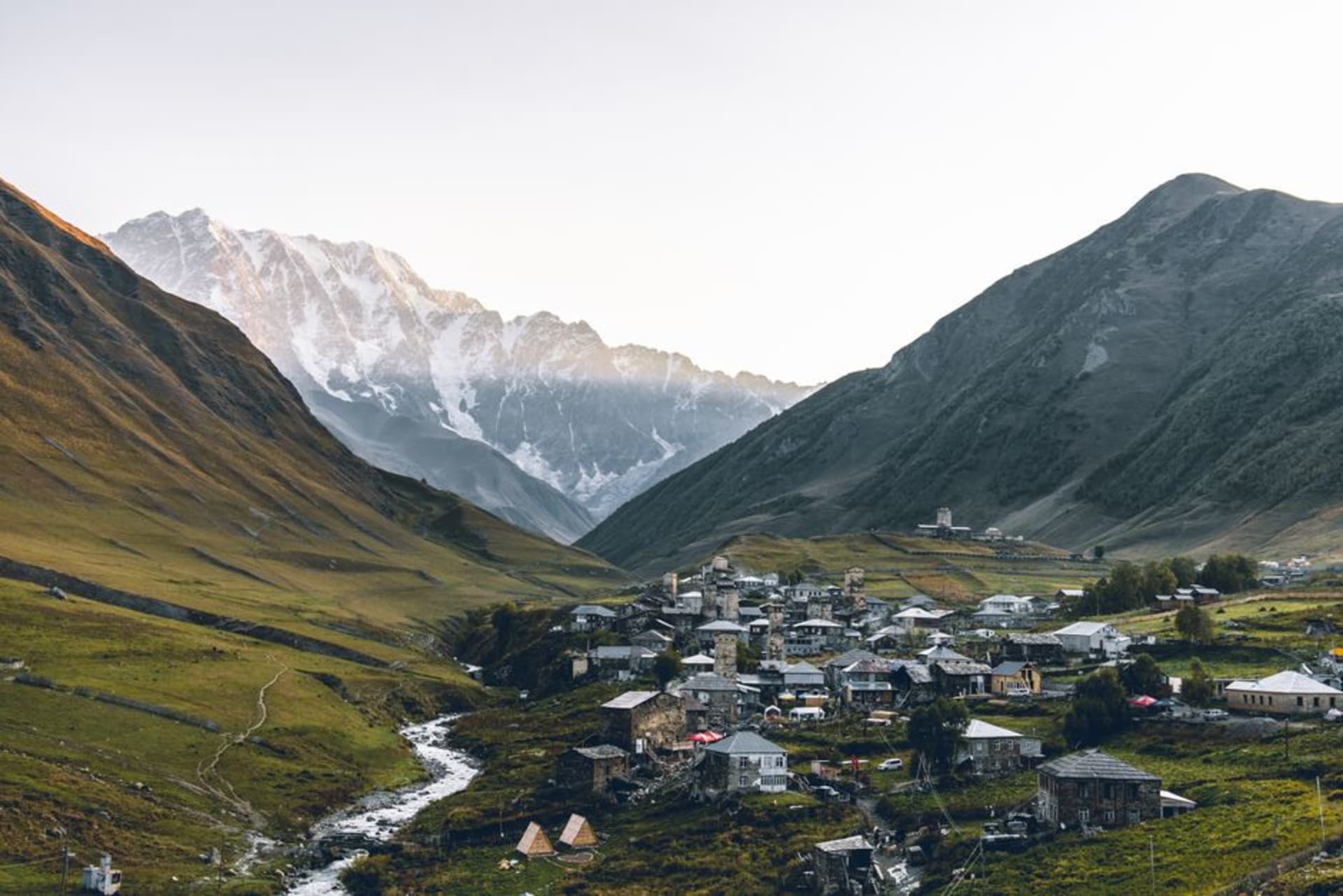
A cluster of four stone villages beneath Georgia's highest peak, where medieval towers have watched over Upper Svaneti for a thousand years.
Lia and I had been warned about the road from Mestia, but nothing quite prepares you for four hours of hairpin turns above a river gorge, watching the jeep’s suspension groan over rocks the size of footballs. By the time we rattled into Ushguli, my back ached and my knuckles were white from gripping the door handle, but the moment the towers came into view I forgot all of it. There they were, dozens of them, grey stone fingers rising out of the four little villages that make up the settlement, with Shkhara — Georgia’s highest mountain at 5,193 meters — standing directly behind like it had been placed there for effect. At around 2,100 meters, Ushguli is often called one of the highest continuously inhabited places in Europe, and standing in that thin mountain air, lungs working a little harder than usual, I believed it.
We spent our first evening wandering into Chazhashi, the best-preserved of the four villages, where the tower complex has been turned into an open-air ethnographic museum. I’d read that these towers went up mainly between the 9th and 12th centuries, built by Svan families as refuges during clan feuds, but reading a fact and standing inside one of these narrow stone shafts are different things entirely. Lia ducked through a doorway barely her height and called back up that she could see arrow slits cut into the wall — defensive architecture from a thousand years ago, still intact enough to touch.
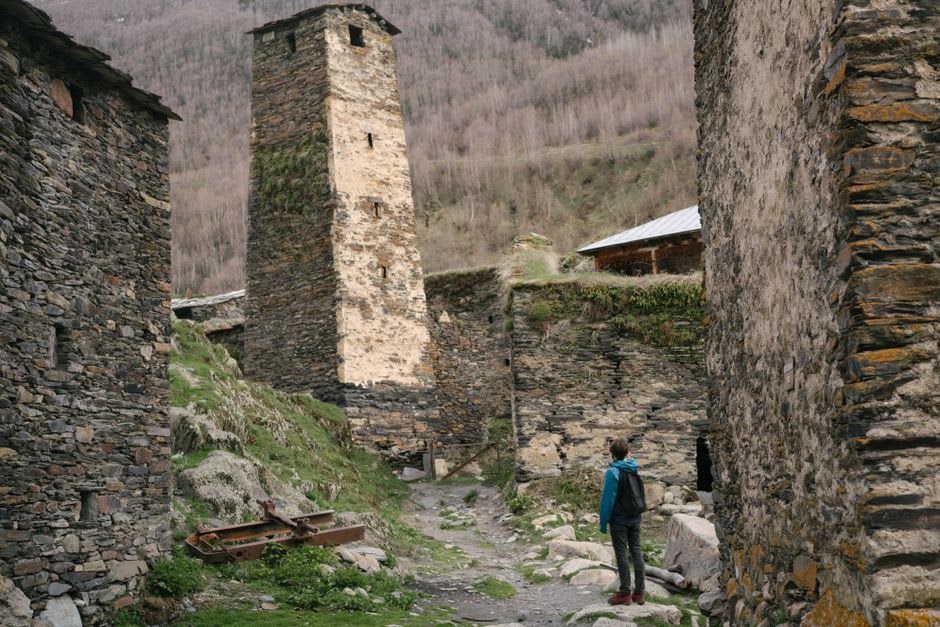
Our host in Ushguli, an older woman named Nino, fed us khachapuri so thick with cheese it practically overflowed the plate, and kharcho stew that she said her mother used to make on the same wood stove. Over dinner she told us, half in Georgian and half in the handful of Russian words we could piece together, that her grandfather remembered winters when the village was completely cut off — no road out at all, just snow. It’s part of why the whole region, Ushguli included, earned UNESCO World Heritage status back in 1996: this isn’t a recreation, it’s a place that kept living the way it always had because it had no choice.
The next morning we hiked partway toward the Shkhara glacier, the towers shrinking behind us and the mountain filling more and more of the sky with every switchback. We didn’t make it all the way to the ice — we’re not that fit, and honestly we wanted the afternoon light for photos of the village — but even from a few kilometers out, watching the glacier catch the sun while grazing horses wandered past unbothered, I understood why people describe this valley as the edge of something.
When to go: Aim for June through September — the unpaved road from Mestia gets buried in snow for much of the year, and outside those months you risk arriving to find Ushguli as cut off as it’s always been.