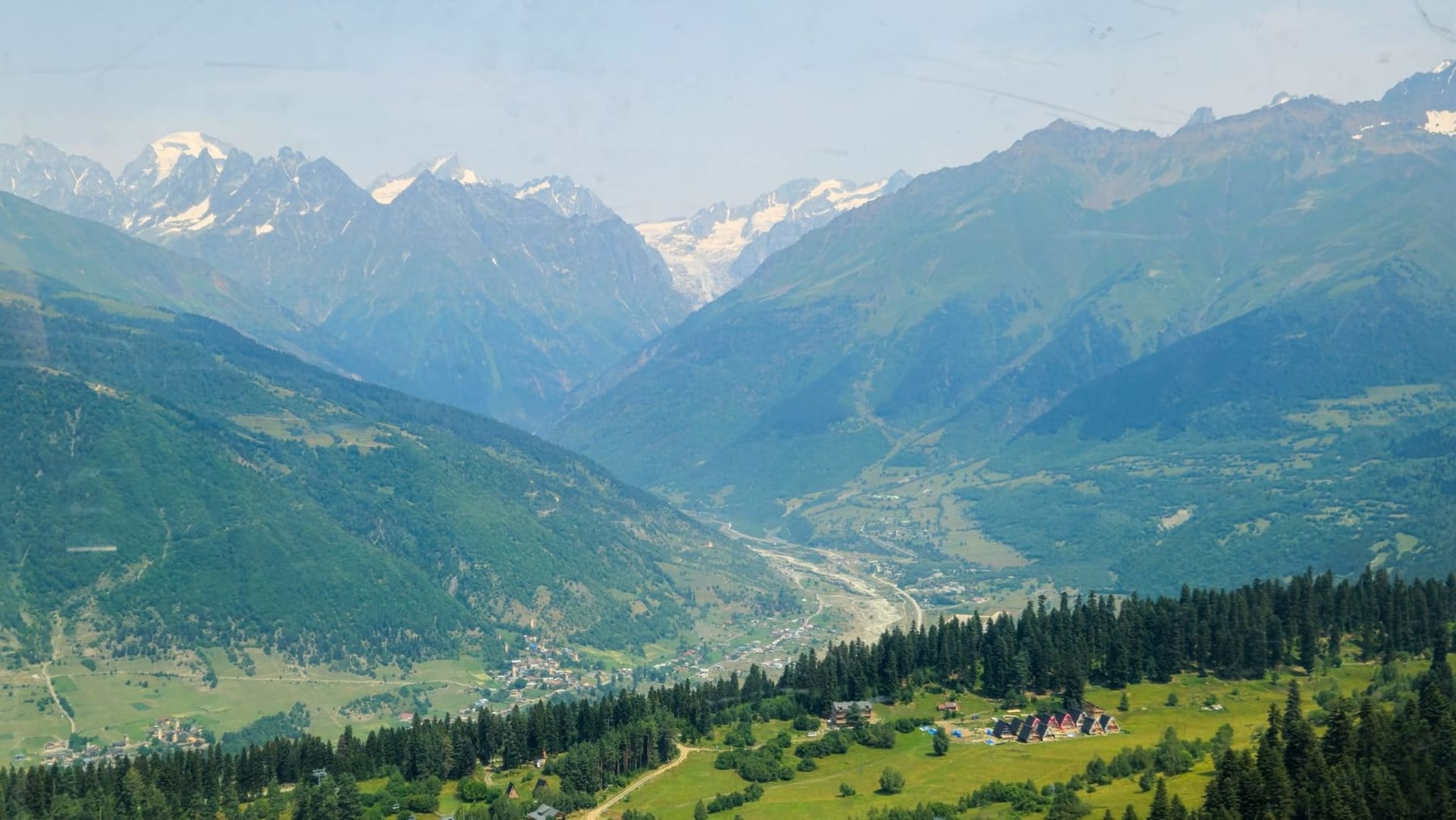
A highland village of medieval defense towers in Georgia's Caucasus, gateway to glaciers and trails few tourists walk.
The marshrutka from Zugdidi takes five hours on a road that was barely a road for most of its length — switchbacks above gorges, concrete bridges that looked provisional, forest giving way to rock and then to sky. When Mestia finally appeared below us, I understood why every travel photo of this place looks the same: there is simply no angle that hides the towers.
There are around thirty of them still standing in the village itself, some leaning slightly, all built between the ninth and thirteenth centuries by Svan families who needed to survive both invaders and each other. They are not ornamental. They were watchtowers, arsenals, refuges of last resort. The families who built them are still here, living in the houses clustered around their bases.
The Weight of the Towers
I spent my first morning walking the lanes around the central square, past the Ethnographic Museum and down toward the Mestiachala River. The towers are everywhere — you look up from a narrow alley and there one is, its stones dark with centuries of weather, slotted windows cut for archers. Lia kept stopping to photograph them against the cloud-streaked peaks of Mount Ushba, which lords over the valley from the southeast, its twin summits perpetually half-hidden.
What surprised me was the smell of the village: woodsmoke and pine resin, with something fermented underneath — the local beer, kubdari baking in someone’s woodfire oven. That flatbread stuffed with spiced meat and onion is the dish of Svaneti, and it is nothing like the khachapuri sold in Tbilisi. Denser, more serious, the kind of food that makes sense at altitude.
Into the Glacier Country
The trails above Mestia are not crowded the way Kazbegi’s trails are crowded. We walked toward the Chalaadi Glacier on a morning when the sky was the color of old tin, the path cutting through birch forest before opening onto a riverbed of grey gravel. The glacier itself, retreating visibly over the decades, hangs above a terminal moraine of tumbled rock. I had not expected to feel grief there, looking at it. But I did.
The trail network also reaches Ushguli, a four-village cluster at 2,200 meters that claims to be the highest continuously inhabited settlement in Europe. It is four hours by foot or one very rough hour by jeep. We walked.
When to go: Late June through September offers the clearest skies and open mountain trails. May and early June bring wildflowers and thinner crowds, though some high passes remain snowbound.