Mount Tabor
"Tabor stands alone in the valley like something that forgot to be part of a range — and from the top, the whole of Galilee lays itself out below you."
The road up Mount Tabor is one of the strangest driving experiences in the Galilee. The mountain rises alone from the Jezreel Valley floor — no adjoining range, no gradual climb, just flat agricultural land and then this isolated volcanic dome erupting from it at 588 meters. The access road circles the mountain in tight switchbacks, seventeen curves in four kilometers, wide enough for one vehicle at a time. Franciscan taxi drivers operate a shuttle service from the base because the road is technically open to private cars but practically speaking invites regret. I took a taxi. The driver had done the route so many times that he cornered without slowing, narrating the view at each bend in Hebrew I did not understand but whose tone communicated the satisfaction of showing someone something worth seeing.
At the summit, the first thing is the silence. The wind moves through the oaks and pistacia that cover the upper slopes, but below the summit platform the valley is so deep and the mountain so isolated that the sounds of the plain below — tractors, highway traffic, the ordinary noise of the Jezreel — do not reach. The summit belongs to itself. Two religious communities maintain their own compounds up here: a Franciscan convent that runs a guesthouse, and a Greek Orthodox monastery with blue domes visible above a garden wall. They have been coexisting on this small mountaintop for centuries in the particular accommodation of neighbors who share a fence and have decided to get along.

The Basilica of the Transfiguration — built by Antonio Barluzzi in 1924, the same architect responsible for the church on the Mount of Beatitudes — is the finest of his Galilean churches and one of the most beautiful religious interiors I have visited. Barluzzi based the design on the Syrian Romanesque, with two towers flanking a triple nave, but his masterstroke is what he did with the apse: gold mosaics from floor to ceiling, designed to catch the afternoon light from the west-facing windows and fill the space with something between light and warmth. When the sun is low in the afternoon, the apse glows. Standing in the nave looking toward it, the mosaic of the Transfiguration — Christ in white light between Moses and Elijah — becomes not a depiction but a phenomenon, an event happening again in gold. I am not a religious person and this still stopped me.
The crypt beneath the basilica contains the remains of a sixth-century Byzantine church, the walls of which are still visible in sections. Crusader fortifications from the twelfth century survive on the summit’s eastern approach — an intact gateway and sections of wall that the Crusaders built when they held the mountain and understood its strategic value in a way that its religious significance made complicated. The mountain was a fortress for whoever held the valley below; the basilica and the fortress walls have been adjacent for eight hundred years.

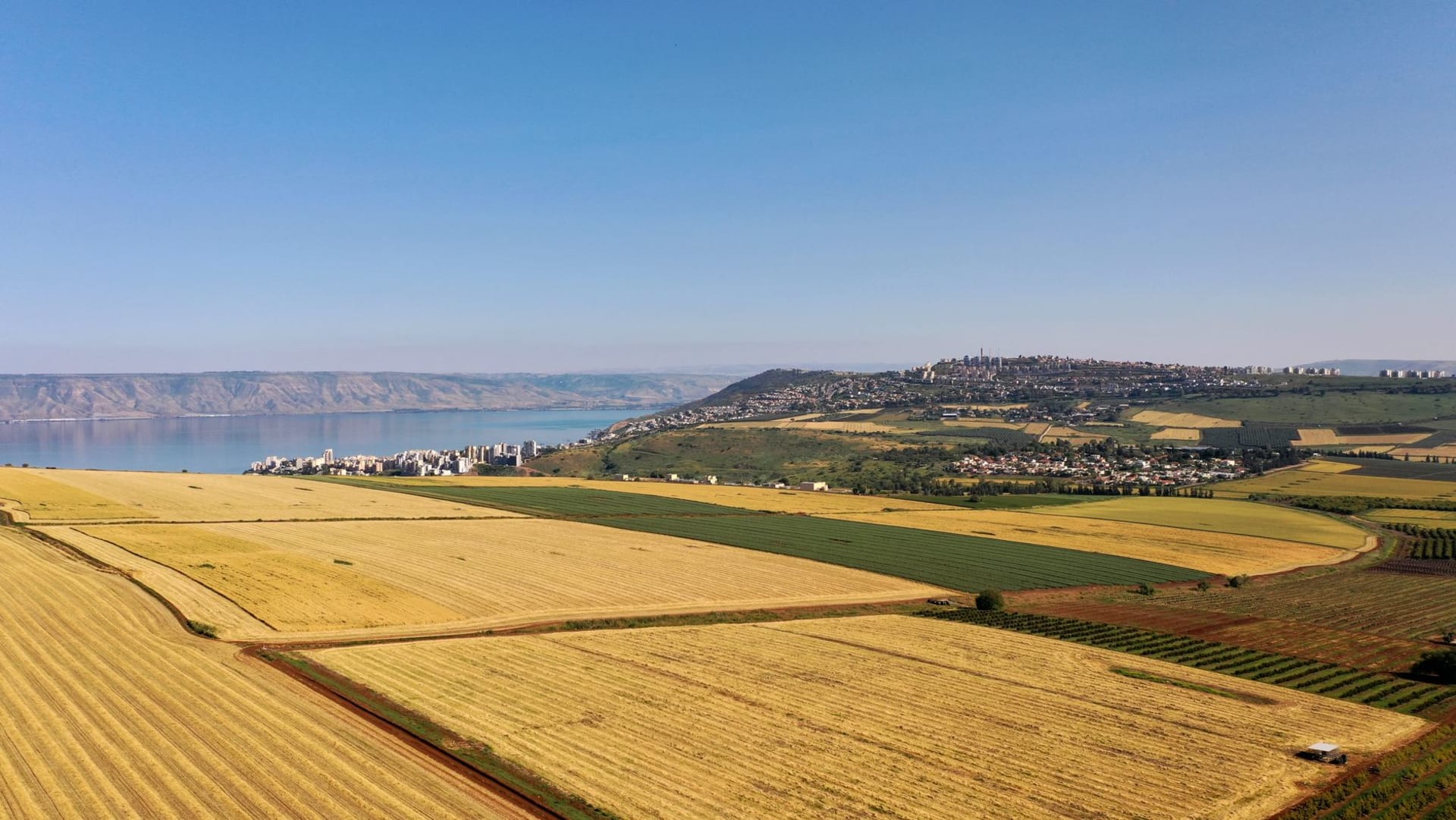
The view from the summit platform is the reason to allow extra time after the basilica. The Jezreel Valley — biblical Armageddon — spreads west and south: flat, intensively farmed, dotted with Arab villages and kibbutzim and the occasional industrial complex. Nazareth rises on the hills to the northwest. The Sea of Galilee is visible on a clear day to the northeast, a gleam of silver. Directly below, the village of Daburiyya sits at the mountain’s base, where the road begins, and above it the forested slopes of Tabor rise in that improbable way — the mountain is so perfectly domed that from a distance it looks like an architectural feature rather than a geological one, something placed rather than formed.
When to go: The basilica is most spectacular in the afternoon, when the light enters from the west and the gold mosaics are at their most intense. Go between two and five in the afternoon if you can. Avoid midday in summer — the mountain absorbs heat and the summit can be genuinely hot. October through April is the most comfortable period; wildflowers cover the slopes in March and April.