Banias
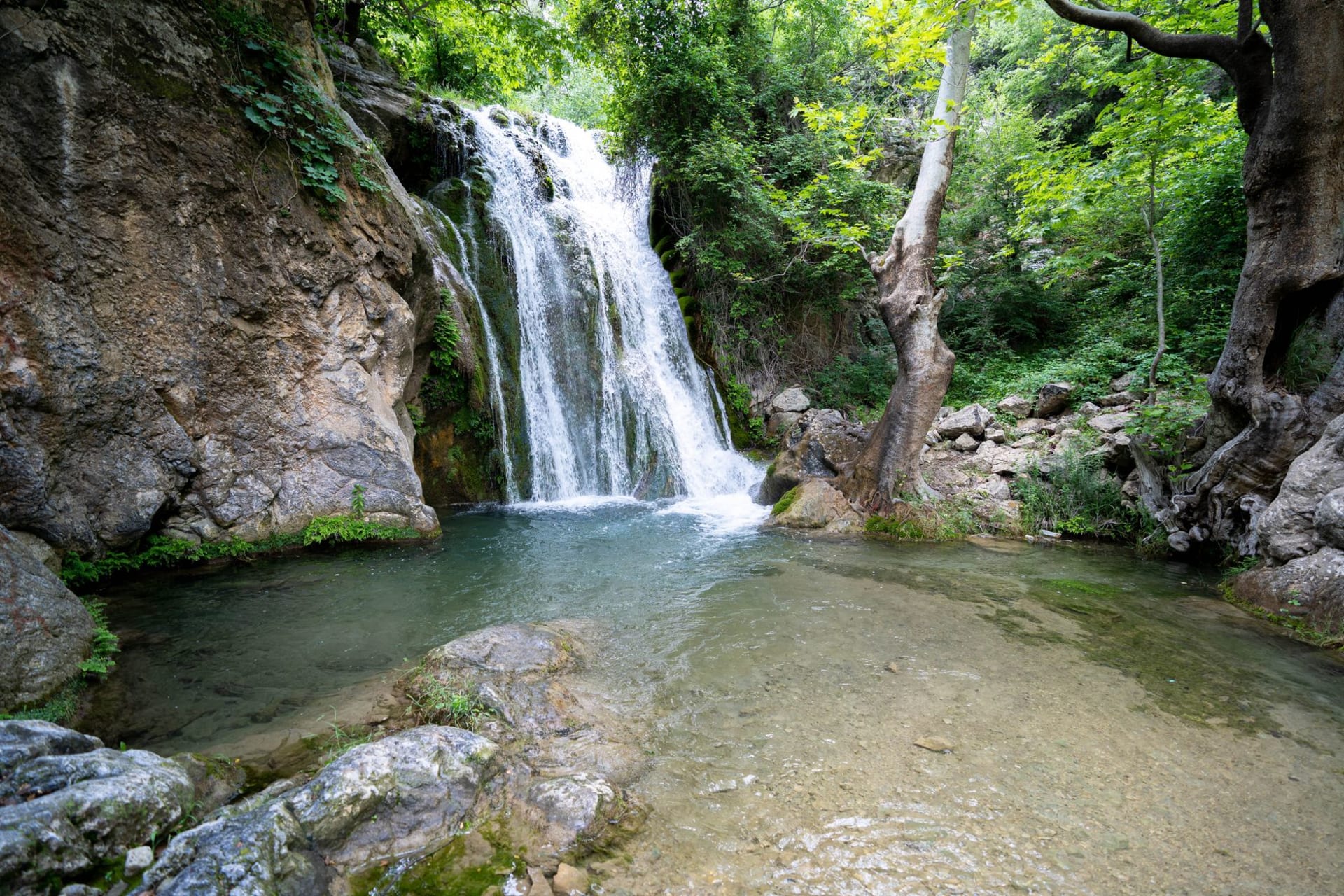
"You hear the Banias waterfall before you see it — the sound fills the canyon like something the canyon is producing on its own."
You hear the Banias waterfall before you see it. Walking the trail through the canyon, the sound builds for ten minutes — a low, sustained roar that gets louder without yet being locatable, coming from everywhere and nowhere, bouncing off the basalt walls and filtering through the plane trees whose roots grip the wet rock above the path. When the waterfall finally reveals itself around a bend in the trail, it is more than the sound prepared you for: a wide curtain of white water dropping fifteen meters into a churning pool, surrounded by the most intensely green vegetation I saw anywhere in the Galilee. Maidenhair ferns growing from every damp crack. Mosses so thick they look upholstered. The air is cool and wet, and the spray carries ten meters in every direction, and after three weeks of dry hillsides and basalt rubble and ancient dust this felt almost hallucinatory.
Banias takes its name from the Greek god Pan — “Banias” being the Arabic pronunciation of Paneas, the city named by Philip the Tetrarch for his cult of Pan. The spring that gives rise to the stream emerges from a large cave at the base of a limestone cliff, and the cliff face around the cave is carved with niches for cult statues and dedicatory inscriptions that are still partially legible: names of priests, records of offerings, the formal language of people asking a deity for things they needed. The niches are empty now — the statues were removed or destroyed over subsequent centuries — but the carved alcoves in the rock have a quality of arrested gesture, like hands reaching for something that has been taken away. I stood there for longer than I expected, reading the Latin and Greek inscriptions that archaeologists have partly translated on the explanatory signs, thinking about the strange continuity of the place: a site sacred to Pan in the first century BCE, then to the Herods who built a white marble temple here for Augustus, then to the Crusaders who built a fortress on the ridge above, then to pilgrims following the path that Jesus reportedly walked through this valley.

The trail system in the Banias Nature Reserve runs for about five kilometers in total, from the archaeological site near the springs to the waterfall and back. The canyon path passes through a canopy of plane trees and oriental sweetgum that is so dense it creates a kind of permanent dusk even at midday — the light greenish and dappled, the sound of the stream constant beside you. In spring, after the winter rains, the stream is full and fast and turquoise with snowmelt from Mount Hermon above. In summer it shrinks but never disappears; the springs are fed by deep aquifers that the mountain’s snowpack replenishes each year.
The area around Banias is Druze country, and the market town of Majdal Shams, fifteen minutes up the mountain, is worth a stop for lunch. The Druze restaurants serve a version of the regional mezze that leans heavier on kibbeh — raw lamb mixed with bulgur and herbs, served in torpedo shapes with olive oil — and a flatbread called marquq that is rolled as thin as paper and baked in seconds on a domed iron griddle. I watched the woman at the restaurant make twenty of them in the time I ate my mezze. The speed and efficiency of it was its own kind of beauty.

The drive from Rosh Pina or Safed to Banias takes about forty minutes through the Upper Galilee and the Golan, passing kibbutzim with apple orchards and stretches of open country where black cattle graze between the basalt outcrops. It is one of the more beautiful drives in the region and worth taking slowly.
When to go: March through May, when the snowmelt feeds the springs to maximum volume and the canyon vegetation is at its most extravagant. The waterfall is spectacular after winter rains. Summer is fine but the trail can be crowded on Saturdays with Israeli families. Avoid the canyon path immediately after heavy rain, when it can flood.