Genovesa Island
"I have never been anywhere where the animals so completely failed to notice me — and on Genovesa, after a while, I stopped noticing myself too."
Genovesa sits far enough north of the main visitor route that most boats never bother with it, which is precisely why I wanted to go. Reaching it means an overnight crossing from Santa Cruz across open water that the panga crew warned us would be rough, and it was — Lia spent most of the night wedged into a corner of the bunk insisting she was fine in the tone of someone who is not fine. By dawn we were inside Darwin Bay, a flooded volcanic caldera whose seaward wall has collapsed, leaving a near-perfect horseshoe of cliffs that you sail straight into. The water was glass. The noise was extraordinary.
The bird island earns its name
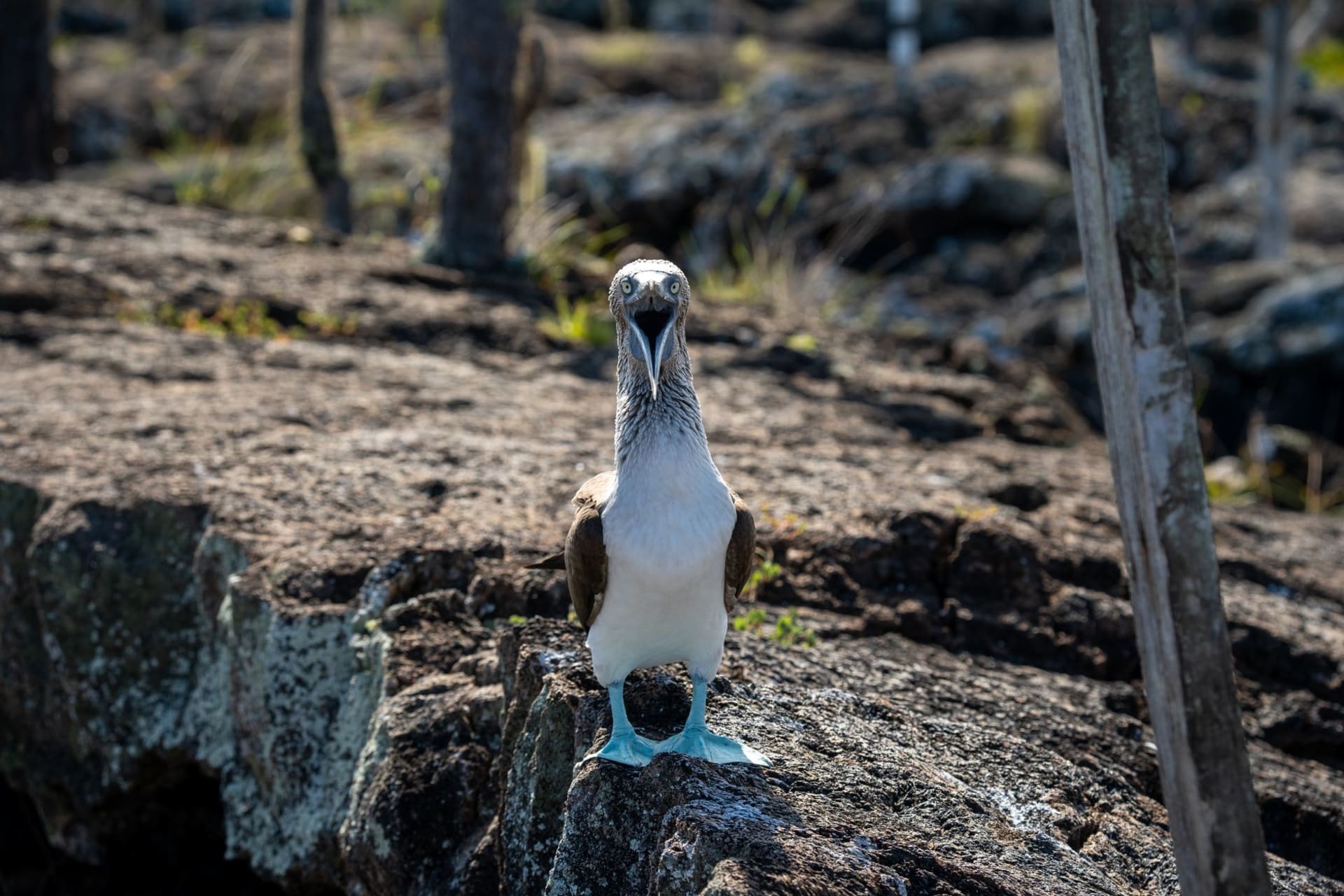
I have read the statistics about Genovesa’s seabird colonies and they did not prepare me for the reality of standing among them. Red-footed boobies nest in the salt bushes at eye level, which feels wrong in the way that all tameness here feels wrong — these are wild animals that have simply never learned to fear a human shape. Great frigatebirds inflate their scarlet throat pouches into taut crimson balloons and sit there vibrating, waiting for a female to be impressed. Swallow-tailed gulls, the only nocturnal gull in the world, stared at us with their absurd red-rimmed eyes from a metre away.

The trail along the bay is short and flat, a loop through the mangroves and across a coral beach, and our guide kept us to a slow shuffle because the birds were quite literally underfoot. I have rarely felt so much like an intruder and so completely ignored at the same time. Lia, recovered and delighted, whispered that it was like walking through a wildlife documentary that had forgotten to include the part where the animals run away.
Prince Philip’s Steps
The other landing is a different proposition entirely. Prince Philip’s Steps — named for the royal visit, and yes, everyone makes the joke — is a steep climb up a cliff face on the eastern arm of the caldera. At the top the vegetation thins to a flat plateau of broken lava, and this is where the storm petrels are. Tens of thousands of them, swirling in a cloud so dense it changes the quality of the light. Somewhere in that chaos hunts the short-eared owl, which on Genovesa has learned to take petrels on foot, in daylight, by ambush — a behaviour found almost nowhere else on earth.
We waited a long time and finally saw one, motionless in a lava crevice, doing the thing owls do where they pretend a rock is looking at you. It eventually launched, took a petrel mid-stride, and the whole plateau seemed to flinch. I did not get a photograph. I was too busy watching.
The snorkel in Darwin Bay was almost an anticlimax after that, though hammerhead sharks patrol the deeper edge of the caldera and we saw fur seals lounging on the rocks. Genovesa is not on most itineraries and requires a longer, less comfortable cruise to reach. Go anyway. It is the closest I have come to seeing what the islands were before we arrived.