Meizhou Island
"A hundred million people across East Asia worship her, and she was born here, on this small rocky island, in 960 CE."
The ferry from Putian takes twenty-five minutes and the island announces itself before you arrive: the statue of Mazu, one hundred and four metres tall, white against the granite hillside, visible from the mainland on clear days and visible from the sea long before the island itself resolves into more than a shape on the horizon. She stands with one hand raised toward the water she protects, and every fishing boat that passed our ferry seemed to carry some acknowledgment of her — a flash of red in the prow decoration, an incense stick in a holder above the wheel.
Meizhou Island is small — about fifteen square kilometres — and almost entirely organized around the fact that it is the birthplace of Lin Mo, a fisherman’s daughter who was born here in 960 CE and died at twenty-eight, and who was deified after death as Mazu, the goddess of the sea. Over the following centuries her worship spread along every coastline where Fujianese and other Minnan-speaking people settled: Taiwan, Southeast Asia, the overseas Chinese communities of San Francisco and Yokohama and Penang. The Mazu Cultural Centre estimates that more than one hundred million people worldwide consider themselves her devotees. The mother temple on Meizhou Island is where it all traces back to, and the weight of that history is present the moment you walk through the first courtyard gate and the incense smoke wraps itself around you.
The temple complex itself is layered — the original Song dynasty structures at the core, expanded over centuries, rebuilt after historical damage, surrounded now by newer halls and pavilions that accommodate the scale of modern pilgrimage. On ordinary days the temple is busy enough; on Mazu’s birthday (the twenty-third day of the third lunar month) the island receives hundreds of thousands of pilgrims from across the Sinophone world, and the boat crossings from Putian run continuously through the night. I came on a regular Tuesday in October and even then the courtyard in front of the main hall was thick with incense smoke and the sound of traditional music drifted from somewhere in the inner complex.
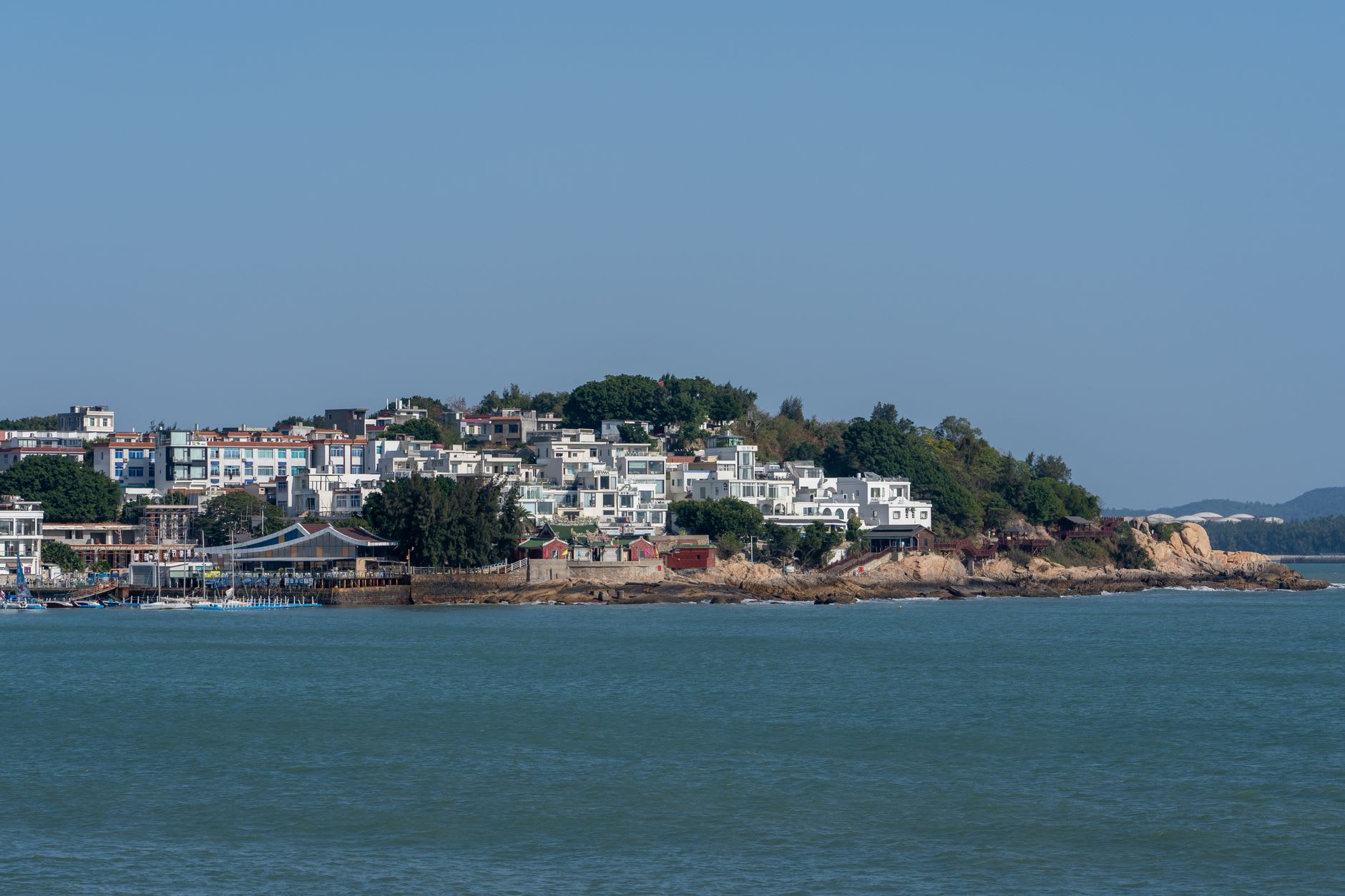
What I hadn’t expected was how much of the island beyond the temple rewarded walking. The granite coastline on the eastern side is cut into a series of headlands and small coves where the rock has been shaped by wind and salt water into formations the locals have named — a particular boulder that looks like a crouching tiger, a natural arch through which you can see the sea. The paths between them are unpaved and the wind off the Taiwan Strait comes in strong enough that walking them is a physical experience. A few fishing villages on the southern end of the island have not fully converted to the pilgrimage economy: old women mend nets in their doorways, strings of drying squid hang between buildings, and the smell of the sea and the processing sheds for the day’s catch gives the village an honest saltiness that the temple complex, for all its power, lacks.

The food on the island is primarily seafood, harvested from the same strait that Mazu is supposed to calm in the interest of fishermen — a theological feedback loop that I found pleasingly coherent. Razor clams steamed with garlic and glass noodles, oysters grilled over charcoal until they split, a soup made with local mussels and pickled mustard greens that was served to me in a fishing village kitchen by a woman who asked me, through a combination of gestures and the universal grammar of pointing at things, whether I liked spicy food. I said yes. I meant it. She smiled with the particular satisfaction of someone who has made this assessment correctly and gone ahead on that basis.
When to go: October through December for uncrowded visits and mild temperatures. Avoid the period around Mazu’s birthday in the third lunar month (usually April or May) unless you specifically want to experience the massive pilgrimage gathering — rewarding but chaotic. Mid-week visits throughout the year mean significantly fewer tour groups at the temple.