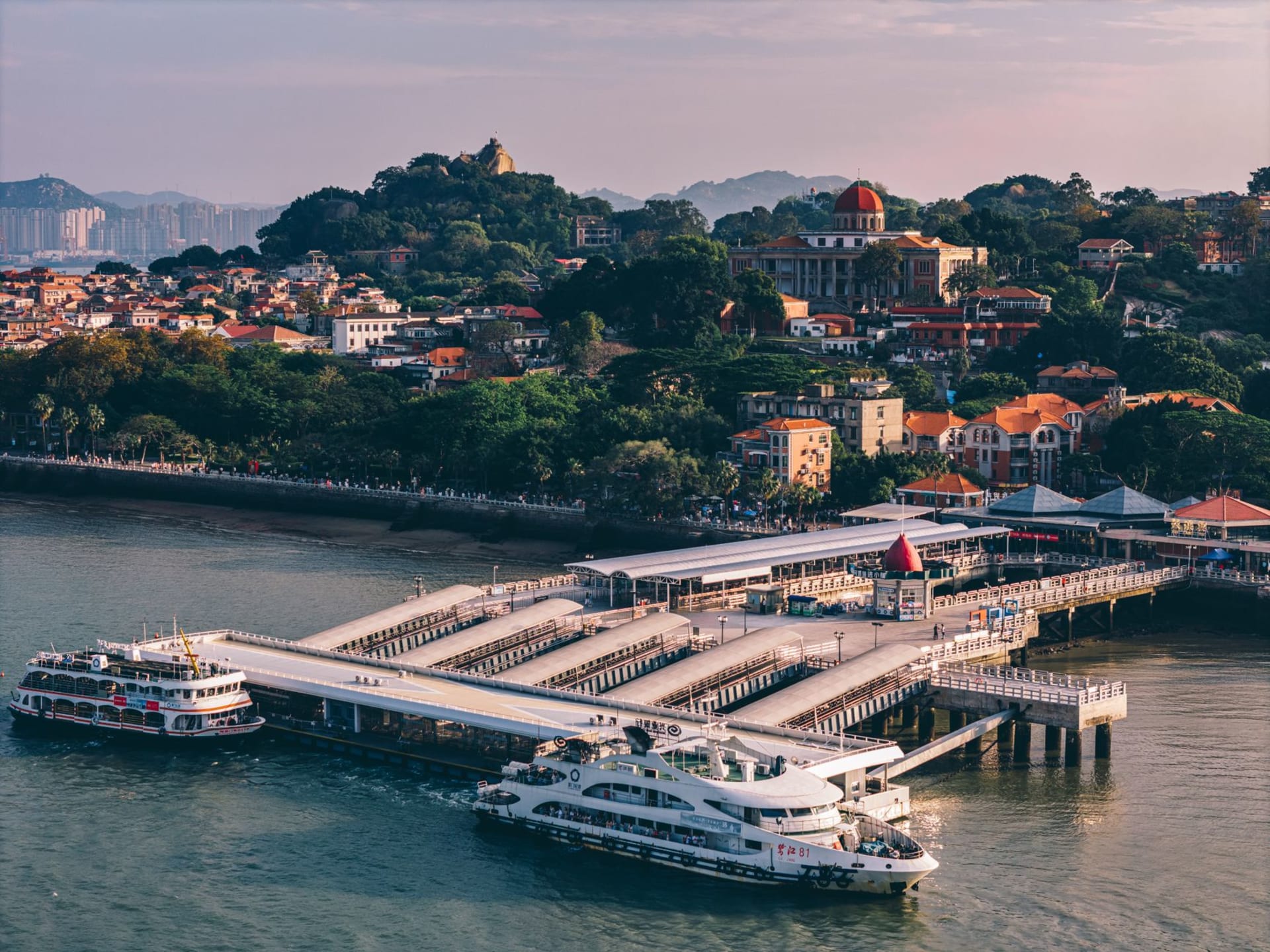
Gulangyu Island
"The kid playing Chopin through the open window didn't know I was sitting on the sea wall beneath him, undone."
I arrived on the seven-minute ferry from Xiamen before the crowds did, which on Gulangyu means before eight in the morning. The boat docked and I stepped onto an island with no cars, no motorbikes, no delivery trucks — nothing with an engine except the fishing vessels that still work the channel. The silence that replaced all that was not the silence of emptiness. It was the silence of something older and more intentional, and into it, almost immediately, drifted the sound of someone practicing piano somewhere up in the lanes. A scale, repeated. A phrase, stopped and restarted. On an island that the colonial era left half-finished, the piano has become the local inheritance. Gulangyu is sometimes called the Island of Piano, and that morning I understood why in a way the brochure had not quite communicated.
The colonial architecture here is not preserved so much as it is inhabited, which gives it a quality that museum-piece restoration never achieves. Dutch and British merchants built their trading houses and consulates on this narrow stretch of land in the 1840s, and the buildings have been slowly digested by the island’s subsequent life. Wrought-iron balconies carry laundry and potted plants simultaneously. A Baroque facade has a hand-painted noodle shop sign bolted to its base. Bougainvillea climbs in great fuchsia riots over walls that haven’t been painted in decades. Walking the lanes — some of them barely wide enough for two people passing — felt less like touring a heritage site and more like wandering through a city that got interrupted mid-sentence and just carried on.
The food is best at the stalls near the ferry terminal and in the side alleys off Longtou Road — before the tourist shops take over the ground floors entirely. I ate oyster cakes fried crisp in a flat iron pan, the insides soft and briny and carrying that specific sweetness of Fujian oysters that I have spent years trying to find elsewhere and haven’t. There were rice noodles with peanut sauce so thick it barely moved when I tilted the bowl, and grass jelly in a cup from a stall run by a woman who’d been there, judging by the patina on her equipment, for several decades. She didn’t look at me when she handed it over. She was watching the ferry.
From the top of Sunlight Rock — a twenty-minute climb up stepped paths between granite outcrops — you see why any of this happened here at all. Xiamen spreads across the water below, its skyline modern and improbably dense, while Gulangyu sits in the channel between two coastlines looking like something that escaped from the nineteenth century by moving slightly offshore. The view also clarifies the island’s strange geometry: it is smaller than it feels from inside, perhaps two kilometres end to end, but the lanes fold back on themselves in ways that keep producing new corners, new piano sounds from new open windows, new angles on the water.
The crowds arrive around ten and the island transforms — day-tripping domestic tourists fill the main promenade, the souvenir shops open their shutters, and the particular magic of the early morning dissolves into something louder and more familiar. I don’t say this to be precious about it. The crowds come because the island is genuinely extraordinary. But those first two hours, before the ferries multiply, the island belongs to the piano students and the fishermen and the elderly residents doing their morning exercises on the sea wall, and it is then that Gulangyu reveals what it actually is: not a heritage attraction but a place where people still live their lives inside a peculiar and beautiful inheritance.
When to go: October through December for mild temperatures and thinner crowds. Weekdays year-round are dramatically quieter than weekends, when day-trippers from Xiamen fill the island by midmorning. Arrive on the first ferry, before 8am, regardless of season.