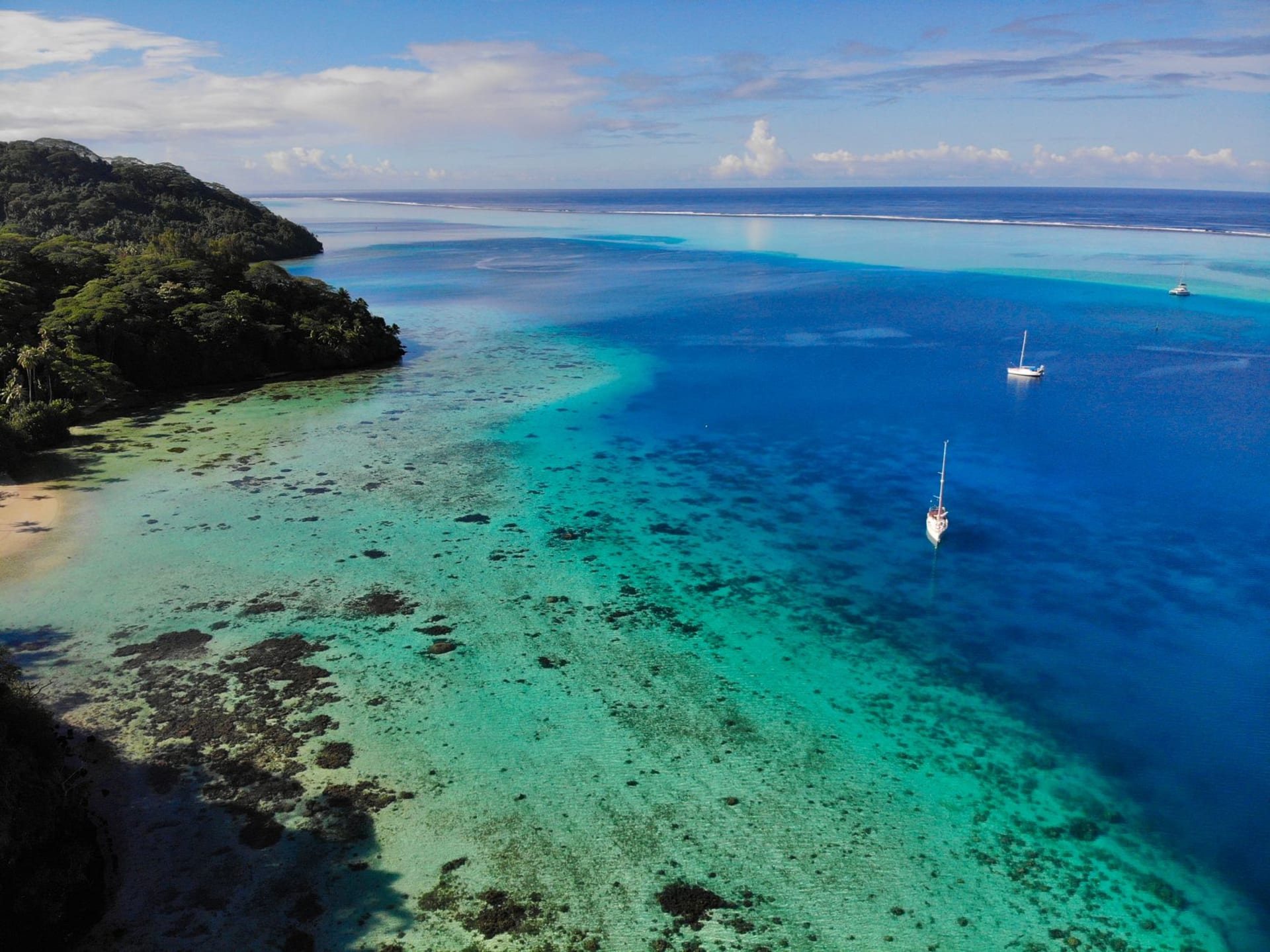
Moorea
"The mist came down off those peaks at six in the morning and I understood why people never leave."
The ferry from Papeete takes thirty minutes, and the approach is one of those arrivals that improves the closer you get. From the open deck I watched Moorea’s silhouette sharpen out of the early haze — thirteen jagged peaks rising from a single island in a formation so theatrical it looks designed. Cook’s Bay cuts into the northern coast like a wound, and as the ferry swung into it I could see the walls of the valley rising on both sides, the jungle impossibly green after a night of rain, with white birds crossing the ridge and a few fishing pirogues already out in the flat water below.
Moorea is the island I recommend to anyone who asks me about French Polynesia and sounds nervous about the price tag. It is a fraction of the cost of Bora Bora, the lagoon is just as beautiful, and the infrastructure hasn’t been entirely surrendered to resort culture. You can rent a scooter for twelve dollars and drive the perimeter road in an afternoon, stopping at roadside stands where women sell pamplemousse — Polynesian grapefruit, sweeter and less acidic than any I’d had before, the flesh stained pale pink. I ate them over the handlebars, juice running down my wrists, while the lagoon appeared and disappeared through gaps in the palm trees.

The poisson cru here is the standard by which I now judge the dish everywhere else I encounter it. At a small snack van parked near the Haapiti motu, a woman who introduced herself only by a wave and a smile handed me a portion wrapped in a banana leaf: cubes of yellowfin tuna that had been marinating in lime juice long enough to turn faintly opaque at the edges, mixed with coconut milk and diced tomato and cucumber, served cold. The lime had done something alchemical to the fish — the flesh was firm but yielding, carrying both the citrus and the sweetness of the coconut without letting either win. I ate it standing up, watching the reef break against the outer barrier, and then I ordered another.
The Belvedere lookout, halfway up the mountain road above Cooks Bay, is a thirty-minute drive that rewards disproportionately. From the parking area you see both bays simultaneously — Cook’s Bay to the left, Opunohu to the right — the volcanic interior spreading between them in every shade of green, the outer reef a thin white line, the Pacific beyond it stretching to the horizon. A local man was eating his lunch on the wall when I arrived, looking at this view with the casual affection of someone who has seen it every day for years and has still not stopped caring.

The Opunohu Valley floor holds Polynesia’s best-preserved ancient marae — stone ceremonial platforms reclaimed by jungle, connected by raised coral paths through a stillness that feels genuinely old. A rooster walked across the main platform while I stood there reading the information board, and for a moment the eight centuries separating me from whoever built this place collapsed entirely.
In the water off the north coast, wild spinner dolphins move through the lagoon in pods that locals have known for generations. They arrive unpredictably, cutting the surface in arcs, and the snorkeling tourists who pile onto the excursion boats usually see them. But some mornings they come close to shore on their own, and if you’re in the water early and patient enough, they’ll pass within ten meters without you having paid anyone anything.
When to go: May through October, the dry season, brings the clearest skies and the most comfortable temperatures for scooter riding and hiking. The Belvedere road after rain becomes a mud track best left alone. April and November are shoulder months with dramatically cheaper accommodation and only occasional showers. The ferry from Papeete runs multiple times daily year-round, making this an easy escape from the capital whenever you need it.