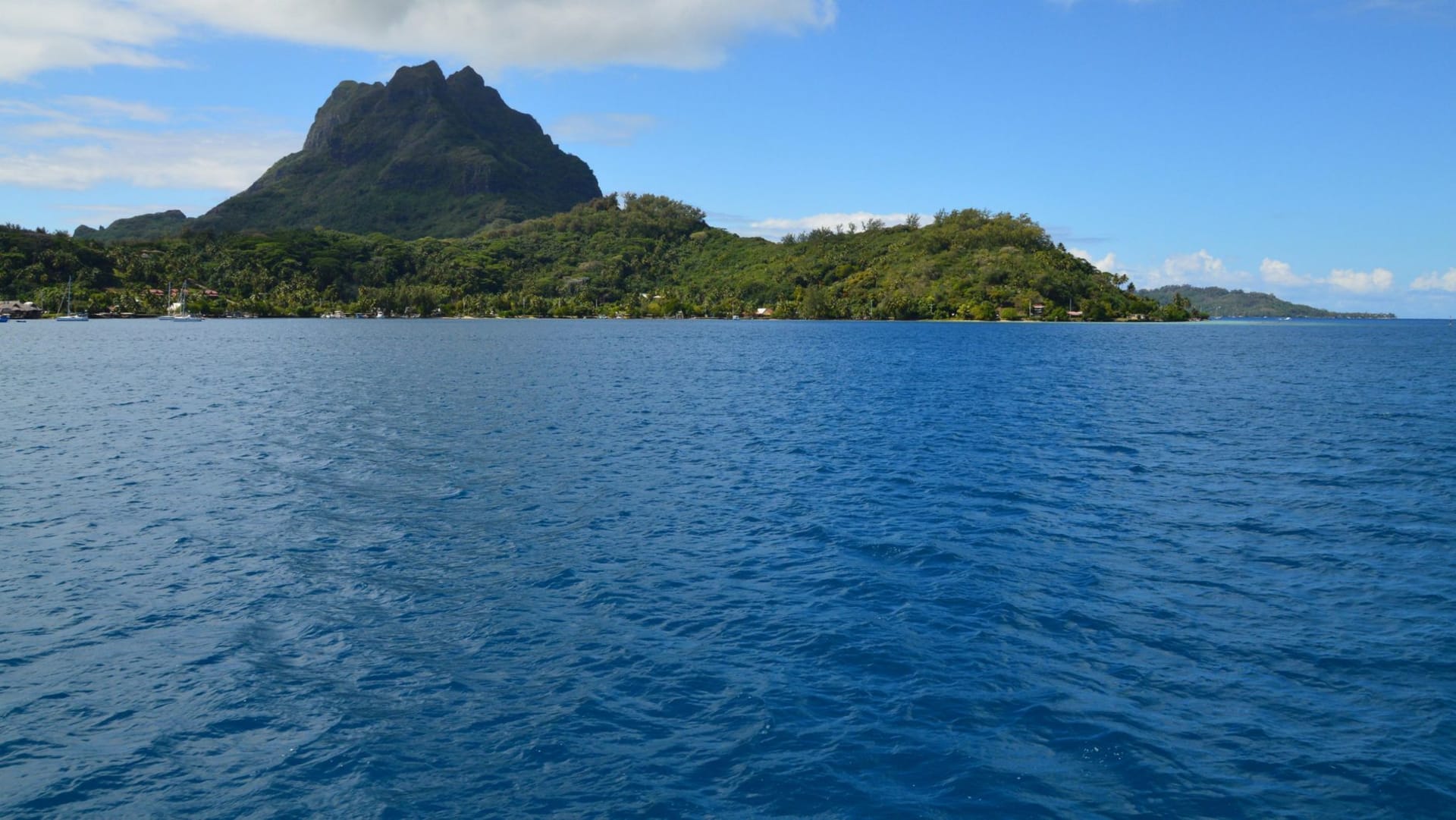
Huahine
"I asked the guesthouse owner how many guests she had that week. She said: just you."
I flew into Huahine on a twin-prop from Papeete, eighteen seats, engines loud enough to make conversation pointless. We landed on a strip of asphalt so short it seemed optimistic, and the terminal was a room with a ceiling fan and a hand-painted sign. Three people got off. The island looked at us without particular interest. A dog was asleep across the exit. I stepped over it and walked outside into the kind of silence that makes you check whether something has gone wrong with your hearing.
Nothing had gone wrong. This is just what Huahine sounds like.
The island is two landmasses connected by a bridge, and together they hold about six thousand people, a handful of guesthouses, one actual hotel, a lagoon that would make Bora Bora look ordinary if anyone knew about it, and somewhere between forty and fifty ancient marae — ceremonial stone platforms built by the Society Islands Polynesians before European contact — scattered through the jungle interior as casually as if they were garden walls. I found my first one by accident, turning off the main road on a scooter to follow what I thought was a paved track and ending up at a clearing where a moss-covered stone platform about the length of a school bus sat in the trees. A red-and-yellow hermit crab was investigating the base. Nobody else was there.

The Maeva marae complex, near the village of the same name on the northern island, is the most significant archaeological site in French Polynesia that most people have never heard of. More than forty structures, built when this island was considered the sacred seat of royal power in the Society Islands, arranged along a hillside above the lake of Fauna Nui. I walked through it in the early morning, when the light was still low and the lake was flat and a great blue heron was standing in the shallows absolutely motionless. The stones have been restored with an unusually light hand — they look inhabited by history rather than curated into a museum. A rooster called from somewhere in the jungle. The heron didn’t move.
Huahine’s lagoon wraps the island in shades of green and blue that I couldn’t name precisely — there’s a point in the shallows over white sand where the water goes the color of a swimming pool full of light, and then it deepens to turquoise, and then to the darker blue-green of the channel. I spent an afternoon on a motu accessible by kayak, a strip of coral sand maybe thirty meters long with two palm trees and a patch of reef at its eastern edge. I saw no other person for four hours. The reef held parrotfish, angelfish, a moray eel threading through the coral heads with that slightly unnerving liquid motion they have.

The black pearl farms in the southern lagoon produce some of the finest pearls in the archipelago, a fact that is largely invisible to the casual visitor. I toured one on the second day — a man named Etienne showed me the oysters suspended on long lines below the dock, each one grafted with a bead nucleus and checked quarterly. He had been doing this for twenty-two years. The pearls he showed me ranged from a grey so dark it was nearly black to a bronze-green that changed color entirely when the light moved across it. He sold one to me for a price that would have been four times higher in the Papeete pearl market. I still have it.
The food on Huahine is simpler than Moorea or Bora Bora — there are a few restaurants, a couple of roullotes in the main town of Fare, and the guesthouse breakfasts of papaya and fresh bread and coffee in those small cups the French manage to make feel civilized even at the edge of the world. I ate well. I ate quietly. Both of these things matter.
When to go: May through October offers dry, pleasant weather for exploring the marae and paddling the lagoon. The island is genuinely uncrowded year-round — even in high season the motu will be empty. If you fly here during the December-March wet season, the jungle turns a more vivid green and the lagoon loses none of its color; you’ll just need to accept occasional rain.