
Orange
"I've stood in a lot of ruins, but this is the first one where I actually clapped just to hear what happened."
A workaday Rhône town wrapped around the best-preserved Roman theatre in Europe, where the wall still throws sound the way its engineers intended two thousand years later.
Orange doesn’t try to charm you the way Gordes or Ménerbes do. It’s a real, slightly scruffy Rhône valley town with a ring road and a supermarket car park practically abutting its main monument, and I mean that as a compliment — the theatre isn’t cordoned off in some manicured historical district, it just sits there in the middle of ordinary life, the way it probably always has. We came up from the Luberon on a wine-tasting detour and ended up staying the better part of a day, mostly because of one wall.
The wall that swallowed two thousand years
The Théâtre Antique’s stage wall — the “mur” as the guides here call it with obvious pride — is the only Roman theatre wall in Europe still standing essentially complete, thirty-seven metres high and just as wide as it was when Augustus’s veterans watched plays against it. UNESCO listed it for exactly that reason. We climbed to the top tier of seating, cut into the hillside of Saint-Eutrope, and a guide down on the stage floor spoke in an ordinary voice that carried up to us with almost no effort, the acoustics doing in one wall what a modern amplifier needs a stack of speakers to fake. Louis XIV supposedly called it “the finest wall in my kingdom,” which is a strange thing for a king to say about a wall, and also the only sensible thing to say once you’ve stood under it.
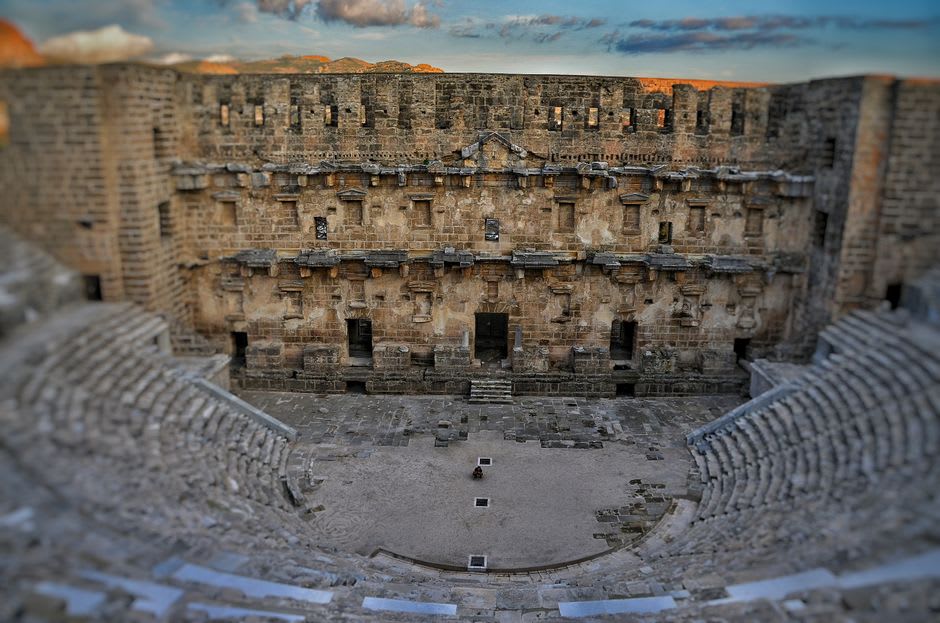
Every summer the theatre still hosts the Chorégies d’Orange, an opera festival that’s been running since 1869, staged against the same wall the Romans built — we missed it by a few weeks and I’ve already told Lia we’re coming back in July specifically for that.
The arch at the other end of town
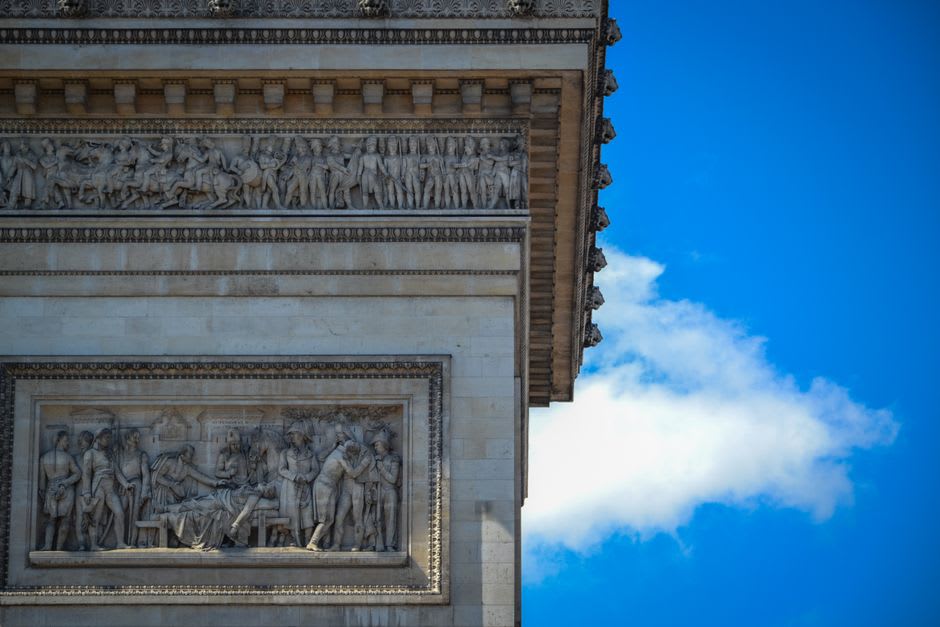
A fifteen-minute walk north, past the Wednesday market and the plane-tree boulevards, stands the Arc de Triomphe of Orange, a triumphal arch built around 20 BC to commemorate Julius Caesar’s veterans and later Roman victories over Gallic tribes, its reliefs of naval battles and captured weapons still legible after two millennia of Rhône valley weather. It now sits, almost comically, in the middle of a traffic roundabout on the old Via Agrippa, cars circling a monument nearly as old as the empire that built the road beneath them. We stood on the traffic island longer than was strictly safe, working out the carved trophies of shields and anchors, before retreating to a café to recover with a glass of something local.
Orange sits right at the northern gateway to Côtes du Rhône country, and the vineyards start almost as soon as the town does — Châteauneuf-du-Pape is a short drive south, Gigondas and Vacqueyras further east under the jagged Dentelles de Montmirail. We used Orange as a base for two days of tasting rooms without ever feeling like we were missing the “real” Provence; if anything, the wine came with less pretense here than further south.
When to go: Late June through July for the Chorégies opera festival, if you can get tickets and stand the heat. Spring and September give you the same acoustics and half the crowd, plus better conditions for the vineyard hopping. The mistral rips down this stretch of the Rhône corridor with real force in winter, so pack for wind, not just cold.
Keep exploring
More of Provence