Château-Chalon
"One of the smallest villages we've visited in France, and it's responsible for one of its strangest wines."
A clifftop village of barely one hundred and fifty people that somehow invented vin jaune, and where the ruined abbey above the vines gave us the single best view of the whole Jura wine country.
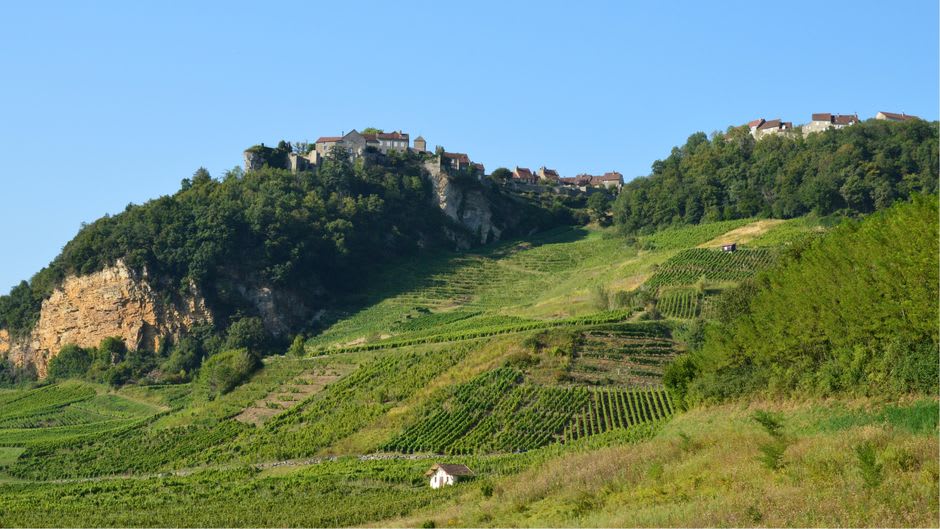
Château-Chalon has no château, or at least not one you can visit — what’s left is a scatter of ruined walls and a squat, half-collapsed keep on the highest point of a limestone spur, and yet the village below it lends its name to the most respected vin jaune appellation in the entire Jura. That felt backwards to me at first: a village this small, maybe a hundred and fifty residents, sitting at the top of a hierarchy of wine most French people outside the region have never tasted. Then I stood at the edge of it, looking down over vineyards terraced onto near-vertical slopes, and understood that scarcity was probably the point.
Vines on a cliff edge
The Savagnin vines here grow on marl soil so steep that some parcels are essentially worked by hand, no machinery able to get a purchase on the slope, and the appellation rules are stricter than almost anywhere else in France — only vin jaune, aged the full six years and three months under its yeast veil, can carry the Château-Chalon name; there’s no simple red or easy-drinking white fallback. We tasted a glass at a tiny cave just below the village walls, and the producer pouring it told us, without much ceremony, that his family had been making only this one wine, this one way, for four generations. I asked what happens in a bad year. He shrugged and said some years you just don’t sell the wine as Château-Chalon at all.
The ruined abbey and the view that explains everything
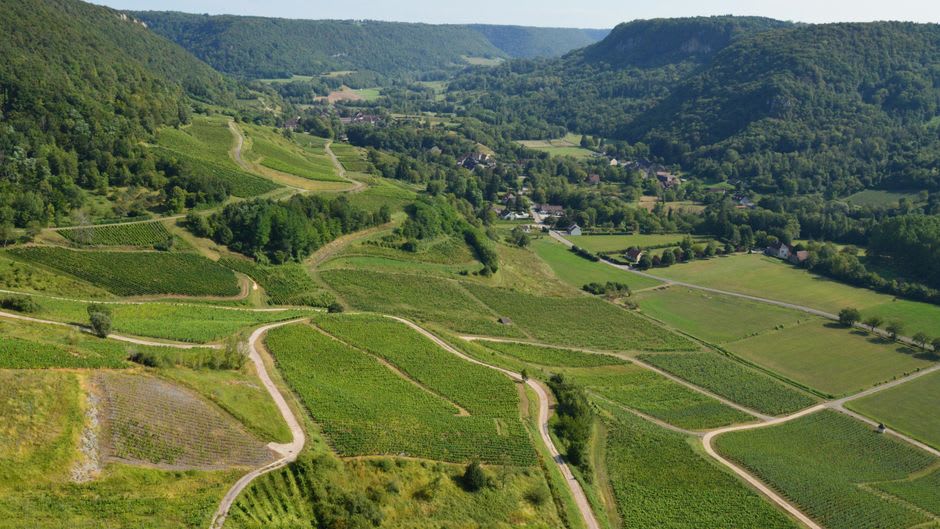
Above the houses, a short climb through nettles and old stone leads to what remains of the Benedictine abbey and the keep, both badly damaged over centuries of border wars between French and Habsburg-controlled Franche-Comté before this region even properly belonged to France. There’s not much structure left standing, but the view from up there is, without exaggeration, one of the best panoramas we found anywhere in the Jura: the Bresse plain flattening out to the west, the folded green hills of the vineyard belt directly below, and on a clear day the pale line of the distant Alps. Lia sat on a broken wall for probably twenty minutes just looking at it while I finished the wine we’d carried up.
When to go: Early October, during the Percée du Vin Jaune festival held somewhere in the Jura each year celebrating the new vintage’s release, or any clear day in September for the view and the harvest activity in the vines.
Keep exploring
More of Jura