
Murol
"Half of Murol is ruins, and the other half is people in chainmail pretending it isn't the twenty-first century."
A ruined castle of black volcanic stone standing on its own basalt outcrop above Lac Chambon, where grown adults in chainmail reenact medieval sieges every summer and somehow make it work.
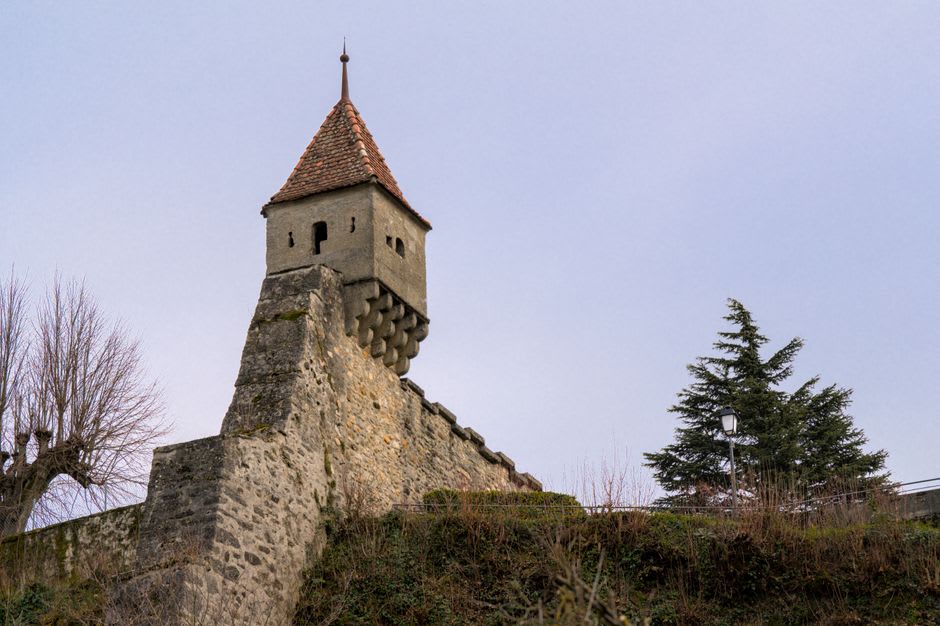
Murol announces itself from a distance, which is the whole point of it: the castle sits on its own volcanic plug, a dark lump of basalt rising out of the Auvergne farmland like something pushed up from underneath, and the ruined walls of the Château de Murol follow the rock’s contours so closely that from certain angles you can’t tell where the geology ends and the masonry begins. We’d been driving through the Monts Dore for an hour, past green pasture and the occasional grazing Salers cow, when the castle appeared on its hill and Lia made me pull over just to look at it before we’d even found the parking lot.
A castle built to be climbed over
The Château de Murol dates back to the twelfth century and was expanded over four hundred years into the ruin that stands today, its walls built from the same black lava stone as half the villages in this part of the Auvergne, quarried from the very outcrop it sits on. What makes it different from most French ruins is that you’re actually allowed to clamber through it — narrow stone stairwells wind up into towers with no railings, and the whole structure is threaded with the kind of gaps and half-collapsed floors that would get a building shut down anywhere less committed to letting people experience a ruin as a ruin. From the top, the view opens onto the whole Chaîne des Puys to the north and the jagged volcanic profile of the Sancy massif to the south.
Knights, on a Tuesday afternoon
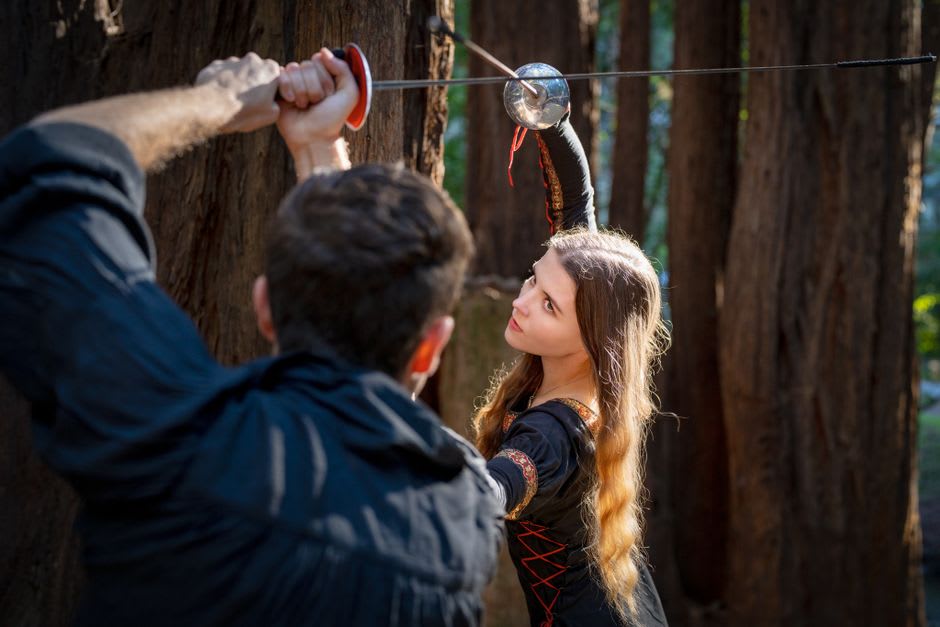
On summer weekends and through most of July and August, the castle runs medieval reenactments — costumed volunteers in genuine chainmail and leather staging swordfights, falconry demonstrations, and full sieges with actual trebuchets flinging things at the walls, all narrated in French with enough physical comedy that we followed along fine without much of the language. It sounds like it should be cheesy, and it is, a little, but watching two men in full armor actually swing broadswords at each other on the same stones where that happened for real seven hundred years ago has a way of erasing the distance between reenactment and history. We sat on a low wall eating a crepe from a stand at the base of the hill and watched an entire mock siege unfold above us.
Below the castle, the village of Murol itself is small and unhurried, and a ten-minute drive brings you to Lac Chambon, a glacial lake in a volcanic bowl ringed by the Dore forest, popular with swimmers and paddleboarders in summer and eerily still the rest of the year. We swam there after the castle, which felt like the correct way to cool off after watching people fight in armor under the July sun.
When to go: July and August for the medieval reenactments and warm enough weather to swim in Lac Chambon afterward; the castle stays evocative but quiet in shoulder season if you’d rather skip the crowds and the trebuchets.
Keep exploring
More of Auvergne