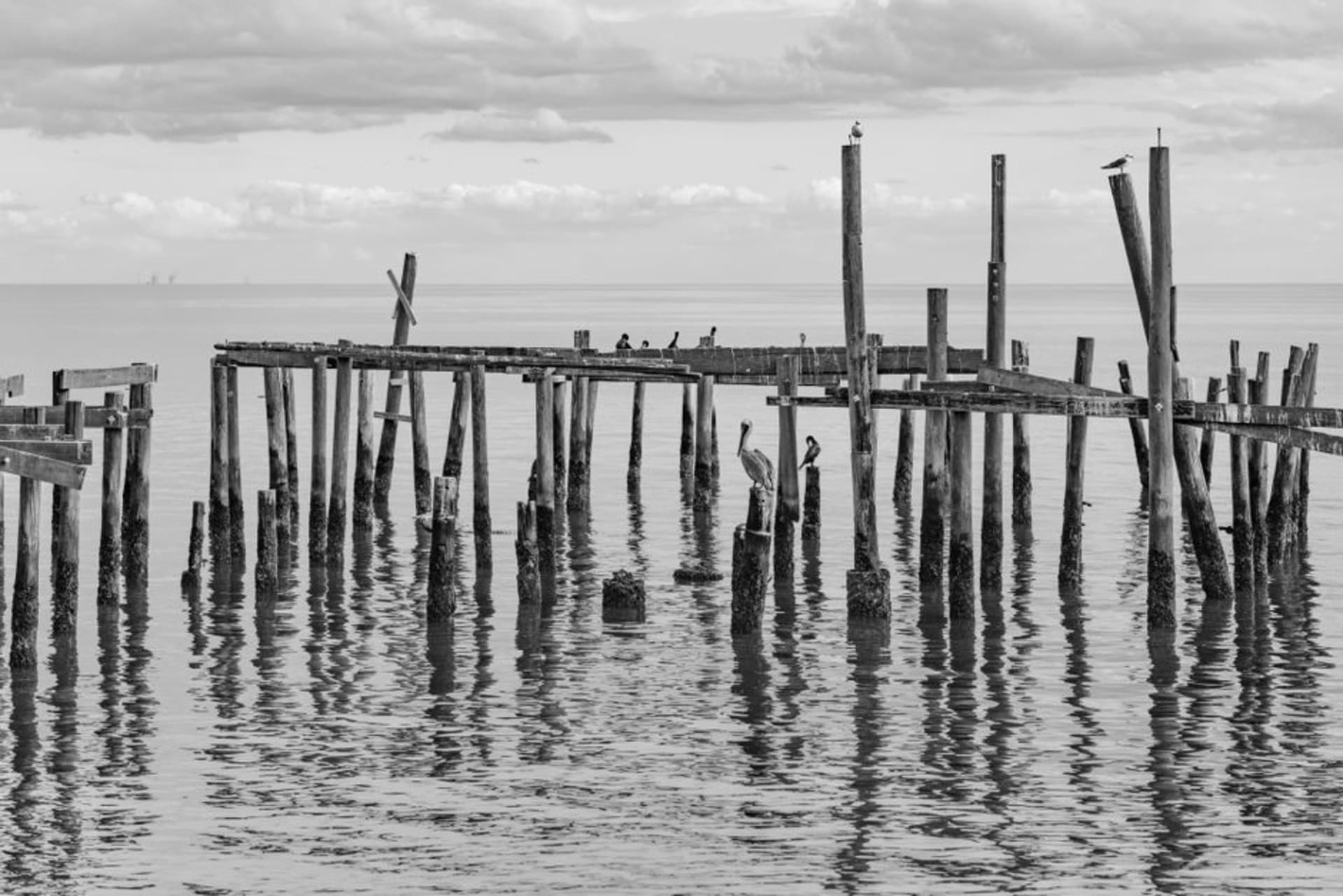
Cedar Key
"Cedar Key doesn't try to impress you. It just waits for the tide to come back in."
A sleepy Gulf-coast island where clam boats replaced pencil mills, and the pace of life slows to the tide.

We almost drove past the turnoff. Highway 24 just keeps going west through pine flatwoods and salt marsh until, without much warning, it runs out of land and dumps you onto a two-lane causeway with water on both sides. Lia was navigating and kept saying “are you sure this is right,” and then the marsh grass opened up and there was Cedar Key, a little grid of clapboard houses and one main street, sitting out in the Gulf like it had drifted there by accident. I remember cutting the engine and just hearing wind and rigging lines clinking against masts. That quiet is the first thing that gets you.
It took me a day of poking around the small museum on the edge of town to understand how loud this place used to be. In the 1860s Cedar Key was Florida’s second-largest port, the western end of David Levy Yulee’s railroad that hauled goods clear across the peninsula from the Atlantic. Mills here sliced the local cedar into pencil slats and shipped them north to Eberhard Faber and Eagle, which felt strange to learn while holding an actual pencil in the gift shop. Fire and decades of overharvesting finished the cedar business by the early 1900s, and the town just deflated, port and railroad and all, back into a fishing village that time mostly forgot about.

What’s left now is quieter but no less working. Cedar Key is Florida’s biggest producer of farmed clams, and Lia and I figured that out the hard way — by ordering a dozen steamed at a dockside shack and being told, with a shrug, that they’d been in the water that morning. The clam farms grew out of the 1995 net-fishing ban, when fishermen who’d lost their livelihood turned to the water in a different way, planting instead of casting. You can still see the cages at low tide from the causeway, neat rows of them out in the flats, a whole economy built on something that small.
One afternoon we rented kayaks and paddled out toward the Cedar Keys National Wildlife Refuge, a scatter of low mangrove islands just offshore where pelicans and oystercatchers nest undisturbed. We didn’t go far — the current was stronger than it looked, and Lia is a far more patient paddler than I am — but even from a distance, watching a line of white ibis lift off one island at once, it was obvious why this stretch of coast gets left alone. Nobody’s building condos on a wildlife refuge.

When to go: Aim for October through April, when the Gulf humidity breaks and the town’s seafood festivals hit their stride — we still think about that dozen clams more than we probably should.
Keep exploring
More from Florida
 florida
 Dry Tortugas
An unreachable brick fortress in open Gulf waters, surrounded by the clearest water and most abundant coral in Florida.
Explore florida
 Everglades City
The quiet western gateway to Ten Thousand Islands, where the mangrove wilderness starts immediately and the silence is absolute.
Explore florida
 Ichetucknee Springs
A chain of crystal springs feeding a river so clear and cold it seems impossible in subtropical Florida.
Explore florida
 Key West
The end of the road — a genuinely eccentric island town where the sunsets actually justify the crowd they draw every evening.
Explore florida
 Little Havana
A Miami neighborhood where Cuban exile culture has become something entirely its own — not Cuban, not American, but distinctly Miami.
Explore florida
 Sanibel Island
A barrier island on the Gulf coast that lies east to west instead of north to south, which is why its beaches catch more seashells than almost anywhere else in the hemisphere.
Explore