Rovaniemi
"The aurora doesn't perform for you. It moves when it wants, how it wants, and you just have to be cold enough and patient enough to be there."
The taxi from Rovaniemi airport crossed the Kemijoki River at dusk, which in December means roughly two in the afternoon. The driver said nothing, which I had already learned was not unfriendliness but simply Finnish interaction protocol — particularly in Lapland, where the silences are longer and the land outside the windows was doing enough talking on its own. Snow-covered birch trees lined the road, the sky ran a band of deep violet above the treeline, and somewhere out there was the Arctic Circle, which we crossed without any ceremony other than the driver pointing at a sign briefly with one finger.
Rovaniemi is a rebuilt city — the Wehrmacht burned it almost completely to the ground in 1944, and Alvar Aalto was commissioned to redesign it from scratch in the shape of a reindeer head, which you can see in aerial photos and which feels like exactly the kind of Nordic decision I admire enormously. The result is orderly, modern, and functional, sitting at the confluence of the Kemijoki and the Ounasjoki rivers, both of which freeze solid in winter and become part of the landscape in a way that is quietly spectacular.
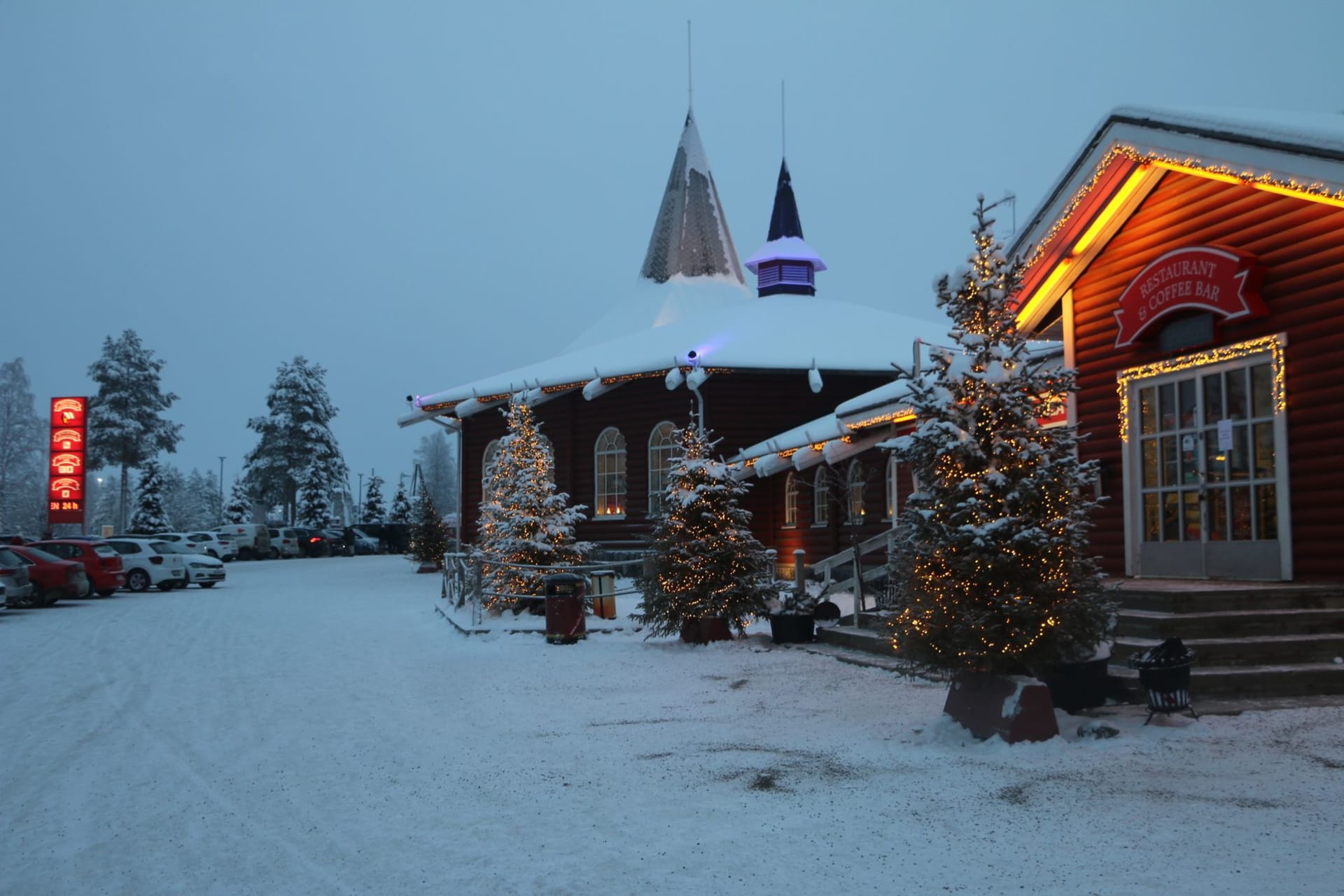
I spent three days in Rovaniemi not thinking about the Santa Claus Village, which exists and is clearly designed for children and families, which I am not. What I was there for was simpler: auroras and reindeer and the particular quality of light that exists in Lapland in December, which is less like daylight and more like a very long, very beautiful dusk that peaks around noon and then fades back into night.

The Arktikum museum sits on the bank of the Ounasjoki in a building that is mostly glass — a long transparent tube stretching toward the river. Inside, the natural history exhibits on the Arctic and the cultural history exhibits on Lapland sit side by side in a way that makes clear how inseparable the two are. I spent more time there than I expected, particularly with the Sámi cultural section, which handles indigenous history with more seriousness and less romanticism than most European museums I have visited.
The food in Rovaniemi runs toward the elemental. Reindeer appears in everything — in stews served with creamy mashed potatoes and lingonberry sauce, in thin smoked slices that taste like a more delicate venison, in soups that are straightforward and filling in exactly the way you need when it’s minus fifteen and you’ve been standing outside watching nothing happen in the sky for an hour before, suddenly, something does.

The auroras, when they came, came fast. I’d been waiting on the riverbank at about ten at night — which at that latitude in December is a darkness so total it has weight — with two Finnish men who were fishing through a hole in the ice and paying the sky no particular attention. The green started at the north and spread. It moved in ribbons and then in curtains and then in something I don’t have a word for, a kind of organized chaos with the whole northern sky rearranging itself in real time. I watched for forty minutes and then went inside for reindeer stew and I have been trying to describe it accurately ever since.
When to go: December through March for auroras, dog sledding, and snowshoeing. The polar night peaks around the winter solstice when the sun doesn’t rise at all — bleak in the best possible way. March offers better aurora odds statistically and some returning daylight, which makes the landscape legible in a way that pure darkness doesn’t.