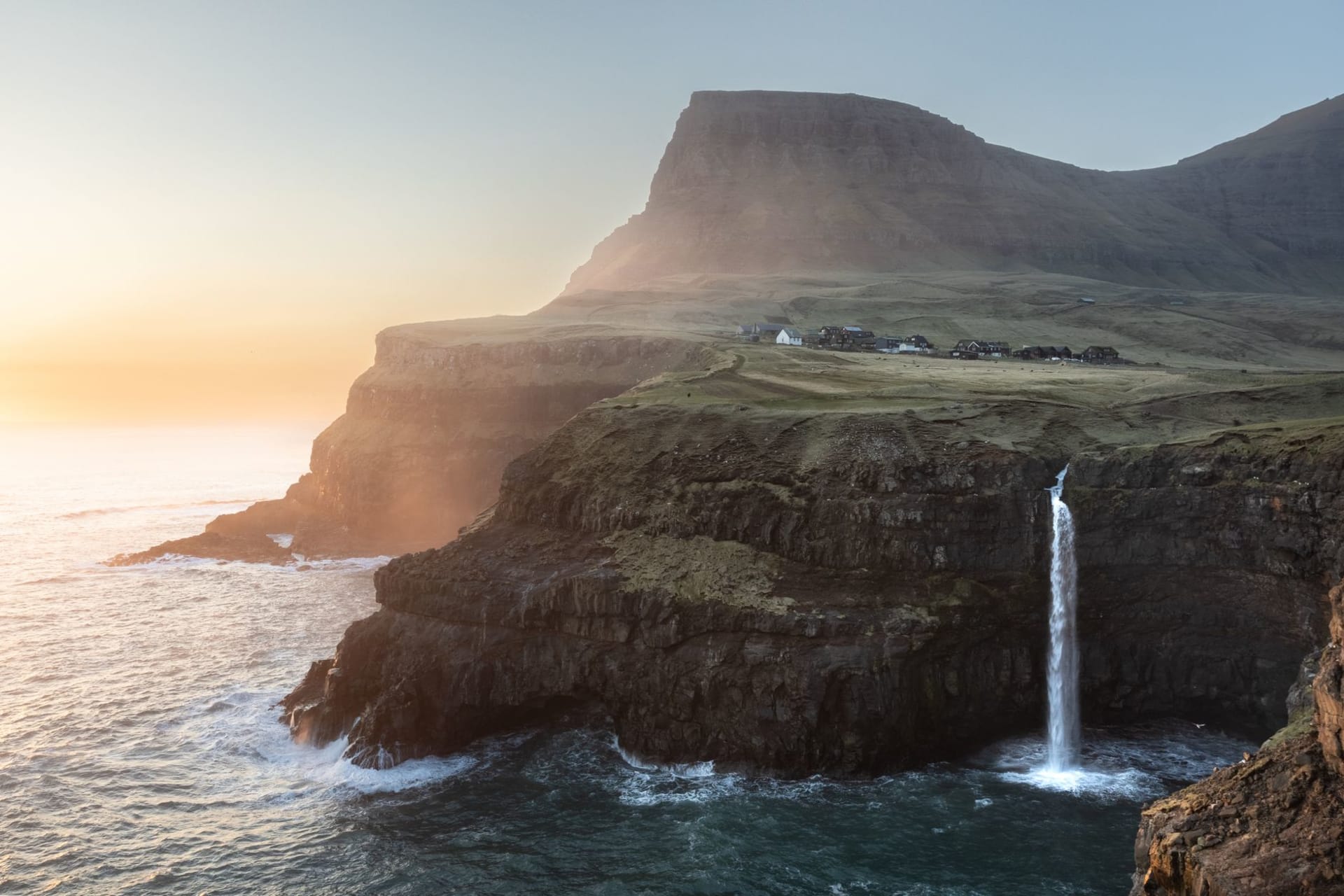
Gjógv
"The gorge at Gjógv sounds like the island breathing — which is exactly the sound you come here to hear."
I came to Gjógv on the wrong kind of day and it turned out to be exactly right. The weather was what the Faroes specialise in — horizontal rain one moment, vertical sun the next, a fifty-meter visibility cloud base that was already lifting by the time I parked at the edge of the village. The gorge appeared before I’d seen anything else: a crack in the basalt running from the hillside down to the sea, the walls close enough to touch on both sides with arms extended, the water at the bottom churning white in a sound that travels up through the rock and into your feet before you see it.
Gjógv sits at the northern tip of Eysturoy, where the island ends in cliffs and the Norwegian Sea runs south in a long open fetch. The name means gorge in Faroese, which is admirably direct — the gorge is the village’s defining fact and its name simultaneously. It was used historically as a natural harbour, boats pulled through the narrow opening and hauled up on the rock above the waterline. The stone ramps worn smooth by generations of that practice are still there, slightly concave in the middle, and looking at them I felt the weight of a labour that is easy to romanticise from a distance and was simply the ordinary work of survival up close.

The village has perhaps forty permanent inhabitants and a guesthouse that has become well known on the hiking circuit. It serves dinners I’ve been told are excellent, though I arrived too late to book one and ate instead from supplies packed in Tórshavn, sitting on a low wall while the rain came and went. What I did find was a path up the ridge behind the houses that climbed through sheep-grazed grass to a point where, in the brief window of clear sky that followed the last downpour, I could see the coast of Eysturoy curving south and the island of Kalsoy across the water to the northwest and, further, the pale silhouette of Kunoy’s ridge. The light was doing the thing Faroese light does in summer — arriving at a low angle that turns grass into something gold and unlikely — and I stood on that wet ridge in damp clothes and felt unreasonably satisfied about it.

The drive to Gjógv from Leirvík passes through a subsea tunnel and then climbs through a valley that is one of the most quietly beautiful things I saw in the entire archipelago — a succession of small farms, turf-roofed barns, the road narrowing through a hamlet so small it doesn’t appear on most maps. No dramatic views, just the accumulation of a particular Faroese scale: intimate, green, wind-scoured, human-sized in a landscape that otherwise tends toward the monumental. It starts to feel like a language you understand a little better each time you encounter it.
When to go: May through September. The gorge is dramatic in any weather, but the ridge hikes and the particular quality of evening light on the village are summer gifts. The guesthouse requires advance booking — it fills up with walkers using Gjógv as a base for Slættaratindur, the highest peak in the Faroes, whose approach from here is among the best in the islands.