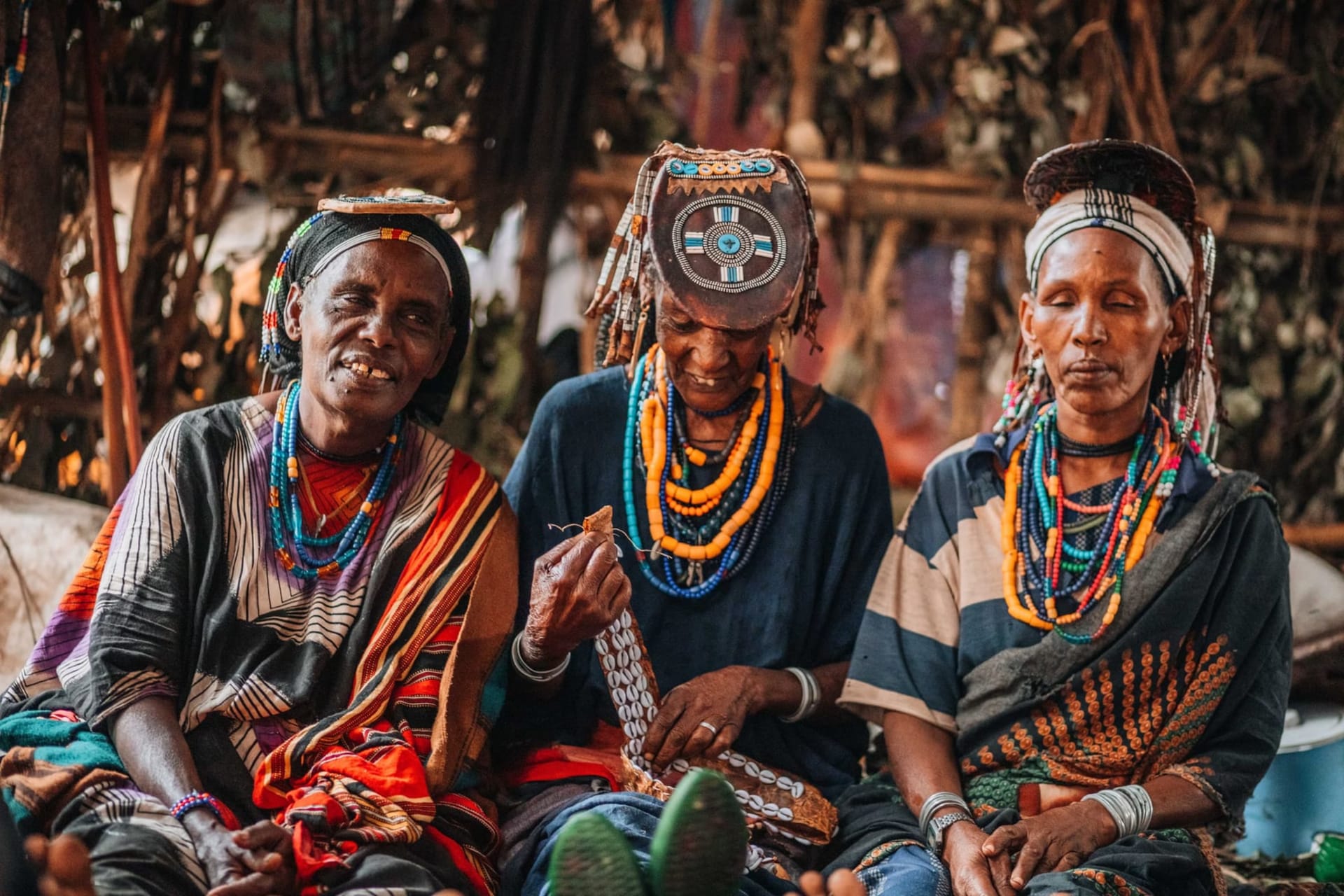
Home to dozens of indigenous tribes who have preserved ancient traditions of body decoration and cattle culture.
The road from Arba Minch dissolves somewhere past Konso, where the tarmac gives up and the track becomes a suggestion — red laterite dust that coats everything, the dashboard, the back of my throat, the inside of my lungs. By the time we reached Jinka, Lia and I looked like we had been terracotta-fired. We had not yet seen a single Hamar person. We had already understood that this place required surrender.
The Morning Market at Turmi
I woke before five to walk to the Turmi market, which happens weekly and which no guidebook adequately prepares you for. The light at that hour in the Omo Valley is the color of weak tea — thin, dusty gold — and it arrives sideways across the savanna like it is not entirely sure it belongs here. Women walk in from the bush carrying gourds of fermented milk, their leather skirts and copper bracelets catching whatever light there is. The smell is animal and woodsmoke and something faintly floral I never identified, perhaps a resin the women work into their hair.
The Hamar women move through the market with an authority that stopped me mid-step. Their skin is rubbed with ochre and butter until it glows the color of old amber. The metal rings stacked on their necks are not decoration in any decorative sense — they are biography, status, the record of a life. A woman with many rings has been seen. I bought a small woven bracelet from a vendor and felt, briefly, embarrassed by how light my own wrists were.
Ceremony at the Edge of the Village
The unexpected thing happened on our second evening, outside a homestead near Dimeka. We had heard there might be a cattle-jumping ceremony — the Hamar rite of male passage — but our fixer said it was uncertain. Then we heard the singing, that high trembling ululation that carries across flat land with eerie precision. Lia grabbed my arm. We followed the sound through a thorn-scrub thicket and came out into a clearing where perhaps a hundred people had gathered in the failing light, and the ceremony had already begun.
What I was not prepared for was the whipping. Women relatives of the initiate present their backs to be struck with thin switches — it is an act of solidarity, of love, of proof. The marks they wear afterward are worn proudly. I stood very still and tried to understand a logic of care that looked, from the outside, like its opposite.
How to Move Through Here
Travel in the Omo Valley moves at the rhythm of market days and ceremony seasons, not at yours. Jinka is the practical base — small, functional, with enough guesthouses to sleep decently. From there, Turmi and Dimeka are the market anchors, and the drive between them passes Karo villages perched on bluffs above the brown Omo River. Stop when something requires it.
When to go: October through February offers the most reliable roads and the highest chance of overlapping with harvest-season ceremonies. Avoid the April–June rains, when the valley roads become impassable and the river floods.