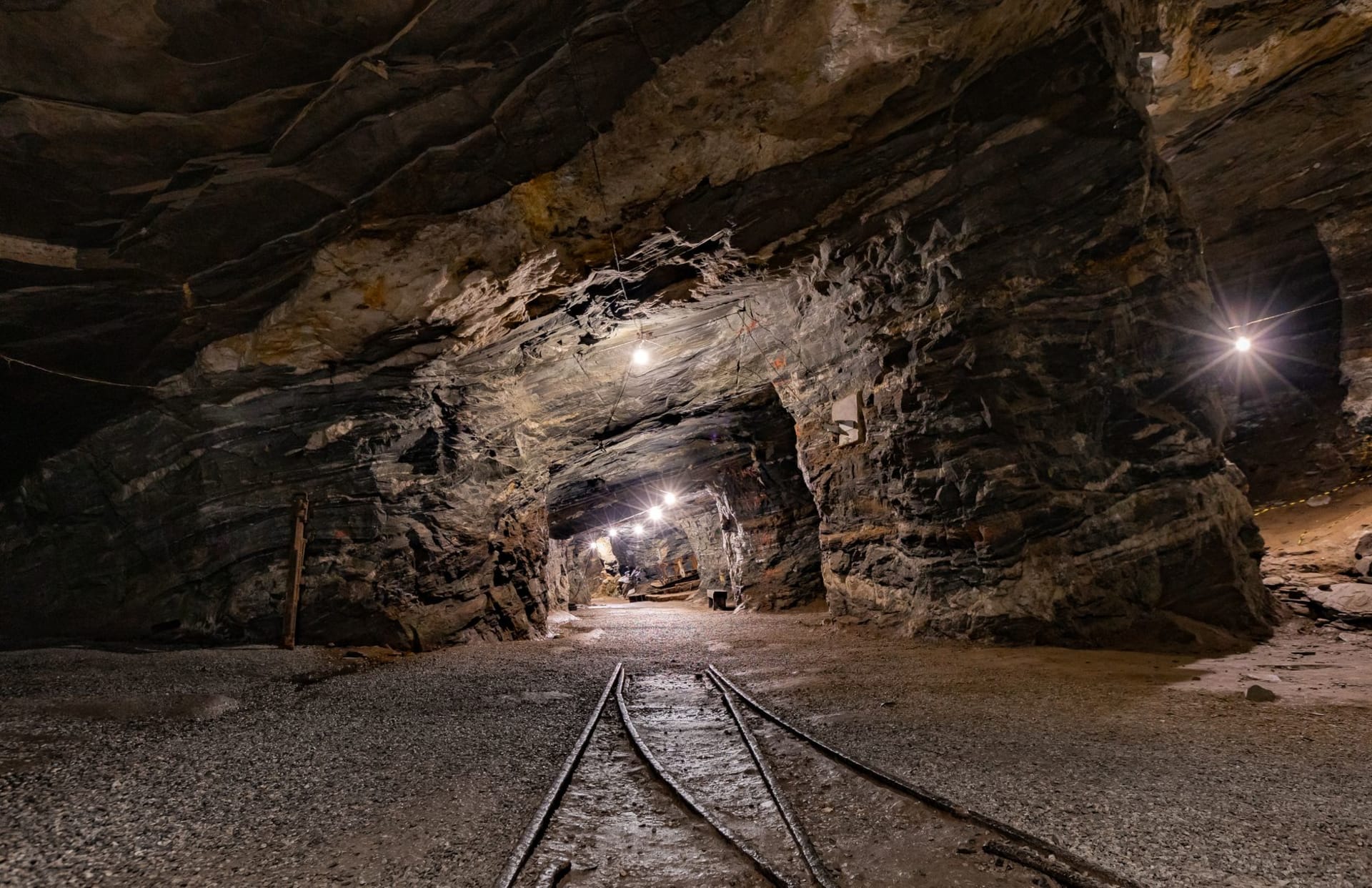
Ngwenya Mine
"I stood at the edge of a hole that people had been digging before there was farming, before there was writing, before there was almost anything, and felt the back of my neck go cold."
I have a weakness for superlatives that turn out to be true, and “the oldest mine in the world” is a hard one to walk past. Ngwenya Mine sits on the flank of Ngwenya Mountain in the far northwest of Eswatini, close enough to the South African border that you can see the line of hills running on into another country. Lia was sceptical — “it’s a hole, Pierre, you’re driving two hours for a hole” — and she was, technically, completely right, and also completely wrong, which is the usual outcome when you drag someone to a place that only makes sense once you’re standing in it.
Forty thousand years of digging
The claim, supported by archaeologists who excavated here in the 1960s, is that Stone Age people were mining this mountain for haematite and specularite — iron-rich minerals ground into red and shimmering pigment — as far back as forty thousand years ago. They weren’t after iron to smelt; that came much later. They wanted the colour: red ochre for bodies, for ritual, for the deep human urge to mark things. The dating makes Ngwenya, by some measures, the oldest known mining site on the planet. Standing there, I found the arithmetic genuinely difficult to hold in my head. Forty thousand years. The cave paintings of Europe are younger than the first diggings here.
In the twentieth century the mountain was mined again, industrially, for high-grade iron ore shipped out by a purpose-built railway, and the great open cut you see today — terraced red-brown rock, raw and enormous — is mostly that modern wound. But the ancient workings, the small hand-dug adits where the ochre was taken, are what give the place its strange gravity. There’s a small interpretive display and a guide who walks you through it with the patient air of a man who has explained “forty thousand” to many doubtful faces.

The reserve around it
The mine sits inside the Malolotja-adjacent Ngwenya area, high grassland country that is genuinely beautiful in its own right — rolling green highveld, aloes, the occasional blesbok, and views that go on for tens of kilometres into the haze. We hiked a short loop from the mine site and saw, in an hour, more open sky than I’d seen in weeks. The altitude keeps the air clean and cool even when the lowveld below is baking, and the light up here has a clarity that flattered even my phone photographs.
Lia, by the end, had revised her position. We sat on a rock above the cutting eating the sandwiches we’d brought, and she said the thing I keep coming back to about this whole tiny mountain kingdom: that it packs more into a small space than it has any right to. A mine older than agriculture, an hour from a wildlife sanctuary, an hour from a craft market, all in a country you can drive across in a morning.

Practical notes
Ngwenya is in northwestern Eswatini, near the Ngwenya border post with South Africa and easily combined with a visit to the Malolotja Nature Reserve and the well-known Ngwenya Glass works nearby. There’s a modest entry fee, a small visitor centre, and a guide worth taking. Wear proper shoes — the ground is loose and red and will stain anything pale — bring water and a hat for the open grassland, and go in the morning when the light rakes across the old workings and the whole improbable age of the place feels closest to the surface.