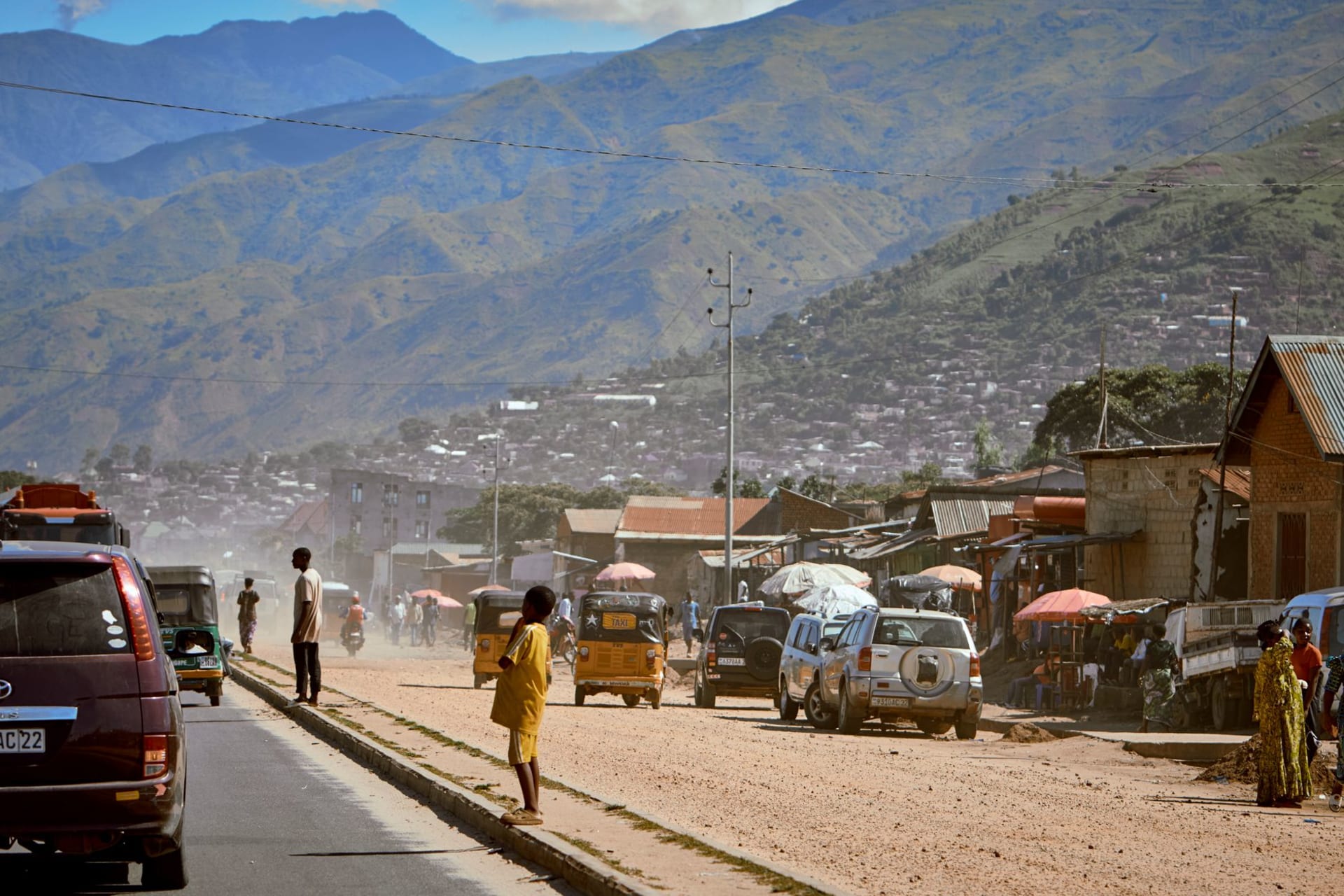
Dekemhare is the kind of place you end up rather than plan to visit. It sits about forty kilometers south of Asmara on the main road toward the highlands, and the first time I stopped there it was because the bus paused for twenty minutes and I got out to stretch my legs and buy something cold. I found a small café with metal chairs on a swept-earth terrace, ordered a macchiato, and by the time it arrived the bus had left. I was not as distressed about this as I should have been.
The town was built by Italian colonizers as a minor administrative and industrial center, and unlike Asmara’s grand Art Deco gestures, Dekemhare is in the more modest Italian provincial mold — a main street with arcaded walkways, a small piazza with a church, two-story buildings with faded yellow and cream facades. The scale is human in a way that Asmara’s imposed grandeur sometimes isn’t. Everything is walkable in twenty minutes, and in twenty minutes you feel you’ve understood the town’s daily geometry: the market near the road, the school at the top of the hill, the mechanic shops behind the main street, the chai houses where the older men sit in the late morning as if this is where they’ve always been.

The pasta is the reason the town has any culinary reputation at all. There are pasta factories here that have been running since the colonial period, producing dried pasta in shapes that have barely changed since the 1930s — spaghetti, rigatoni, a short twisted form I never identified by name. This pasta appears on the menu of every small restaurant in town, cooked by people who grew up eating it, with sauces that are their own synthesis of Italian technique and Eritrean spicing. I ate a plate of spaghetti with a slow-cooked beef sauce that had been simmered for what tasted like most of the previous day. It cost the equivalent of a dollar and arrived in a quantity that required two people to finish, so I finished it alone and felt no shame.
The highlands around Dekemhare are farmland — terraced fields on slopes too steep for most agriculture elsewhere, with the ingenuity that Eritrean farming seems to require as a baseline condition. In October and November, just after the rains, the terraces are green and the landscape has a softness that the drier months can’t offer. I walked up into the fields one afternoon with no particular direction and ended up sitting on a terrace wall watching a farmer guide an ox-drawn plow across a slope, the animal’s breath visible in the thin air, the furrows turning a deep reddish-brown soil.

There is nowhere to stay in Dekemhare that I found, which means it works best as a day trip from Asmara or as a stop en route to the southern highlands. But stopping is the point. The town operates at a frequency that Asmara, for all its extraordinary qualities, has lost in the business of being a capital city. In Dekemhare, the afternoon is genuinely slow, the arcades throw proper shade, and the coffee comes without being asked for twice.
When to go: Year-round for a day visit — the highland climate is consistently moderate. October through November is particularly beautiful for the surrounding farmland. Combine with a drive to Qohaito or Senafe if heading south, or use it as an excuse to miss the first bus back from Asmara and take the second one instead.