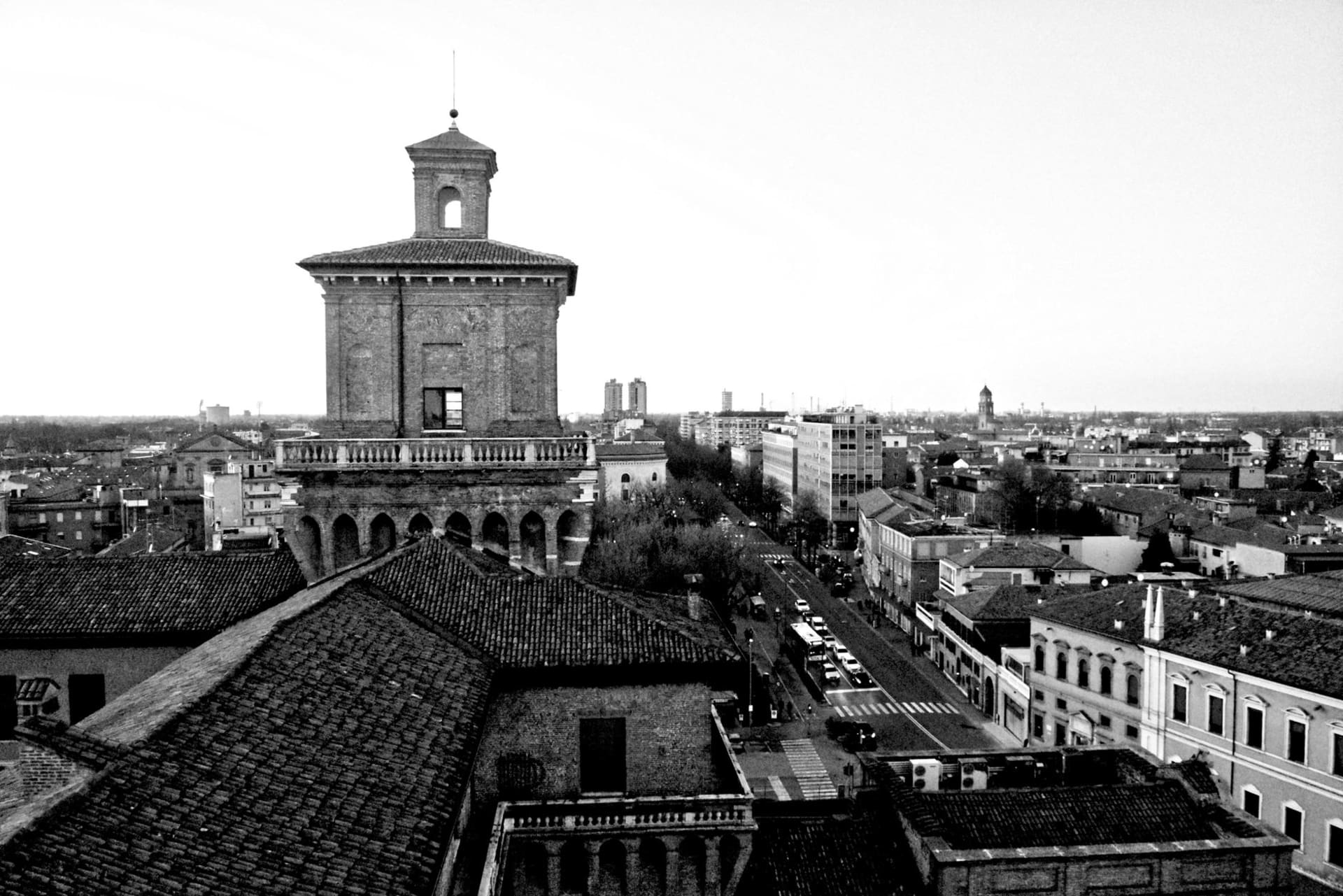
Ferrara
"Ferrara has no main attraction — it is the attraction, the whole city, all of it."
The fog was in when I arrived. November in the Po Valley produces a particular fog that doesn’t so much descend as accumulate — it rises from the flat land and settles into the medieval streets and makes everything feel simultaneously ancient and slightly theatrical, as though the Renaissance were being performed rather than remembered. I walked from the train station through the old Jewish Ghetto — a compact network of alleys where the stones run right to the edges of the narrow pavements — and emerged into the Piazza delle Erbe to find the castle floating in mist above its moat, perfectly, almost absurdly composed.
The Castello Estense is the Este family’s fortress, begun in 1385 after a popular revolt convinced the ruling duke that a moat was a sensible investment in political stability. The Este were one of the great Renaissance courts — patrons of Ariosto, of Tasso, of some of the finest manuscript illustration in Italy — and their castle reflects that strange combination of military pragmatism and courtly extravagance that the fifteenth and sixteenth centuries perfected. I paid the entrance fee, crossed the drawbridge, and spent two hours in rooms where the frescoes have mostly faded but the structure tells the story clearly enough: a family that needed to be defended and intended to be admired simultaneously.

What makes Ferrara remarkable, though, is not any single monument but the coherence of the whole. The Addizione Erculea — the northern extension of the city planned by Biagio Rossetti in the 1490s, commissioned by Duke Ercole I — is considered the first planned urban extension of the Renaissance. Wide, straight avenues, rational city blocks, palaces set back from the road: a vision of orderly civic life that was radical at the time and still reads, five hundred years later, as unusually livable. The streets of the Addizione are quiet in a way that medieval city centres rarely are, the architecture stately without being oppressive. I rented a bicycle — everyone in Ferrara has a bicycle, the city is entirely flat and perfectly suited for it — and spent an afternoon riding through streets where I encountered almost no other tourists.
The local pasta is cappellacci di zucca — pumpkin-filled pasta that looks like a larger, softer tortellino, dressed simply with butter and sage. In Ferrara they will tell you, with some heat, that it is nothing like the Mantua version. They are right. The pumpkin here is mixed with mostarda and Parmigiano and has a complexity that the buttery dressing barely masks. I ate it at a restaurant on Corso Giovecca and thought about the fact that a forty-kilometre distance across the Po plain produces a fundamentally different dish and a passionate argument about which is correct.

The synagogues — there are five of them, from different communities, tucked into the ghetto — are open to visitors and contain a museum of Jewish history in the Po Valley that is unexpectedly moving. Ferrara’s Jewish community was one of the largest in Renaissance Italy and produced, among others, Giorgio Bassani, whose novel The Garden of the Finzi-Continis is the finest literary account of the city. I reread sections of it that evening in my hotel room and looked out the window at the fog and the castle’s lit towers and felt the particular melancholy that comes from understanding a place’s history fully.
When to go: Spring — late April through May — when the fog has lifted and the countryside around the city turns green. October and November are atmospheric but cold. Ferrara draws almost no crowds year-round, which means it is genuinely good in every season.