Brisighella
"There are maybe six tourists here on a Tuesday in October. This is not a failure of marketing — it is a success of location."
I found Brisighella the way you find the best places in Italy: not by looking for them, but by following a road that seemed to lead somewhere interesting and eventually stopping because there was nowhere better to go. A friend in Bologna had mentioned it in passing — “there’s a village in the Lamone valley with three rocks, you should see it” — and I’d filed it away and then remembered it on a Tuesday in late October when I needed somewhere to be that wasn’t Bologna or Faenza or anywhere on the tourist map.
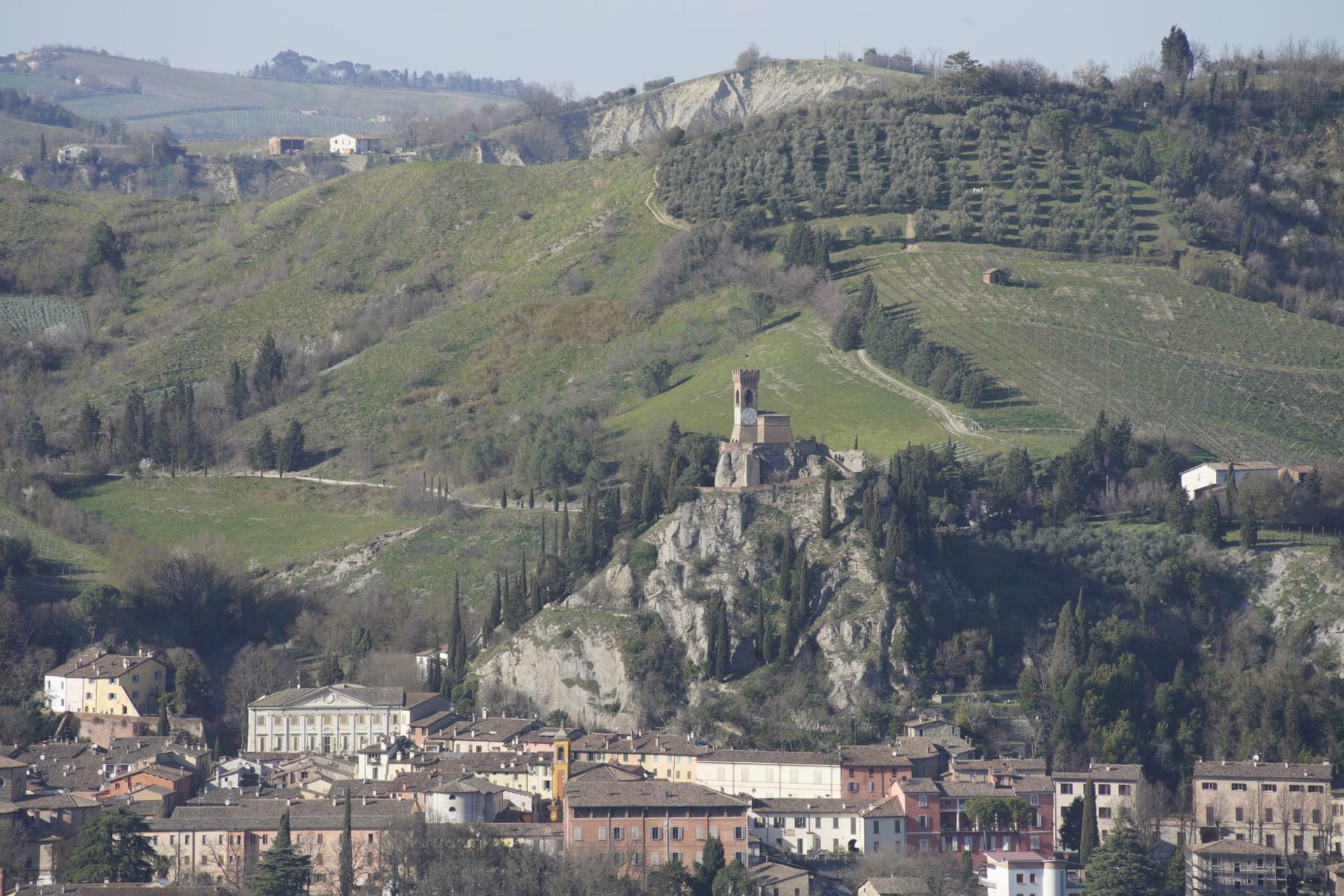
The three rocks are the thing. Three distinctive pinnacles of gypsum rise separately from the valley floor, and on each one something has been built: a medieval fortress on the highest, a sanctuary of the Madonna on the second, a clock tower on the third. The village clusters below and between them, and from any angle you look at Brisighella it presents this arrangement — three punctuation marks in stone above a terracotta-roofed village — as though it were assembled for a painting rather than habitation. I walked up to the clock tower first, along a Via degli Asini — the donkey road, a covered walkway with arched windows overlooking the valley, used historically for sheltering animals and goods — and emerged at the top with the valley spread below me and the Apennines going green and complicated into the distance.

The olive oil is the other reason to come. The Lamone valley produces a DOP olive oil — Brisighella DOP — that is distinguished by its low acidity and a flavour that sits somewhere between fresh-cut grass and almond. The olives are harvested in November, earlier than most Italian varieties, when they are still green and the oil is at its most assertive. I visited a small producer outside the village on the afternoon I arrived, and the owner opened a jar of oil from the previous harvest and drizzled it over a piece of bread without ceremony. It tasted like everything you want olive oil to taste like: bright, peppery, specific. She had about a hundred trees. She wasn’t interested in scaling up. The local cooperative handles larger production for the DOP, but many of the best bottles come from operations like hers, sold from farmhouse doors.
There are almost no tourists. This is not because Brisighella lacks things to see — the medieval fortress is genuinely interesting, the Pieve del Thò is a ninth-century church in the valley floor that predates the village itself, and the village streetscape has been preserved with the care that UNESCO recognition sometimes produces (it is a Borghi più belli d’Italia, one of the most beautiful villages in Italy). It is because Brisighella requires effort to reach without a car, sits forty minutes from Faenza on a regional bus that runs twice daily, and hasn’t been discovered by the kind of travel writing that creates queues. I ate dinner at the only restaurant that appeared to be open — lamb chops with rosemary, a plate of local mushrooms, a carafe of red from the Sangiovese vineyards above — and shared the dining room with three other tables of Italians, all of them locals.

Walking back to my guesthouse after dinner, the village was entirely quiet. No music, no passing cars, no voices. The clock tower on its rock was lit from below. The moon was up over the Apennines. I stood in the street for a while and listened to nothing at all.
When to go: Late October through November for the olive harvest — some producers welcome visitors, and the sagra of the local oil runs in mid-November. April and May bring green hills and good walking weather. Avoid peak summer if you prefer having the place to yourself, which is to say: most of the year is good.