
Bahía de Jiquilisco
"The mangroves at Jiquilisco don't perform for you. You have to go quiet and let them work."
El Salvador's largest mangrove estuary, where oyster fishermen work tidal channels that also happen to be a Ramsar-protected turtle nursery.
I found a fisherman named Don Chepe at the dock in Puerto El Triunfo who agreed, for a modest price and considerable patience with my Spanish, to take me out into the Bahía de Jiquilisco in his wooden canoe. We left before seven, the water still glassy, and within minutes the open bay narrowed into a maze of mangrove channels so tight in places that branches brushed both sides of the boat. This is the largest mangrove estuary in El Salvador, a tangle of red and white mangrove stretching across a Ramsar wetland site big enough that Don Chepe still, after decades, occasionally takes a wrong channel.
The bay does double duty in a way I hadn’t appreciated before going: it’s a working estuary, supporting fishing and oyster-farming communities who’ve lived off these waters for generations, and it’s also one of the country’s most important refuges for wildlife, including nesting sea turtles on the outer beaches. Don Chepe’s cousin runs an oyster operation on ropes strung between mangrove roots near Isla de Méndez, and we stopped there so he could haul up a cluster, crack one open on the spot, and hand it to me raw with a squeeze of lime he kept in his shirt pocket for exactly this purpose.
Life in the channels
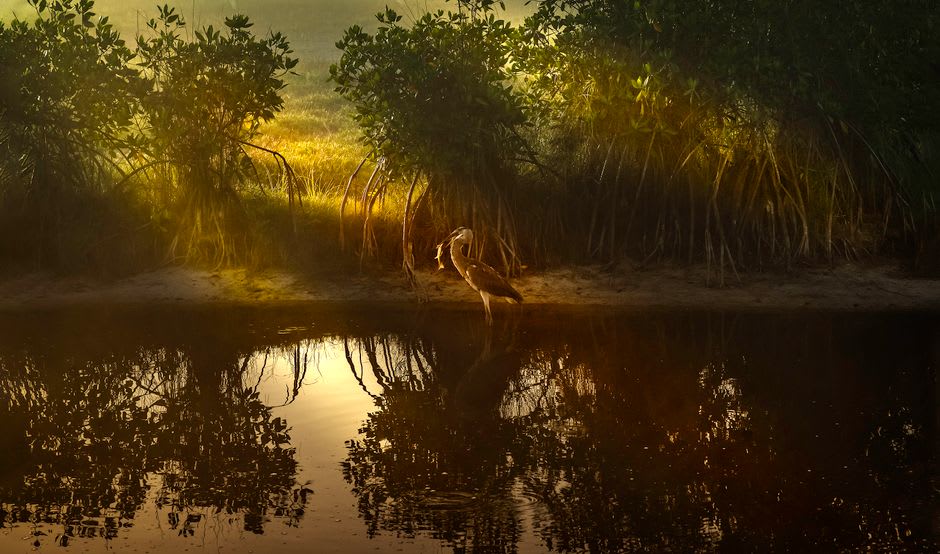
What struck me most was the density of small, specific livelihoods packed into this one estuary. We passed women in another canoe collecting curil, a black clam dug by hand from the mud at low tide, their hands moving with the practiced speed of people who’ve done this since childhood. A heron stood motionless in the shallows for so long I assumed it was a decoy until it struck, impossibly fast, and came up with a small fish. Don Chepe cut the engine at one point and just let us drift, the only sound the water lapping against mangrove roots and, somewhere off in the channel, an unseen bird making a sound like a rusty hinge.
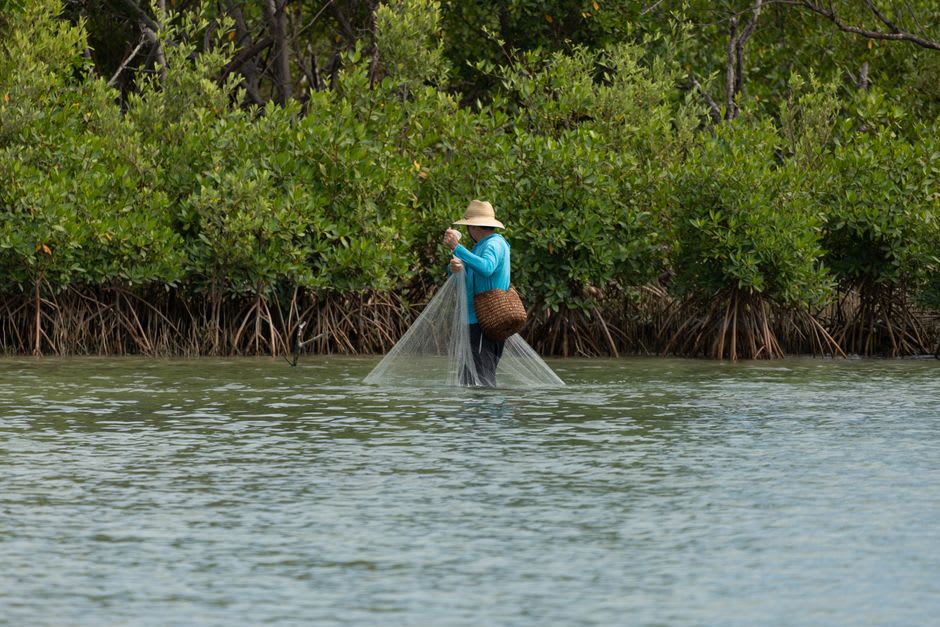
Toward Isla de Méndez, the channel opened onto a beach where Don Chepe told me turtles come ashore at night between certain months to lay their eggs, and where a local conservation group patrols to protect the nests from poachers as much as from the tide. We didn’t see any turtles — wrong time of day, wrong season for the peak of it — but the sand was marked in places with the kind of roped-off patches that told the story anyway.
We came back into Puerto El Triunfo around midday, the heat properly up by then, and Don Chepe’s wife had a pot of soup made from the morning’s catch waiting at their house. I ate it sitting on a plastic stool at the edge of the water, watching the same channel we’d just come out of, now busy with other boats starting their own version of the same day.
When to go: Dry season (November to April) for the calmest water and easiest boat access; visit August through November if sea turtle nesting is the priority, and go through a local guide or conservation group rather than independently.