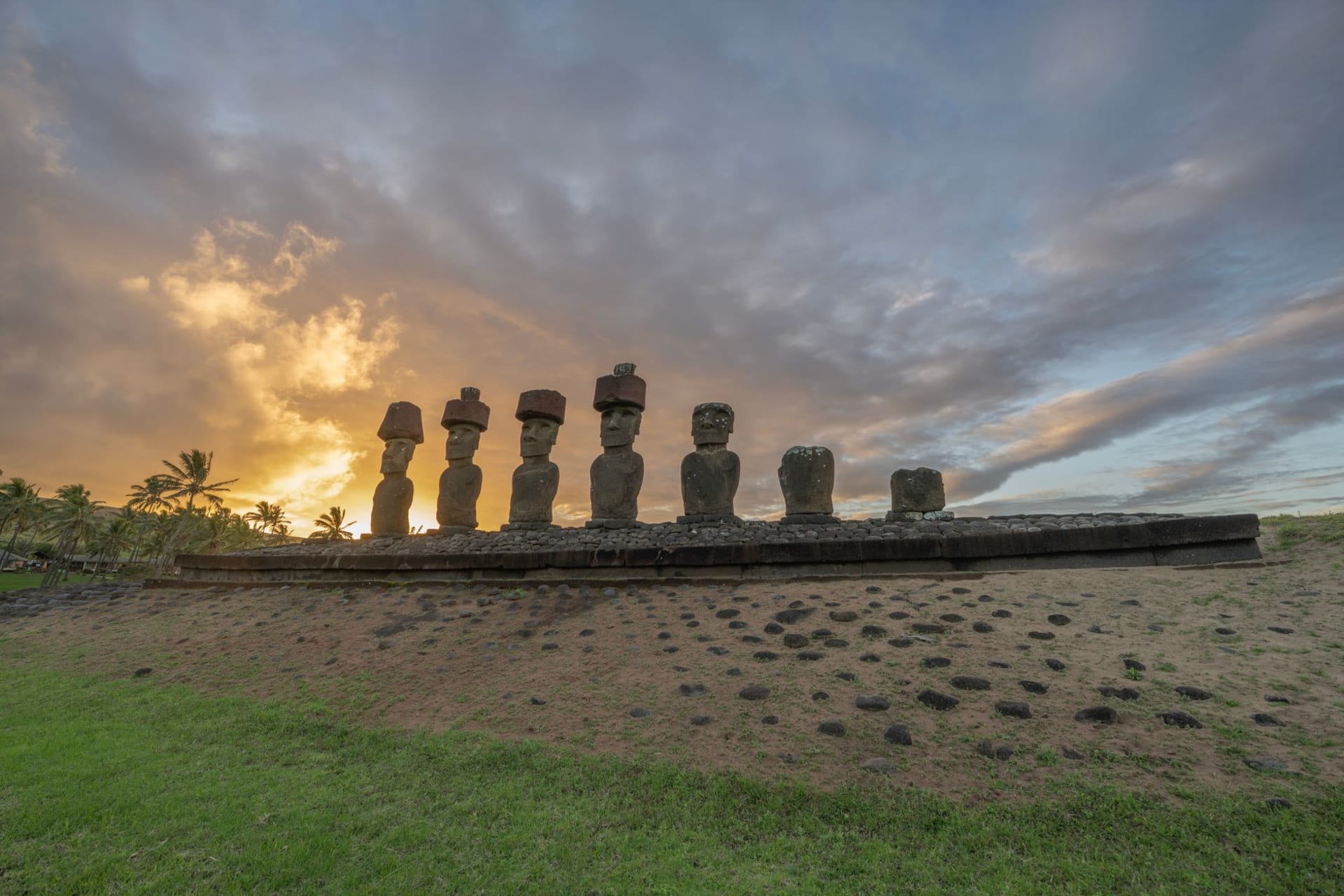
Ahu Vinapu
"The stones fit so perfectly that I put my hand flat against the wall and couldn't feel a single joint."
Near the southern end of the island, not far from the airport runway, two ceremonial platforms sit side by side in a field that feels less dramatic than much of Easter Island — no commanding cliff views, no obvious stage-setting. Ahu Vinapu doesn’t announce itself. You come off the road, walk across some grass, and there is the wall. It takes a moment to understand why you’re supposed to care.
Then you get close enough to see the stonework.
The main wall of Ahu Vinapu 1 is made of precisely fitted basalt slabs, worked to a smoothness and jointed with an accuracy that looks, unmistakably, like the mortarless stone construction found in the Incan monuments of Peru. This is not a casual resemblance. Thor Heyerdahl, the Norwegian explorer who sailed a balsa raft from Peru to Polynesia in 1947 to demonstrate the plausibility of contact, cited Ahu Vinapu specifically as evidence that Easter Island’s culture had South American roots. Mainstream archaeology has largely refuted Heyerdahl’s broader theory — the Rapanui are Polynesian, genetically and culturally — but the stonework here remains genuinely, puzzlingly exceptional. Most Easter Island construction used rough-fitted basalt; this is something else.
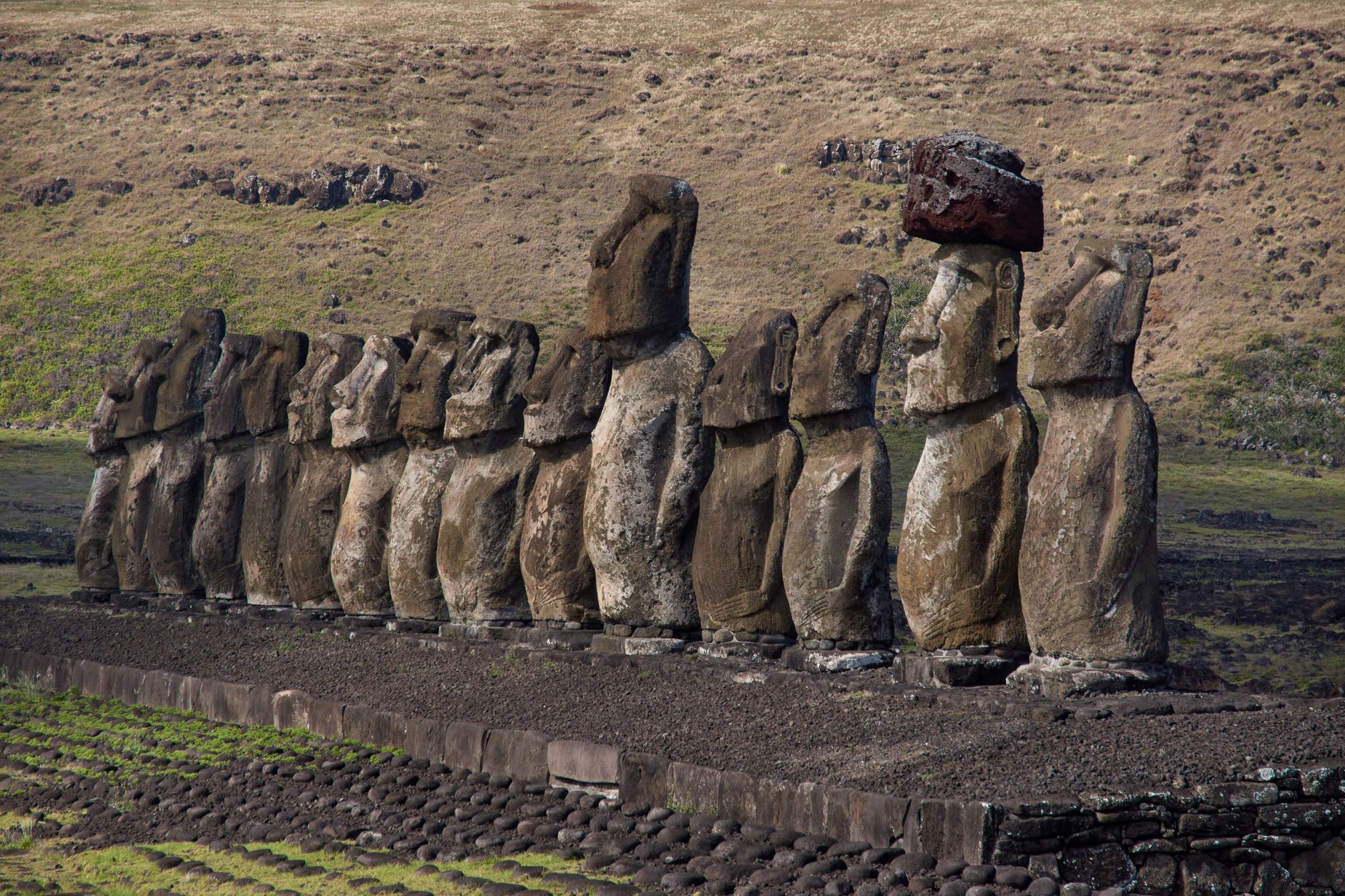
I put my hand flat against the wall. I couldn’t feel the joints. Some of these stones are enormous — you can see the sizes when you stand back, slabs two and three meters across — and yet they fit together with a precision that seems to belong to a different order of craftsmanship from what’s visible elsewhere on the island. Whether that reflects contact with South America, independent development of technique, or something more specific to this platform’s particular history remains genuinely unresolved. I found the unresolved-ness satisfying in a way that definitive answers rarely are.
Ahu Vinapu 2, next to it, is the later platform, less carefully built, its moai knocked face-down and unrestored. The contrast between the two is instructive: the earlier, better-made structure and the later one. There’s a narrative there about the acceleration of construction as the island’s resources depleted and the need became more urgent, or about changing priorities, or about something else entirely. I sat on a rock between the two platforms and thought about craftsmanship and urgency and what happens when communities run out of time.

The airport proximity is, admittedly, not the setting you’d choose. You can hear the occasional arrival while you’re standing there, which is a peculiar audio accompaniment to one of the island’s most archaeologically complex sites. But most planes arrive in the morning and the airport is quiet the rest of the day, and by mid-afternoon Ahu Vinapu is a peaceful, uncrowded, genuinely interesting place to spend an hour with your hand on an inexplicable wall.
When to go: Ahu Vinapu is included in the Rapa Nui National Park pass and is accessible by rental vehicle or bicycle from Hanga Roa (about 4 kilometers south along the coastal road). Morning and late afternoon give the best light on the stonework for seeing the joints — or rather for not seeing them. It’s often the least crowded major site on the island’s southern circuit, which adds to its appeal.