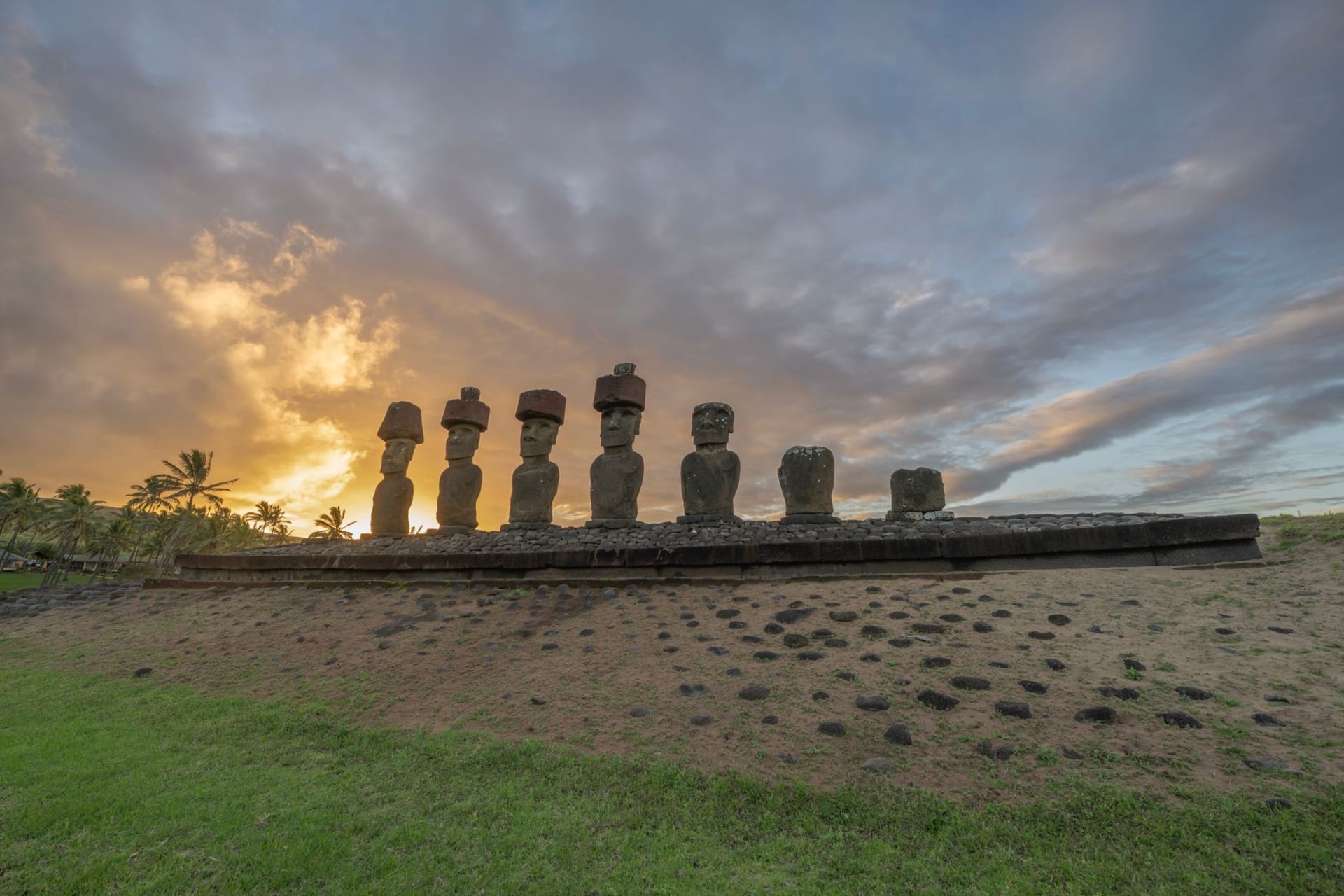
Ahu Akivi
"Every other moai on this island faces inland. These seven face the sea. That single fact makes them feel like something different entirely."
Every moai guide will tell you that moai face inland, watching over the communities that built them. It’s one of the first things you learn on Easter Island, and it becomes part of how you understand the statues: as protectors looking back over their people’s territory, backs to the water, indifferent to the ocean. Ahu Akivi breaks that pattern entirely, and I found that the break — seven moai standing in the grassy interior of the island, pointed west, facing the setting sun and the sea beyond — made these statues feel fundamentally different from all the others I’d seen.
The site sits inland, which is itself unusual for an ahu. Most ceremonial platforms were built near the coast. Ahu Akivi is several kilometers from the shore, in a relatively flat area of the island where the grass runs long and the wind moves through it in waves. When I arrived on a hired moped in the middle of the day, the light was flat and white, the kind that makes photography difficult and observation easy. I parked and walked across the grass and stood in front of the seven figures for a while, just looking.
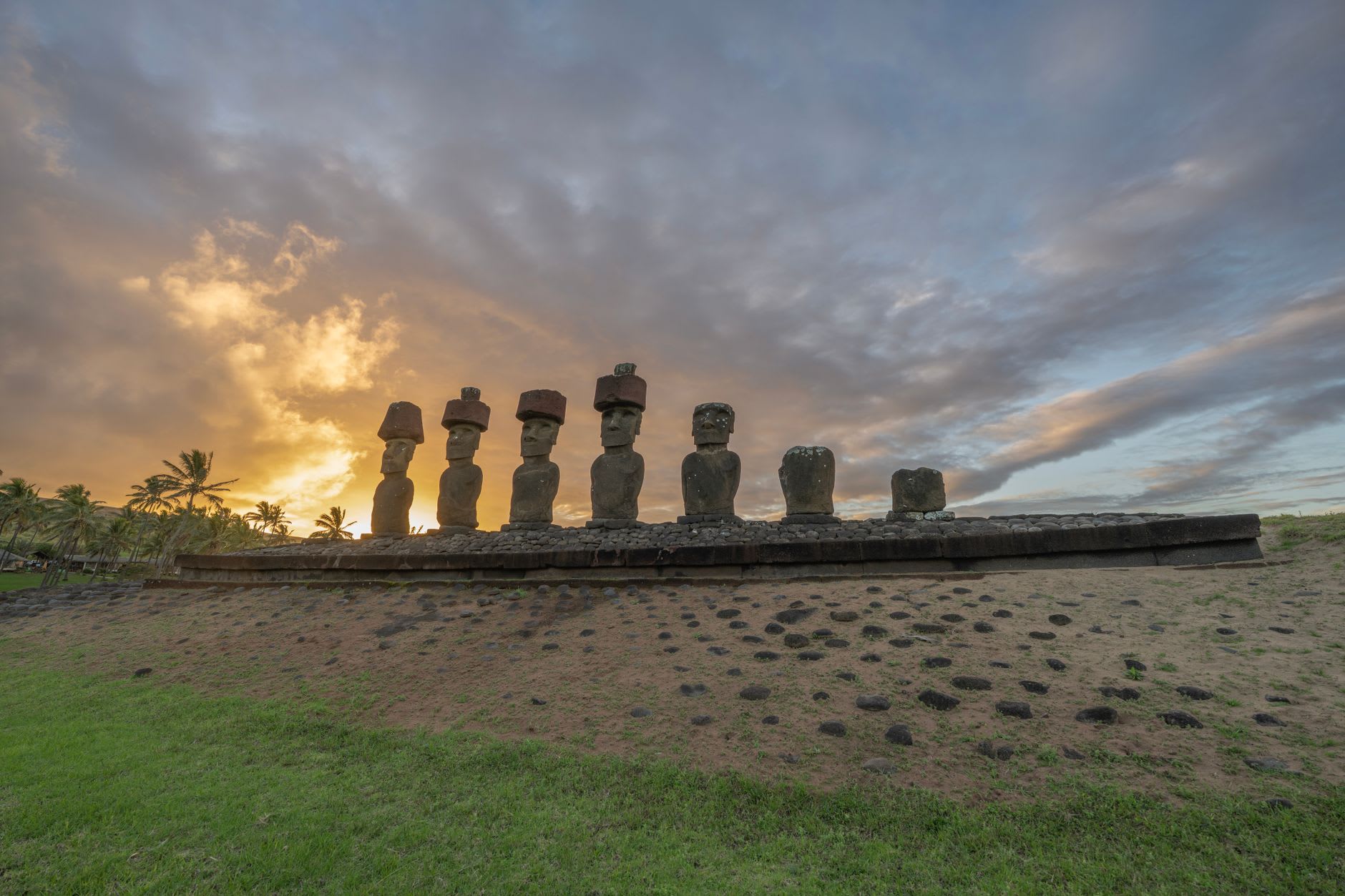
The Rapanui explanation for their orientation is that these seven moai represent the seven explorers sent out by the founding chief Hotu Matu’a before his people settled the island — scouts who traveled back in the direction they came from, perhaps eternally watching the route home. An astronomical interpretation also exists: the statues align with the setting sun at the equinox. Both things may be true simultaneously. The site was restored in 1960 by William Mulloy, who also restored Ahu Tahai, and it was the first ahu on Easter Island to be re-erected after the toppling — the beginning, in a sense, of the island’s long project of reconstruction.
What I noticed standing there was the silence. Or not silence exactly — the wind in the grass, a bird somewhere behind me — but a kind of distance from the island’s tourist infrastructure that Ahu Akivi, being inland and slightly harder to stumble onto, preserves. There were no other visitors for the better part of an hour. I sat on a rock about twenty meters back from the platform and ate the empanada I’d bought in Hanga Roa that morning, warm enough still from the paper bag. The statues faced the ocean. I faced the statues. The wind did its thing.
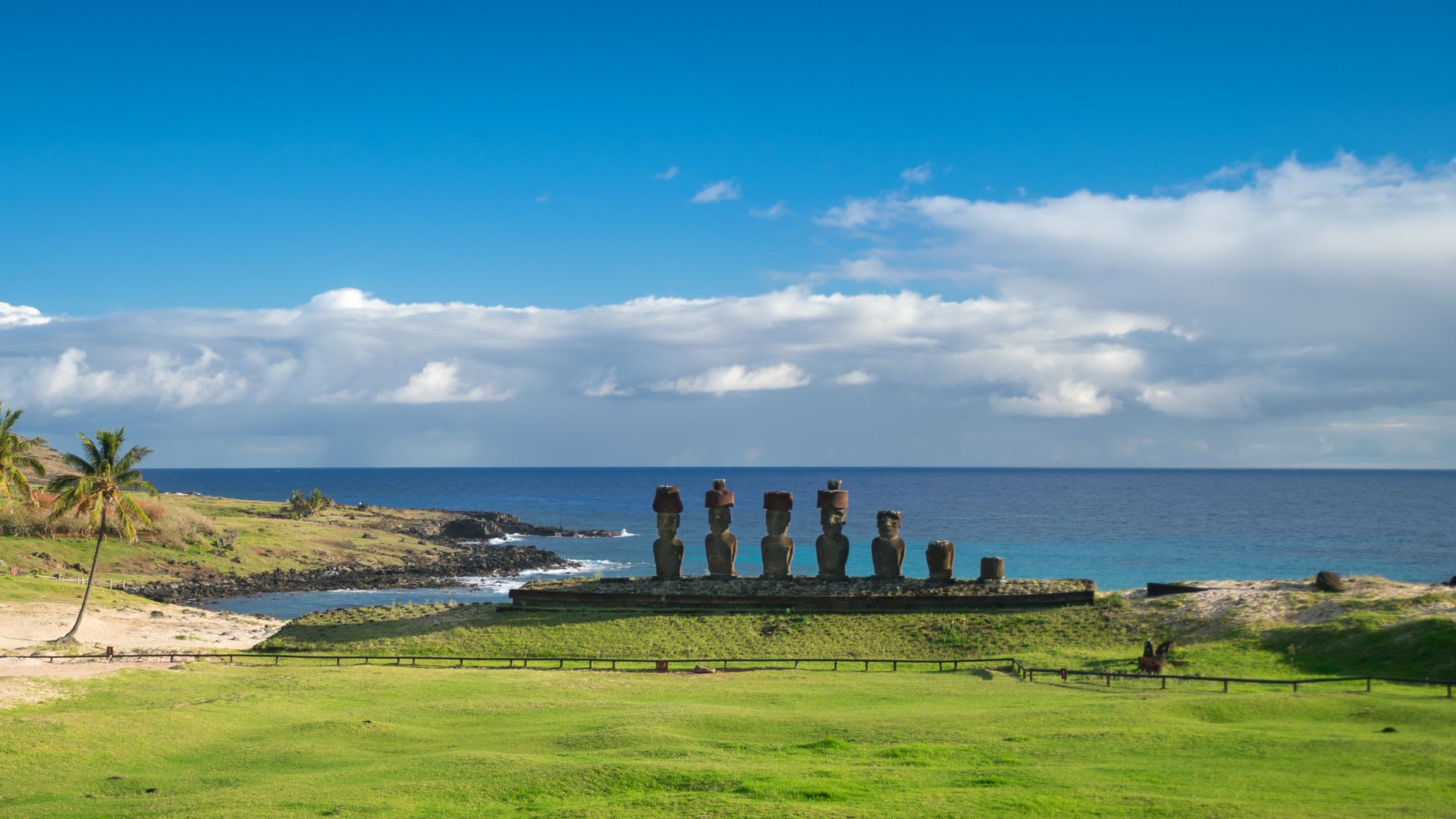
The moped ride back to Hanga Roa took me along the island’s interior roads, which are in varying states of condition and offer a different kind of Easter Island from the coastal circuit. You see the agricultural fields — the small plots of taro and sweet potato that Rapanui families still cultivate — and the domestic landscapes of the island, the parts that aren’t packaged for tourists. A woman hanging laundry. A dog sleeping in the middle of the road. The same wild horses I’d seen everywhere else, standing in a group in the shade of a few trees, looking at me with magnificent unconcern.
When to go: Ahu Akivi is accessible by moped, rental car, or bicycle from Hanga Roa (about 8 kilometers along reasonable roads). Equinox visits — March 21 and September 22 — are the most astronomically significant, as the statues align with the setting sun. Sunset is the best time generally, both for the light and because the westward-facing moai are fully illuminated as the sun descends. The site is included in the Rapa Nui National Park pass.