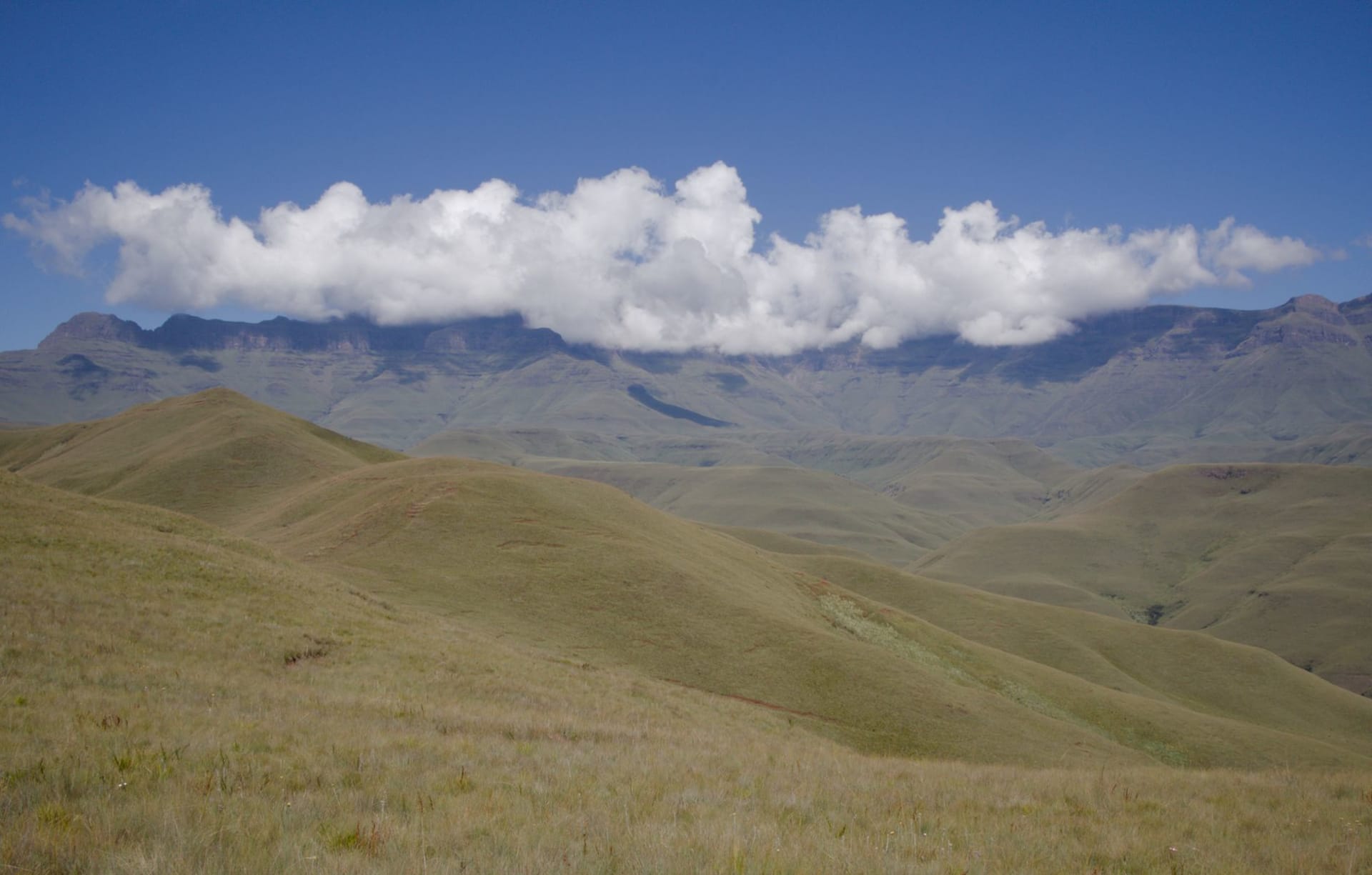
The road to Injisuthi turns to gravel twenty kilometres before the camp gate and gets no better. For the last stretch you are driving through a canyon of sugarcane and indigenous forest with the mountains visible occasionally above the ridgeline, and then the valley opens up and the scale of what’s ahead stops you. The escarpment at the head of the Injisuthi valley rises to over three thousand metres and dominates three full quadrants of the sky. The fourth quadrant is the way you came in. That enclosed, cupped quality — mountains on three sides, grassland valley floor, the Injisuthi stream threading through it — gives the place a quality I’ve only felt in a handful of locations: the sense that you have arrived somewhere that is genuinely separate from everywhere else.
Injisuthi sits in the central Drakensberg, technically part of the same conservation area as Giant’s Castle, but accessible only from the north via a completely different road that passes through private farmland. The result is that it receives a fraction of Giant’s Castle’s visitors despite offering hiking and scenery of comparable quality. The camp itself is small — a handful of chalets and a campsite beside the river — and on the three days I spent there in June I counted perhaps a dozen other guests in total. The silence in the evenings was complete in the way that altitude and remoteness combine to produce, not the absence of sound but the presence of a particular quality of air that makes urban noise seem like something that happens to other people.

The Battle Cave is Injisuthi’s signature San art site — an overhang at the head of a two-hour trail that shelters one of the most complex multi-figure compositions in the Drakensberg. The name comes from the Victorian-era interpretation of figures appearing to fight, though contemporary understanding suggests the scene is more likely a ritual gathering involving trance. Whatever it depicts, the density and preservation of the art here is extraordinary. Figures overlap across the cave ceiling in a palimpsest of painting styles from different eras, the oldest and most faded visible beneath newer work that is itself centuries old.
The hiking in the Injisuthi area is serious mountain country. The trail to the summit of Injisuthi Peak — at three thousand four hundred and ten metres, one of the highest in the range — requires a full long day and includes a chain ladder section and substantial scrambling near the top. The views from the summit ridge are an education in the scale of the southern Drakensberg: wave after wave of escarpment running north to south, the valleys between them green and unoccupied, Lesotho visible as a tawny plateau to the west. On the day I attempted it, cloud moved in from the plateau at noon and I retreated to the col below the summit, where I sat for an hour watching the cloud pour over the escarpment edge like slow white water.
The valley’s birdlife is among the richest in the Berg. Bearded vultures patrol the cliffs. Cape rock thrushes sing from every prominent boulder. In the forest patches along the stream, Gurney’s sugarbird — one of the protea-associated species endemic to this corner of Africa — moves through the flowering sugarbushes with a tail so long it seems like a design error.

The camp kitchen at Injisuthi sells basic provisions and firewood, and the camp manager produces hand-drawn trail maps that are more accurate than any digital alternative for this part of the Berg. In the evenings, the river gurgles over the stones and the mountains hold their colour until very late, and on cold winter nights the stars over the valley are the best argument for going off-grid I know.
When to go: May through August for clear summit days and manageable temperatures on the high trails. The Battle Cave trail is comfortable year-round. The valley road can become impassable in heavy summer rains — confirm conditions before visiting November through March. The camp is frequently full in school holidays; weekday visits in shoulder season are easiest.