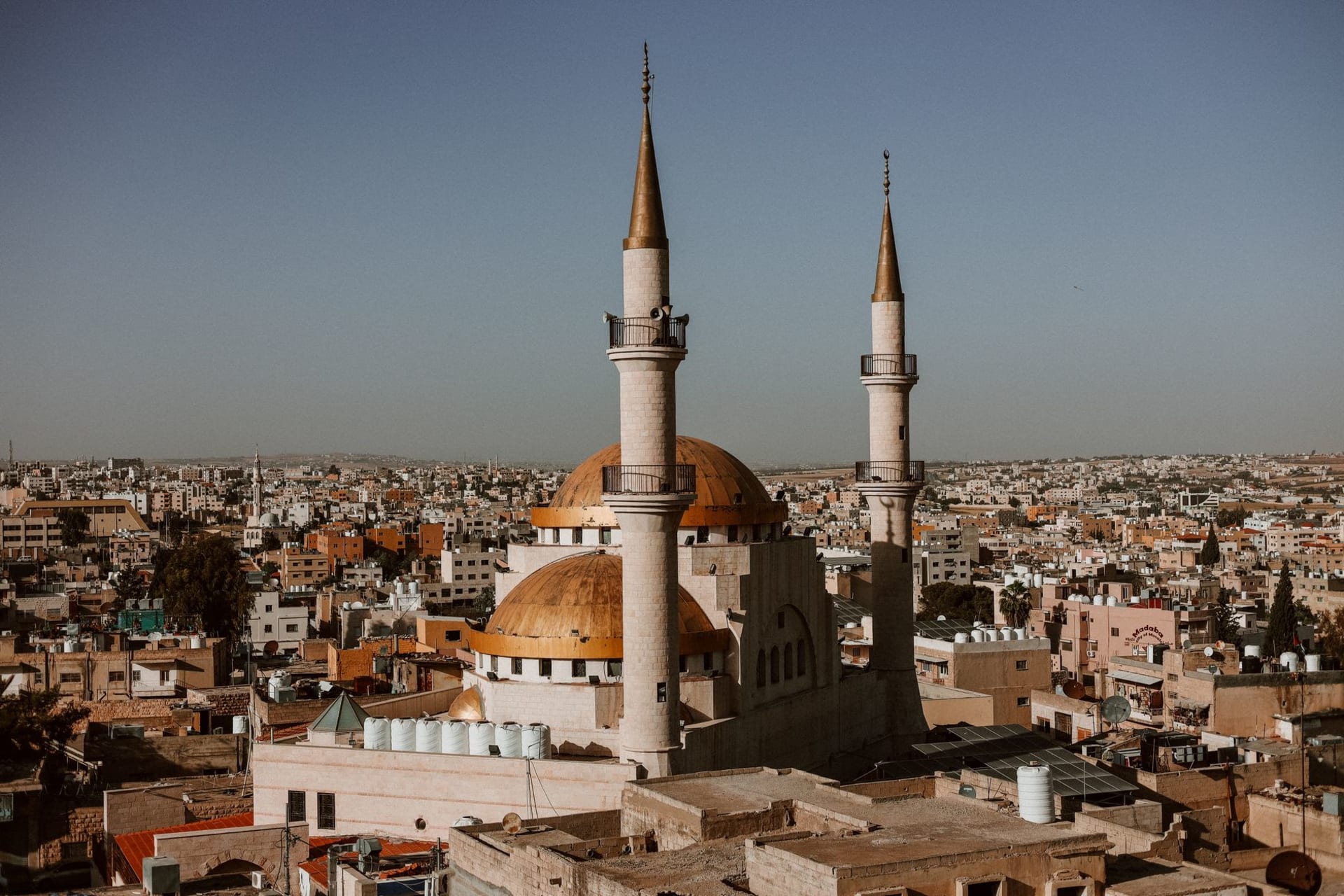
Madaba
"Six million tesserae assembled in the sixth century to say: here is where we are. I found that ambition strangely moving."
Madaba looks, from the highway, like every other mid-sized Jordanian city: concrete apartment blocks, satellite dishes, a main road clogged with traffic and the smell of diesel and flatbread. I almost didn’t stop. What changed my mind was the memory that the floor of a particular church here contains something extraordinary — not a painting, not a sculpture, but a map of the known Holy Land rendered in mosaic tiles, assembled by hand in the sixth century, and still largely intact under the feet of Sunday morning worshippers. I parked near the church, walked in off the street, and stood for a long time looking at the ground.

The mosaic map is not large — perhaps five by ten meters of the original remains, the rest lost to successive rebuildings — but what remains is dense with information. Fish swim in the Jordan River. Boats cross the Dead Sea. Jerusalem is rendered at the center of the composition with its colonnaded main street and major churches identifiable by their red roofs. Place names are written in Greek, the lingua franca of Byzantine Christianity. The tesserae are the size of a thumbnail and there are an estimated six million of them in the original map. Someone — a team of someones, working for years — sat on the floor of a church and placed each tile with a precision that survives fifteen centuries later. Standing above it, I kept thinking about that labor, that sustained act of geographic declaration.

The craft is still alive in Madaba. Workshops line several streets near the church, run by families who have been making mosaics for generations. I ducked into one that had its door open and watched a man in his fifties cutting stone with a small metal tool, placing fragments against a backing board with the relaxed accuracy of someone who has done this exact motion forty thousand times. The modern work ranges from kitsch souvenirs to genuinely fine reproductions of Byzantine designs. I bought nothing and stayed for twenty minutes watching him work. Dinner that evening at Haret Jdoudna, a restaurant complex built into restored old stone houses in the town center, involved lamb mansaf and bread still warm from the taboun oven, eaten in a courtyard under vines. Madaba is not Petra. It makes no dramatic demands on you. That understatedness is part of what I liked about it.
When to go: Year-round, though spring and autumn are most comfortable. The town is a practical overnight base for Mount Nebo, the King’s Highway, and the Dead Sea — all within thirty minutes’ drive. Avoid midday in July and August when the streets empty and everything bakes.