Observatory Hill
"A schoolgirl sprinted up the path, touched the temple threshold, turned around, and ran back down. She had done this every morning for years. The mountain didn't react."
Observatory Hill is the high point at the centre of Darjeeling, and the path to the Mahakal Temple at its summit runs through a population of rhesus macaques who have organized their lives around the fact that pilgrims bring offerings. The monkeys are not aggressive in any direct sense, but they have the focused attention of professional opportunists, and if you arrive with a bag of prasad — the sweet offerings sold at the stalls below the path — you will be assessed with the precision of experienced customs officers. I arrived empty-handed, which earned me a single glance of contempt from the largest monkey I have ever seen and thereafter complete indifference, which was fine with me.
The path is short — fifteen minutes from the upper Mall Road — but winds through a forest of rhododendron and deodar cedar strung with so many prayer flags that on a windy morning the sound is continuous: a full-spectrum fluttering that functions as ambient music. The flags are strung from tree to tree in multiple colours — white, yellow, red, green, blue — each colour a different prayer, and the older ones have faded until they are nearly the colour of sky and rain and almost indistinguishable from the mist that comes through on most mornings. The forest gets darker as you climb and then the summit clears and the light hits the temple courtyard all at once.

At the summit, the hill is shared in a way that feels specific to this part of the world. The Mahakal Temple — a Shaivite Hindu shrine to Shiva in his fierce form — sits alongside a Buddhist shrine, both of them draped with offerings, both tended by practitioners from their respective traditions who seem entirely untroubled by the shared real estate. The hill has been sacred since before either tradition formalized its claim, and whatever that earlier sanctity was, it seems to have been successfully transferred into the current arrangement without ceremony or negotiation.
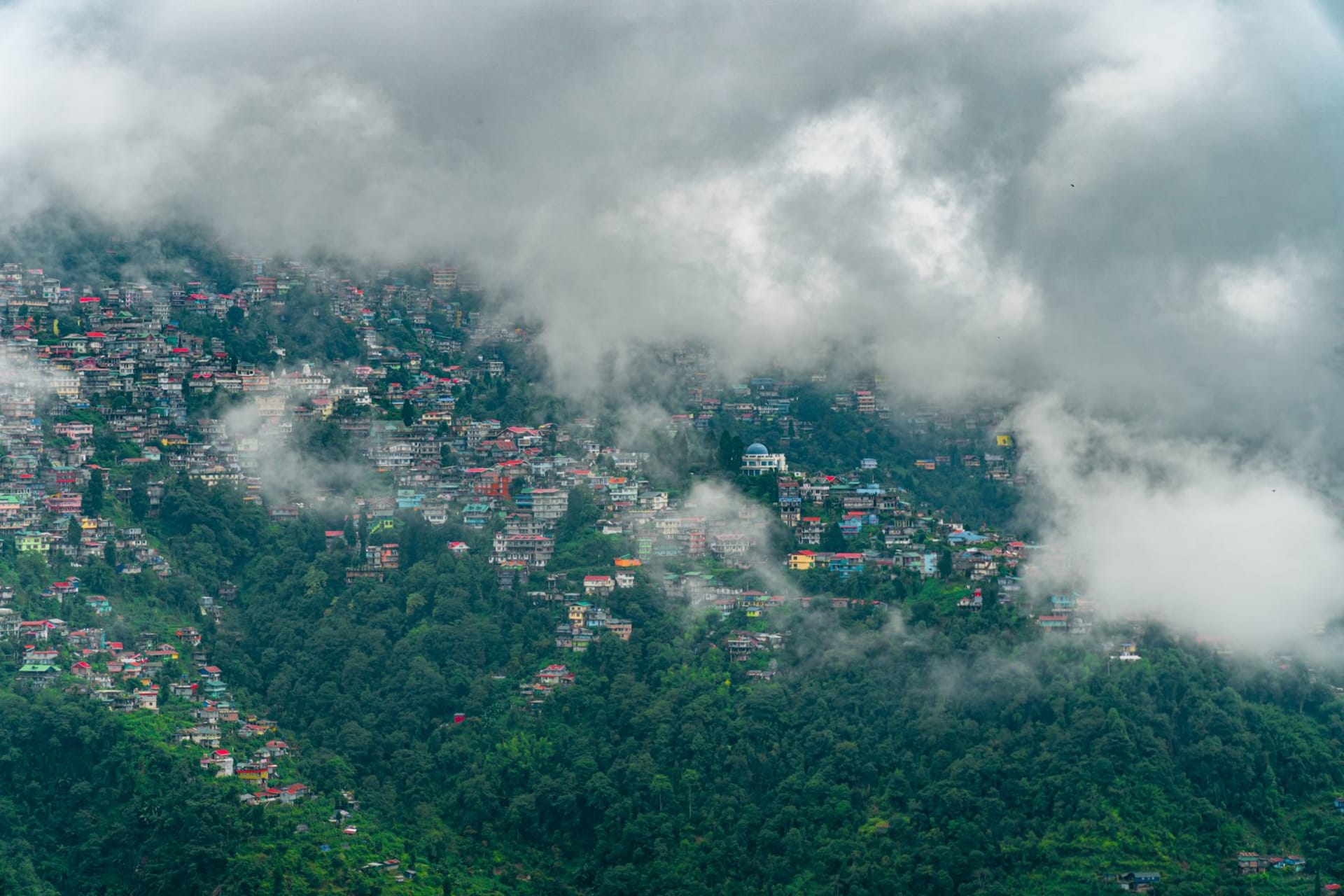
The view from the top extends over the whole of Darjeeling — the red-roofed buildings stepping down the ridge, the tea estates beginning at the lower slopes, and on clear mornings the unmistakable white mass of Kanchenjunga closing the northern horizon. I sat on the concrete steps of the viewing area for a long time, a chai from a thermos flask vendor warming my hands, watching the town go about its morning below me. A girl in school uniform climbed the path at full speed, touched the temple threshold, turned around, and ran back down. She had, I suspected, done the same thing every morning for years. The mountain did not react. The flags kept flying.

When to go: Observatory Hill can be visited on any morning of the year, though clear views of Kanchenjunga require October–November or April–May. Arrive before eight in the morning to catch the first light on the prayer flags and avoid the mid-morning tour group traffic. The macaques are most active — and most interested in your belongings — at dawn and dusk.