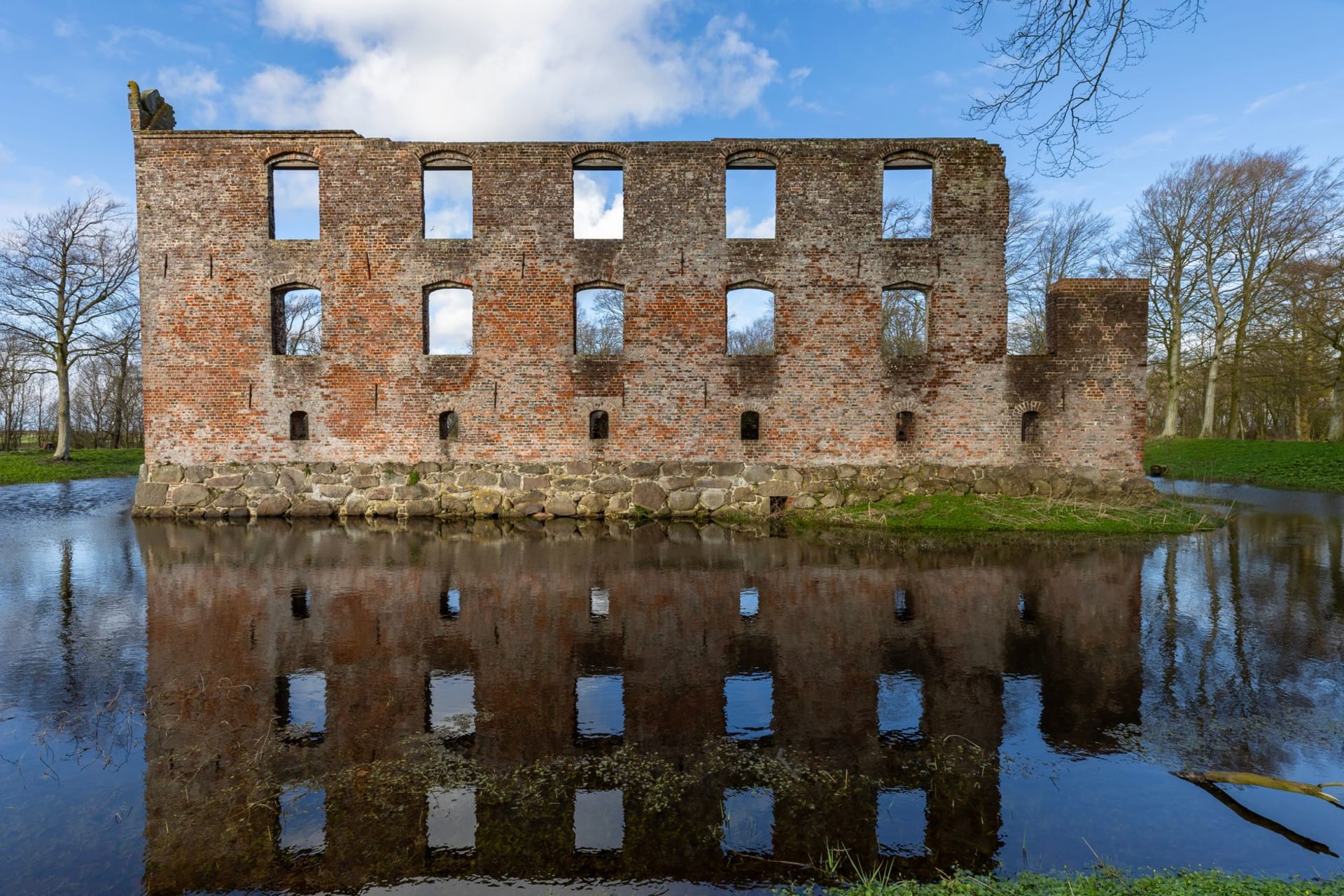
I arrived at Hammershus on foot, which is the right approach — the path from the village of Sandvig follows the cliff edge north and brings you to the fortress by way of a headland view that shows you the full scale of the thing before you’re in it. The ruin sits on a volcanic granite outcrop called Hammeren, rising forty meters above the Baltic, and from the headland path it appears in silhouette against the sea: towers, walls, gatehouse, all the bones of a military idea that was large enough once to matter. The jackdaws were audible before anything else — they nest in the towers and their calls ricochet off the stone in a way that makes the ruin sound inhabited, which in some useful sense it is.
Hammershus was built in the mid-thirteenth century, probably by the Archbishop of Lund, and expanded repeatedly over the following centuries until it became the largest castle complex in the Nordic countries. It controlled Bornholm’s politics, imprisoned political enemies — including the seventeenth-century court astronomer Leonora Christina, who spent twenty-two years of her life here for the crime of being married to a man accused of treason — and eventually became so expensive to maintain that the Danish state decommissioned it in 1743 and began systematically dismantling it for building materials. The local farmers who collected the dressed stone were practical men; the ruins we see now represent what proved too awkward or heavy to remove.

What remains is still considerable. The outer wall circuit is largely intact, the gatehouse stands to its full height in places, and the round tower called Manteltårnet rises above the cliff in a state of picturesque disintegration that makes it look more dramatic than it probably did when it was complete. The stone is Bornholm granite — pinkish-grey, coarse-grained, warm to the touch in the afternoon sun — and the contrast between its roughness and the wildflowers that grow from every crack gives the ruin a particular quality. Stonecrop and thyme colonise the wall tops. Elderflower blooms in the sheltered corners. I watched a wheatear hunting insects from the highest accessible section of wall for perhaps fifteen minutes, and the bird’s orange breast against the grey stone and the blue sea below it was the kind of thing that seems composed specifically for appreciation.
The descent from the fortress to the harbour at Hammerhavn below takes about twenty minutes and passes through a landscape that illustrates, with some compression, what the whole of the Hammeren headland looks like: rough granite heath, juniper scrub, the occasional rowan bent permanently sideways by the prevailing westerlies. Hammerhavn itself is a small protected cove where a handful of wooden fishing boats still operate and where the water is clear enough that you can see the sea floor from the quay. I ate open sandwiches at a picnic table and watched the herring gulls work the cove with their usual opportunism.

The visitor centre at Hammershus is tasteful and informative without being overbearing — a genuine achievement for a site that attracts around four hundred thousand visitors a year. The presentation of the fortress’s history is clear-headed about the violence and political machinations involved, which I appreciated. Most of the exhibition is underground, so as not to impose itself on the landscape. The architects understood that the ruin itself was doing the main work.
When to go: May and September are the quietest months with the most atmospheric light. July is the most crowded but the fortress is large enough to absorb the numbers — if you arrive early (before nine) you’ll often have the walls almost to yourself before the tour groups appear. The cliff path from Sandvig is open year-round; the winter walk is cold but the fortress in grey light and empty of people is genuinely something.