Makarska
"The mountain and the sea are fifty meters apart here — I never knew that was possible."
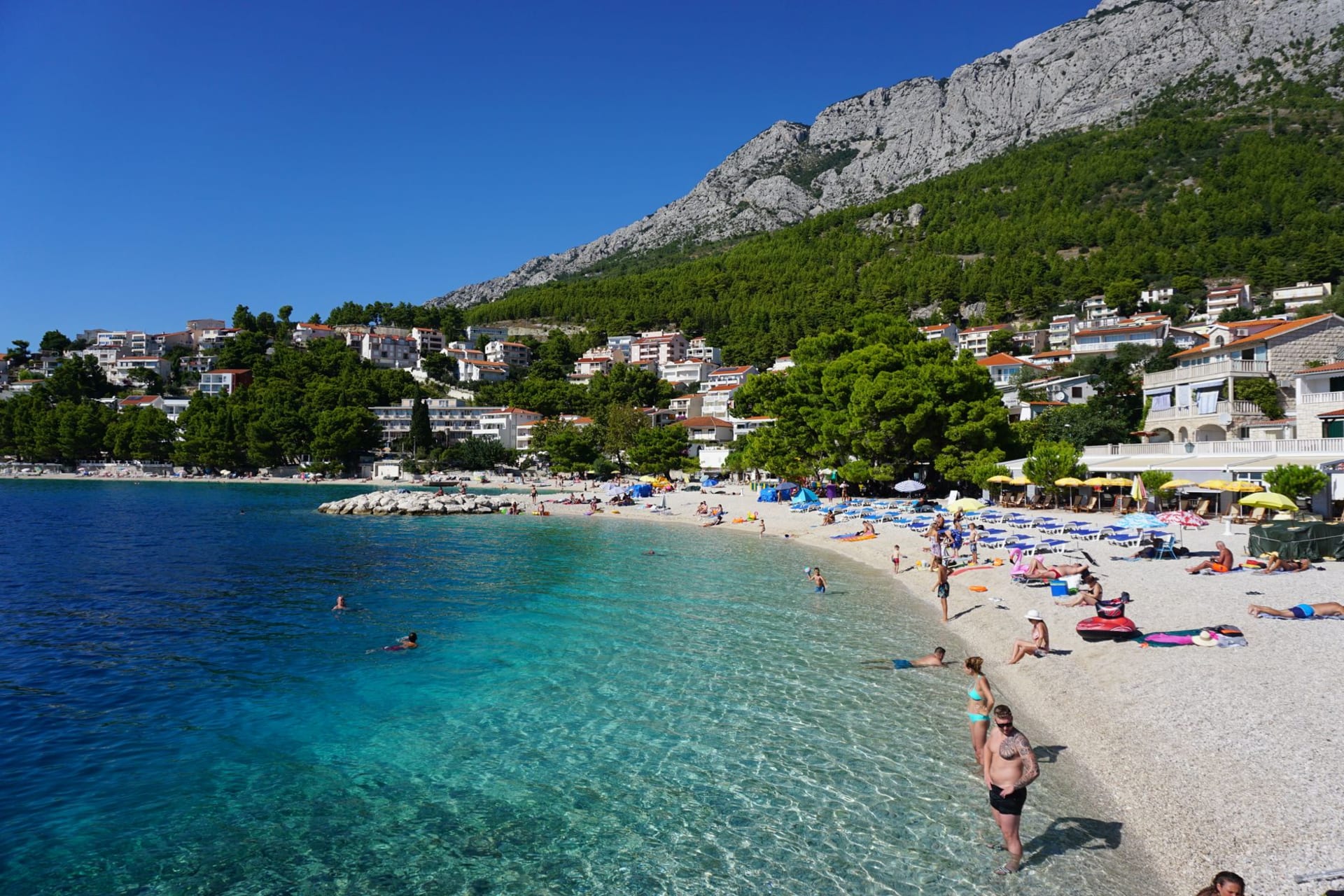
The Biokovo massif drops almost directly into the Adriatic at Makarska, and the result is one of the most visually dramatic settings on the Dalmatian coast. The mountain rises nearly two thousand meters in the space of just a few kilometers, and when you are swimming off the Makarska beaches on a clear day you can look up at the limestone face and see patches of snow in the higher gorges well into April. The town itself — a proper town, with a daily market, a tree-lined main square, a fishing fleet that goes out each night regardless of the tourist season — sits at the foot of this wall of rock, partly sheltered by it, warm when the rest of the coast is still pulling on sweaters. I arrived in early May, when the beach was almost empty and the water was cold enough to feel like an achievement, and spent the first afternoon oscillating between the sea and a café table under the pines on the waterfront, watching the mountain change color as the light moved.

I had come intending Makarska as a base for the Biokovo Nature Park above, and ended up staying four days longer than planned. The path from the town to the Sveti Jure summit — at 1,762 meters the highest point of the Biokovo range — is a serious day’s walk that rewards the effort with views of the entire Dalmatian coast from Split to the Elafiti Islands south of Dubrovnik, the sea laid out below you like a map you have finally learned to read. The interior of the range has abandoned villages, sinkholes, and a quality of silence that is genuinely difficult to find on the coast in summer. You pass from sea-level tourism to something closer to wilderness in the space of an hour’s walking, and the transition is abrupt enough to feel like a different country.
The Makarska Riviera — the stretch of coast from Brela in the north to Gradac in the south — is one of the most beach-dense sections of the Dalmatian coast, and it has the honesty not to pretend it is something other than what it is: pebble beaches, clear water, summer crowds, well-organized infrastructure. Brela, a few kilometers north, has a village center that predates the tourism by several centuries and a coastal path lined with old Aleppo pines that smells of resin and salt simultaneously. The beach at Punta Rata below Brela is one of the most photographed in Croatia — a curved spit of white pebble with a small rock sitting in the water offshore — genuinely beautiful in the way that certain beaches are, without requiring any argument on their behalf.

The evening routine in Makarska involves the waterfront promenade and a degree of social performance that feels different from the more self-conscious resort scenes further south. These are Croatian families on holiday as much as foreign visitors, and the local dialect and local plavac mali wine are both on prominent display. The fish restaurants opening onto the harbour do not go to great lengths to distinguish themselves from each other, which means you can choose based on wherever a table is available and generally eat well regardless.
When to go: May and June are the sweet spot — warm enough to swim, the summer crowds have not yet arrived, and the Biokovo trails are at their most walkable before the heat makes the upper sections uncomfortable. September into early October is equally good, and the mountain views are sharpest in autumn when the haze clears. July and August work well if you are specifically after a summer beach experience; less so if you are not.