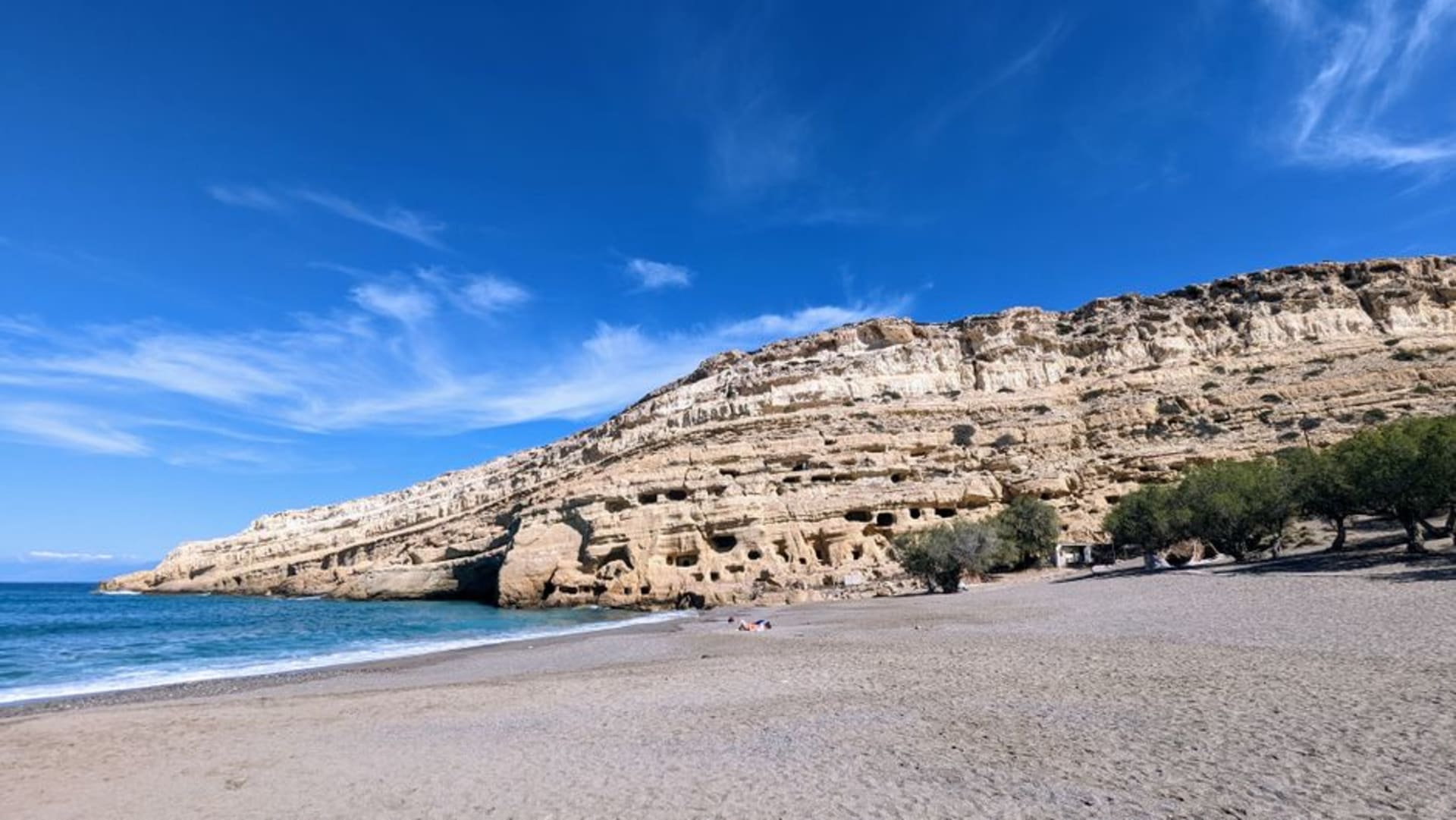
Matala
"I sat in a tomb carved two thousand years ago and understood exactly why nobody wanted to leave."
A crescent of sand under cliffs pocked with ancient tombs turned hippie caves, where Joni Mitchell once slept and the Aegean still hums with that old freedom.
We drove down from Heraklion with the windows open, the road unspooling through the Messara plain until it dropped, almost without warning, into Matala. Lia spotted the cliffs first — she just said “oh” and pointed, and I nearly missed the turn. The bay curves in a tight gold crescent, and the whole southern wall of it is punched through with dark, square-mouthed caves, dozens of them, stacked up the sandstone like an apartment block someone had carved with hand tools instead of concrete. I’d read that they started as Roman-era tombs, but nothing prepares you for how deliberately inhabited they still look.
We paid the small entrance fee to walk the fenced archaeological site and climbed up into a few of the caves — cool, low-ceilinged, smelling faintly of salt and dust. One had a rough shelf carved into the rock that I could easily picture someone using as a bed, a sleeping bag, a candle stub. That’s the strange pull of Matala: you’re standing in a burial chamber and thinking about the 1969 crowd who slept there instead, Joni Mitchell among them, before she wrote “Carey” with this exact bay somewhere behind the words.
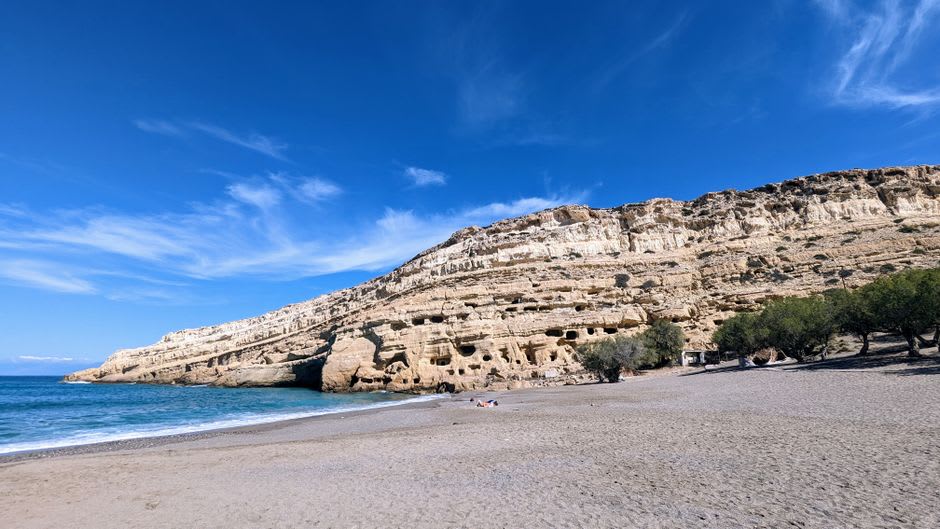
We ate lunch at a taverna right on the sand — grilled octopus, a carafe of the cloudy local wine, Lia’s espresso going cold because she wouldn’t stop looking up at the caves while we talked. I told her about the eviction in 1970, how the authorities eventually cleared the community out, and she said it made the place feel less like a museum and more like a story that had simply paused. That’s the thing about Matala now: the counterculture is gone, but the shape of it — literally carved into the rock — is still right there above the beach umbrellas.
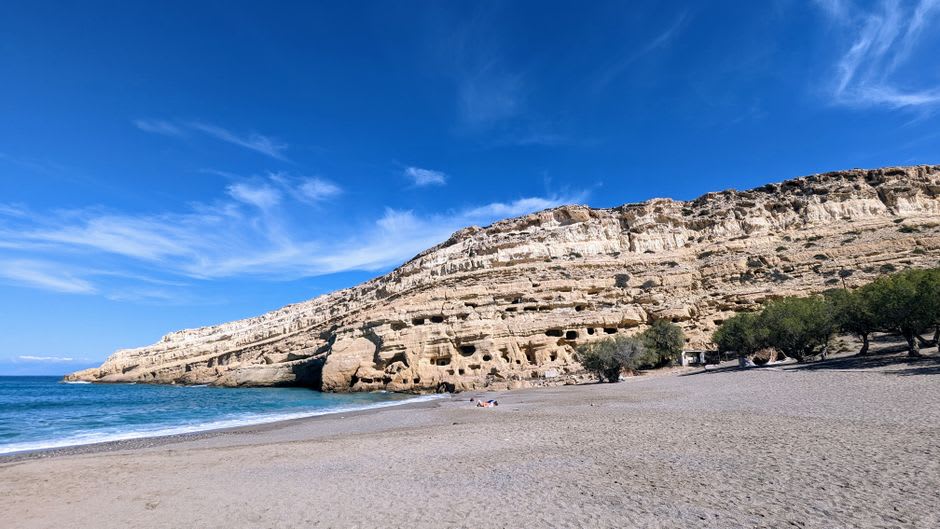
By late afternoon the day-trippers had thinned out and we swam past the buoys, floating on our backs looking up at those black cave mouths catching the last light. It’s a small place — you can walk the whole village in twenty minutes — but I’ve rarely felt a stretch of coastline hold that much layered history in so little space.
When to go: We went in early October and had the beach nearly to ourselves — the water was still warm enough for a long swim, and the caves without the midday crush felt properly quiet. Late May works just as well if you’d rather beat the heat; either way, skip the height of summer.