Northleach
"The barman in Northleach told me the cellar floods every winter from a stream no one can find. I believed him immediately."
The ploughman’s lunch that appears in my memory of the Cotswolds always happens in Northleach. Not because it was the only one — I ate probably four ploughman’s lunches in the region — but because the barman at the Wheatsheaf had clearly decided that telling me about the underground stream beneath the pub’s cellar was more important than pulling my pint, and he was right. The stream, he said, floods the cellar every winter around December, reliably and inexplicably — the pub has tried twice to locate its source and failed both times. The beer itself, when it eventually arrived, was a Hook Norton bitter, cold and slightly earthy and exactly what the story required.
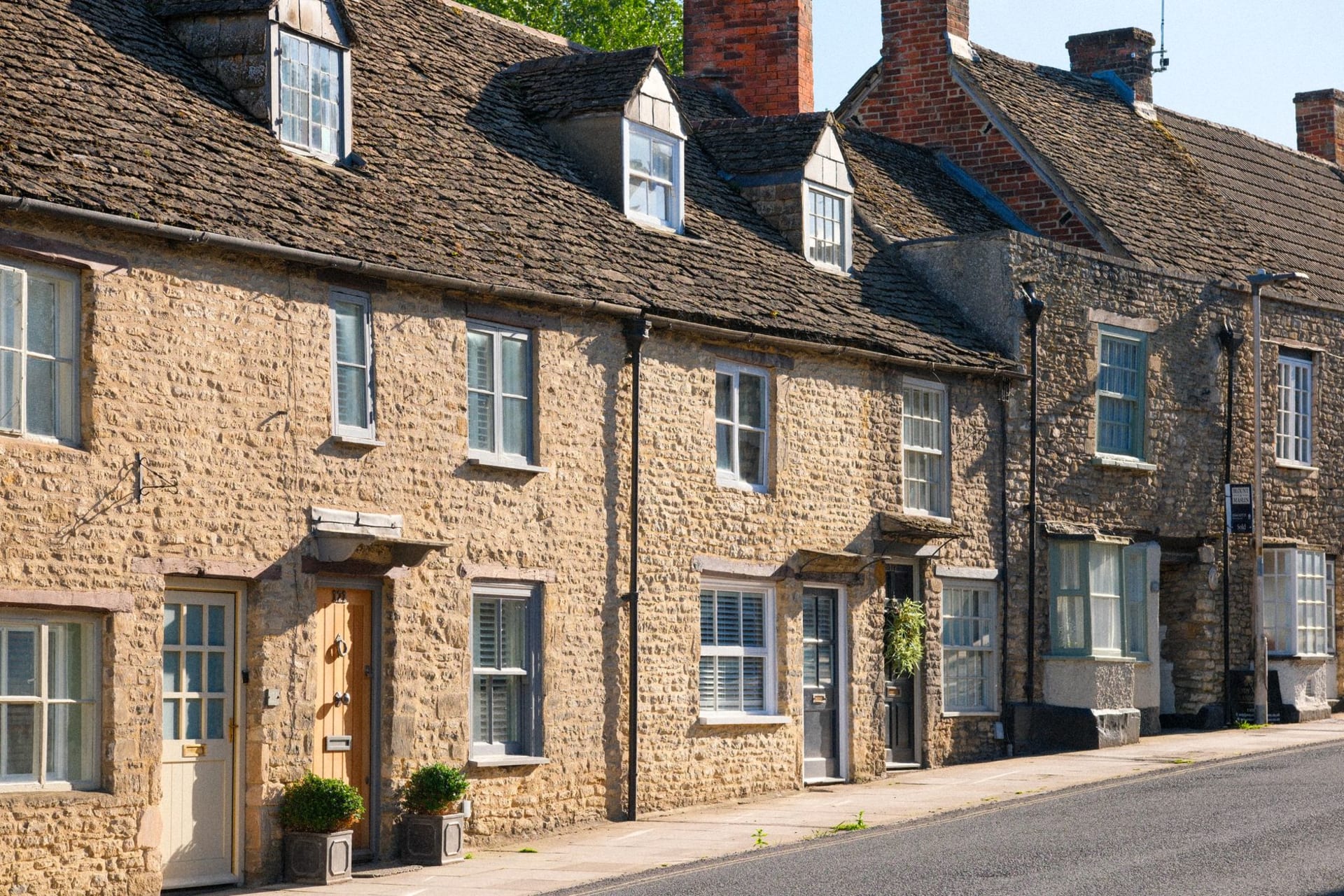
Northleach sits at the geographical heart of the Cotswolds and absorbs almost no tourist attention, which is such a significant error on the part of visitors that I feel personally aggrieved about it. The market square is small and human-scaled, the houses around it a good cross-section of six hundred years of Cotswold building, and the whole thing is overlooked by the tower of the Church of St Peter and Paul, which is one of the finest wool churches in England and significantly less visited than the comparable churches at Chipping Campden or Cirencester. Inside, the light is the particular cool white of large perpendicular windows, and the memorial brasses in the floor are extraordinary — full-length portraits in brass of wool merchants from the fourteenth and fifteenth centuries, showing their faces, their fashionable clothes, and the sheep’s feet they are standing on as a declaration of trade. A man who made his fortune in wool and left his face in brass standing on a sheep: this is a specific kind of confidence.

Keith Harding’s World of Mechanical Music is on the High Street and operates as a working museum and restorer of antique clocks, musical boxes, and player pianos. The demonstrations happen twice daily, and watching a Victorian orchestrion — a mechanical orchestra in a cabinet — play a Viennese waltz while the guide explains the mechanism is an experience that is simultaneously absurd and deeply moving. The machinery is magnificent, all brass cams and sprung steel combs, and the music it produces has a slightly melancholy quality that is entirely appropriate to something beautiful that was made to perform without a performer.
The Cotswold Water Park is twenty minutes south of Northleach, but the easier and more rewarding walk is north to the village of Hampnett, a mile across open fields on a footpath that goes through a dry valley — these little valleys, carved by meltwater at the end of the last ice age, are a characteristic of the Cotswold topography and appear suddenly, dropping away from the plateau in smooth curves. Hampnett has a Norman church and a duck pond and nothing else and is the perfect small discovery.

The town’s setting on the River Leach — another of the clear, cold Cotswold rivers — means the landscape immediately around it is water meadow and willow, the grass very green even in late summer when the uplands start to go brown. Walking downstream toward Eastington in June, the meadows were thick with meadowsweet and water avens, and there was a kingfisher so still on a branch above the water that I mistook it for a very precise piece of jewellery.
When to go: Any time outside August weekends. Northleach is genuinely good year-round — the wool church is worth visiting in any weather, the Water Park birds are at their most interesting in winter. Spring and autumn are ideal for the dry valley walks. The Tuesday market is small and local and good.