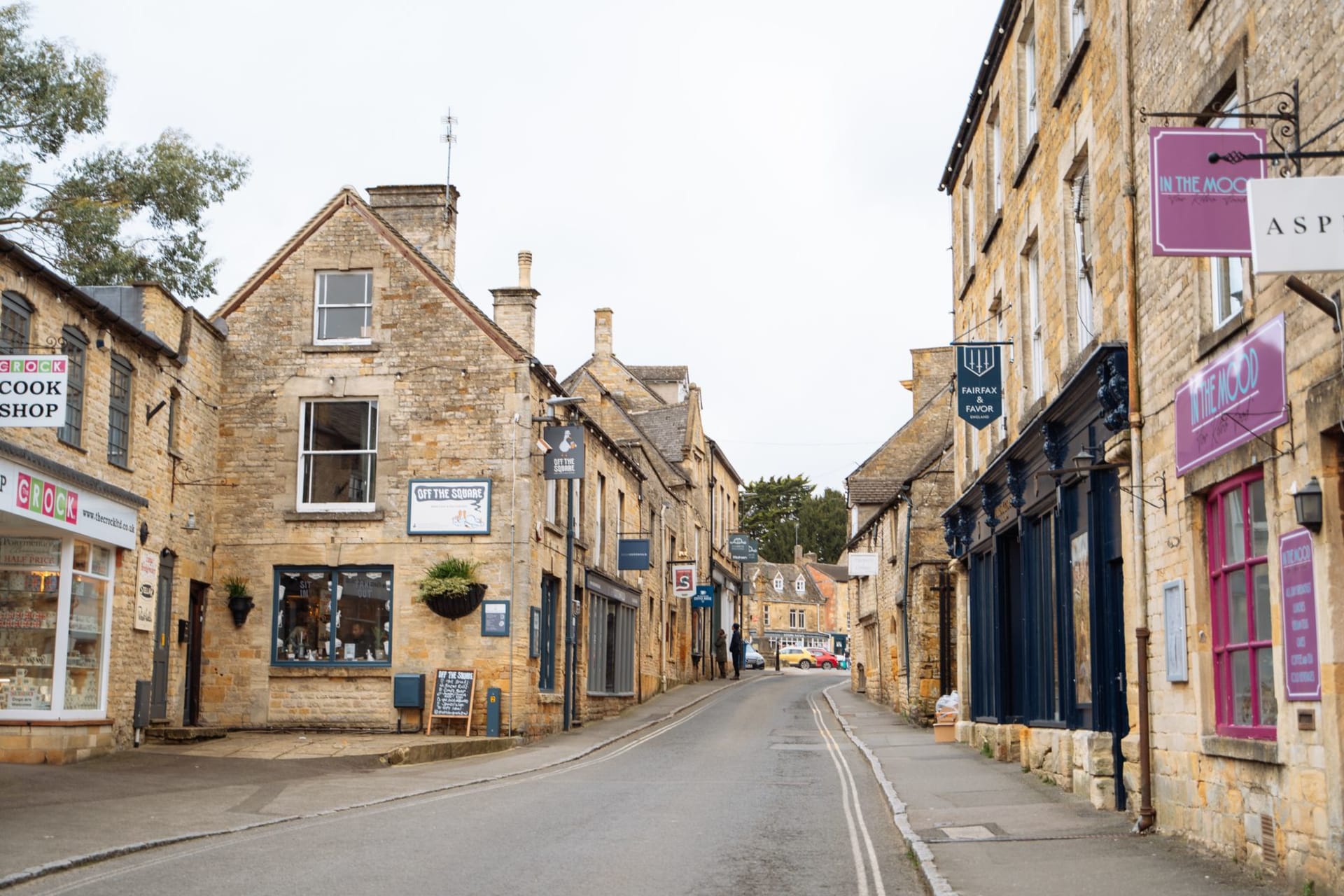
Moreton-in-Marsh
"Every Tuesday, the Cotswolds that exists between the postcards turns up and takes over the high street."
The train drops you at Moreton-in-Marsh on the old Paddington-to-Worcestershire line, and there is something clarifying about arriving somewhere in the Cotswolds by train rather than hired car: you feel immediately less like a visitor managing an itinerary and more like someone who has simply arrived. The station is Victorian and small and opens directly onto the Fosseway — the dead-straight Roman road that runs through the town at an angle that makes clear it was built by people who did not care about existing field boundaries.
The Tuesday market fills the high street completely, which is a wide and long street, and it runs from a mix of outdoor clothing stalls and farm-fresh eggs and honey and vegetable boxes and a cheesemaker from Gloucestershire who sets up a table and cuts samples with the easy confidence of someone who already knows the cheese is excellent. I arrived on a Tuesday in September and spent an hour working through the stalls at the pace the market required: slow, slightly meandering, making minor purchases that added up. The cheesemaker sold me a half a Double Gloucester and a wedge of something younger and sharper that he called a Cotswold single. I ate both within twenty-four hours and do not apologise for this.

The Redesdale Market Hall stands at the south end of the high street, a nineteenth-century loggia in Cotswold stone with an upper floor that served various civic purposes and now tends toward exhibition. The Curfew Tower at the north end of the town is older — sixteenth century, with a bell that was rung every evening until 1860 to warn residents to cover their fires for the night. These two structures, a few hundred metres apart, sketch the timeline of a town that has been a market centre for a very long time.
Batsford Arboretum is three miles west of Moreton and is one of those English places that does something quietly extraordinary with scale and time. The arboretum was planted in the 1880s by Algernon Freeman-Mitford — diplomat, traveller, grandfather of the Mitford sisters — after he returned from Japan with an enthusiasm for Japanese garden aesthetics that he applied to a Cotswold hillside. The result is unexpected: a hillside with one of the finest collections of maples outside Japan, interspersed with bronze Buddha statues and stone water basins, and views across the north Cotswold hills. In October, when the maples are turning, the arboretum is the most extraordinary display of autumn colour in the region — reds and oranges that seem too saturated for England, as if the Japanese DNA of the planting is coming out.

The town also has a Farm and Countryside Show every August which attracts prize livestock and agricultural machinery and people who know things about sheep that I will never understand, and it is a genuinely different Cotswolds from the postcard version — a working landscape revealing its actual economy. The Wellington Aviation Museum is a small and passionate thing, housed in a building near the station, run by volunteers who know everything about the RAF Moreton-in-Marsh station that trained bomber crews here in the Second World War. I went in on a rainy afternoon with low expectations and spent ninety minutes.
When to go: Tuesday for the market, any day in October for Batsford’s autumn colour. Moreton works as a base for the northern Cotswolds — it has a train station (useful), hotels at several price points, and is twenty minutes from Chipping Campden and Stow-on-the-Wold. Come in winter for the market when the stalls are steam-heated and the quality-to-crowd ratio tips decisively in your favour.