Calvi
"The mountains had snow on them and the sea was already swimming temperature. Corsica keeps breaking its own rules."
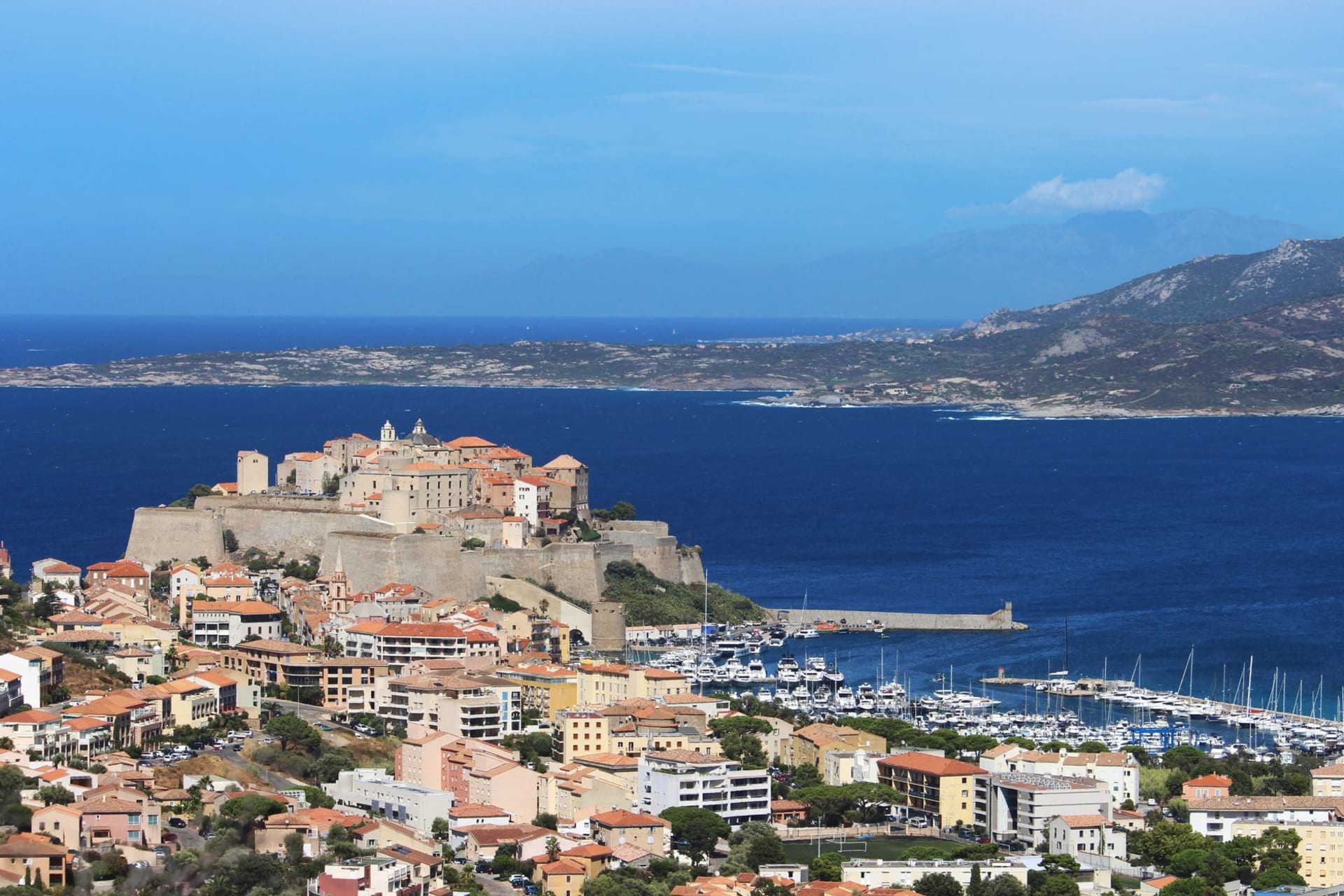
The little train they call the Trinighellu — the trembling one — took three hours from Ajaccio to Calvi, stopping at stations that were sometimes just a platform in a field. I had a window seat and watched the coastline emerge and disappear between cliffs and forested headlands, and then we came around a bend and the bay of Calvi opened in front of us: a wide blue crescent, a long arc of pale sand, and at the far end a citadel on a headland, its Genoese walls the color of dried earth. Behind all of it, Monte Cinto still carried snow in late May. I have a photograph of that moment that I’ve never been able to properly explain to people who haven’t seen it.

The citadel is the usual Genoese construction — thick walls, narrow gates, a cathedral, houses stacked up the slope inside the ramparts — but what distinguishes it is the vantage. From the upper terrace you see the full arc of the bay, the Balagne hinterland rising behind the town, the red and ochre rooftops below, and on the clearest days the Ligurian coast of mainland Italy, a faint smudge to the northeast. Calvi claims, with some local passion and minimal evidence, to be the birthplace of Christopher Columbus. There is a ruined tower inside the citadel said to mark his childhood home. I enjoyed the theory. The Genoese were everywhere in this part of the Mediterranean and the timeline is at least not impossible.
The beach is the other reason people come. Six kilometers of white sand curving west from the citadel headland, backed by parasol pines that provide the only shade. In June the water is already warm enough to swim comfortably and the beach is perhaps a third full. By August every centimeter is spoken for. I swam early one morning when the bay was still, the citadel casting a long reflection across the glassy surface, and the only sounds were small waves and whatever birds live in those pines.

The jazz festival that takes over the town each June — Jazz à Calvi — brings musicians from across Europe and fills every terrace and square with late-evening performances. It is exactly as improbably good as it sounds for a town of five thousand people. Eating well in Calvi is straightforward: the marina restaurants serve fresh grilled daurade with olive oil and herbs, a half-carafe of Patrimonio white, the particular Corsican habit of bringing more bread than you asked for. The town is sophisticated in a low-key way, full of sailing people and walkers who’ve come off the GR20’s northern sections, a mix that keeps it from being purely seasonal and purely decorative.
When to go: June is the sweet spot — the jazz festival, warm sea, manageable crowds. May for quiet and cheaper accommodation with the whole bay almost to yourself. September is excellent for swimming and the return of some breathing space. Avoid August if you value being able to walk on the beach without route-planning.