Ouray
"Ouray makes you feel small in the specific way that actually feels good — not insignificant, just correctly proportioned."
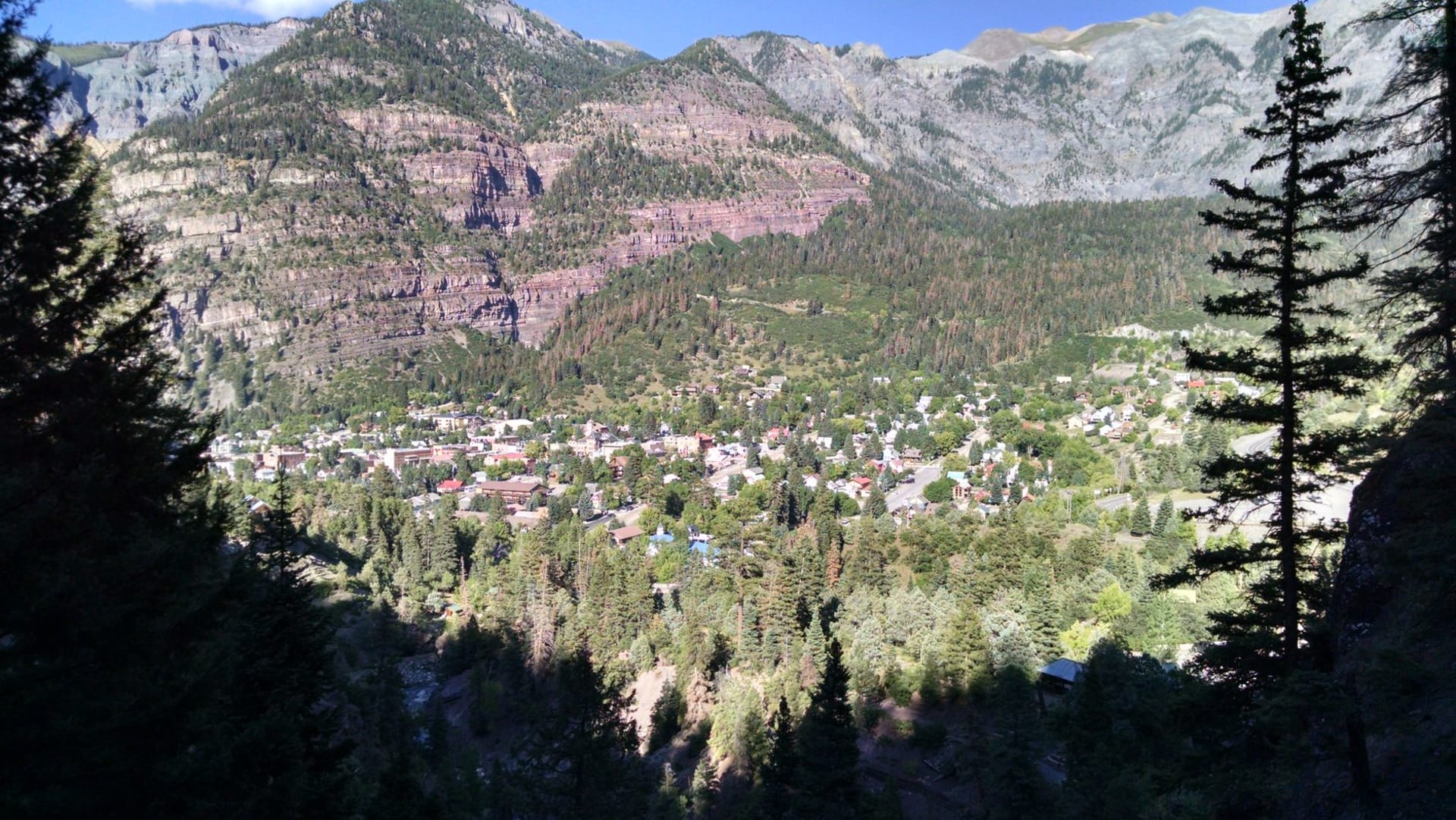
I drove into Ouray from the north, down the sheer walls of the Uncompahgre Gorge on a road that should not exist — a ledge blasted into cliff faces hundreds of feet above the canyon floor, one lane in some places, with drop-offs that appear casually on your left like uninvited guests. I pulled over twice not because I was afraid but because I needed to stop moving to actually see what I was looking at. The box canyon that holds the town of Ouray appeared below me eventually, a tight bowl of Victorian buildings surrounded by peaks on every side, the Box Canyon waterfall audible from the road in its slot a quarter mile away. I sat for a while with the engine off. The mountains here are so close they are almost a condition of interior life rather than a background feature.
Ouray has a few thousand permanent residents and a main street that runs three blocks and contains most of what you need to understand the place. Victorian buildings from the 1880s silver era in various states of expensive maintenance. A bakery where they make breakfast rolls that smell, from outside, of butter and cardamom. A gear shop where the staff talk about ice climbing with the matter-of-fact enthusiasm of people who go out three mornings a week. The hot springs pool sits at the southern edge of town — a naturally fed outdoor pool where the water comes out of the ground at a constant temperature and you float in mineral-rich water while the canyon walls rise around you and, in winter, snow falls on your face.

The ice park in winter is unique. The Uncompahgre Gorge downstream from town has been developed as the world’s largest artificial ice climbing park — the city pipes water onto the canyon walls each November and by January there are hundreds of routes of every difficulty level, free to use, in a gorge so dramatic that even watching from the rim makes your palms sweat. In summer the gorge becomes a hiking trail, and the same walls that held fifty-foot ice columns in January now run with waterfalls and the spray keeps the canyon twenty degrees cooler than the valley above.
The drive south from Ouray on Highway 550 — the Million Dollar Highway — may be the most dramatic road in North America. I drove it three times: once in both directions by day, and once by day going south toward Silverton, through Red Mountain Pass with its rust-colored mine tailings staining the snowfields ochre and red, through Molas Pass above eleven thousand feet where the Grenadier Range fills the entire windshield. The hairpin descents into Silverton. The drop-offs without guardrails. The entire route operating at a scale of drama that European alpine roads, for all their excellence, don’t quite reach.

I had dinner at a table by the window of a restaurant on Main Avenue and ate a grilled trout from the Uncompahgre River that had been on a menu board written in chalk. The cook came out afterward and sat at the bar and ordered the same thing I’d had. That’s Ouray: a town where the chef eats the fish.
When to go: July and August for hiking — the trail above Box Canyon to the waterfalls and the backcountry above are exceptional. January for ice climbing at the park; the festival in late January draws climbers from across the world. September for the combination of warm days, cool nights, and the first of the aspens turning on the surrounding peaks.