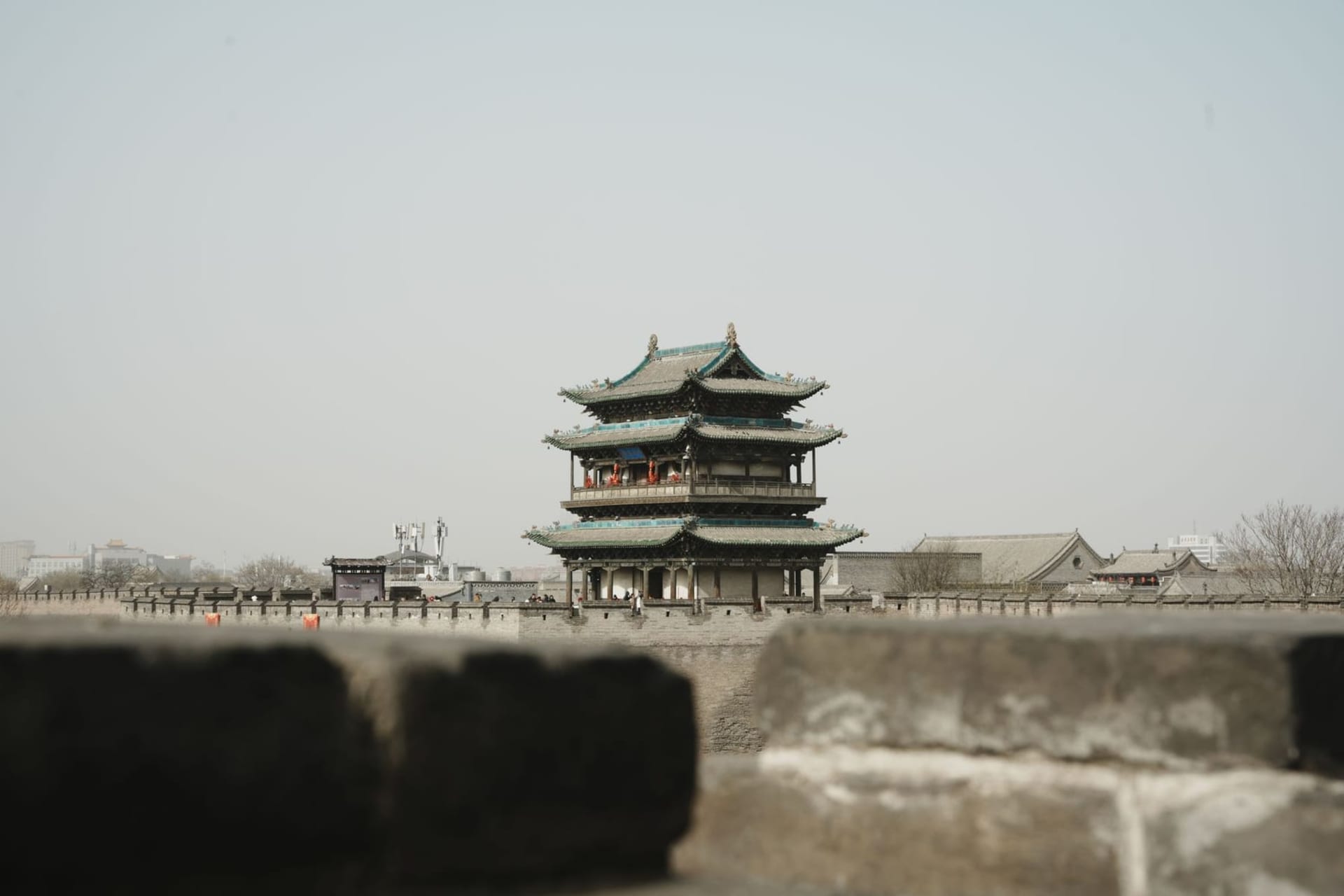
Pingyao
"Walking Pingyao's city walls at dusk, the 21st century disappears faster than any meditation retreat."
The best-preserved walled Ming city in China, where even the street lamps look like a prop department's dream.
There is a moment on the south gate rampart of Pingyao’s city wall — the sun dropping behind the loess plateau, the rooftops below turning the color of old pewter — where I genuinely forgot which century I was standing in. Not because I was tired from the train. Because nothing in my sight line told me otherwise.
Pingyao is the best-preserved walled city from the Ming dynasty in China, and that superlative understates the effect. The walls themselves run nearly seven kilometers, broad enough at the top to walk side by side in easy comfort. Lia and I did a full circuit at dusk on our second evening, passing watchtowers every few hundred meters, the lanterns just beginning to glow amber below us on Ming Qing Jie, the ancient main street, and I kept waiting for a telecom tower or a neon sign to break the spell. It never did.
Inside the Walls
The street grid within Pingyao has barely shifted in four centuries. The main artery, Ming Qing Street — lined with the wooden storefronts of former banks, lacquerware shops, and vinegar merchants — is the obvious place to start, but the real city lives in the hutong lanes that branch off it. Narrow alleys of compressed earth and dark timber, laundry strung between courtyard gates, the smell of fermented grains from the Rishengchang draft bank district where the world’s first draft check was supposedly issued in 1823. I spent an afternoon in there with no agenda and stumbled into a courtyard guesthouse where an old man was playing erhu in the shade of a persimmon tree. He did not stop. I did not speak. It was one of the more complete silences I have experienced in a city.
What to Eat on Xi Da Jie
Pingyao beef — slow-braised, soy-dark, pulled into strips — is the dish the city is proudest of, and rightly so. The stalls on Xi Da Jie sell it cold in paper cones for a few yuan, and I ate it for breakfast twice without remorse. The other revelation was cat-ear noodles, a local pasta shape that looks exactly as described, tossed in chili oil and vinegar made from Shanxi’s famous sorghum. The vinegar here is sharper and more complex than anything I had tasted before — a condiment that belongs in a different category entirely from what I grew up calling vinegar in Lyon.
The Surprise
The unexpected thing about Pingyao was not the architecture. It was the quiet. I had expected tourist machinery — and there is some, along Ming Qing Jie. But by nine in the evening the main street empties, the lanterns sway, and the interior of the old city becomes genuinely, improbably still. We walked back to our guesthouse on Yide Lu through absolute silence, flagstone underfoot, a half moon clearing the south wall. I had not planned on feeling moved. I was.
When to go: Late September through early November offers cool, clear days and low crowds — the tourist peak thins after Golden Week and the light on the old walls is extraordinary. Avoid July and August, which bring heat, haze, and the fullest tour groups.