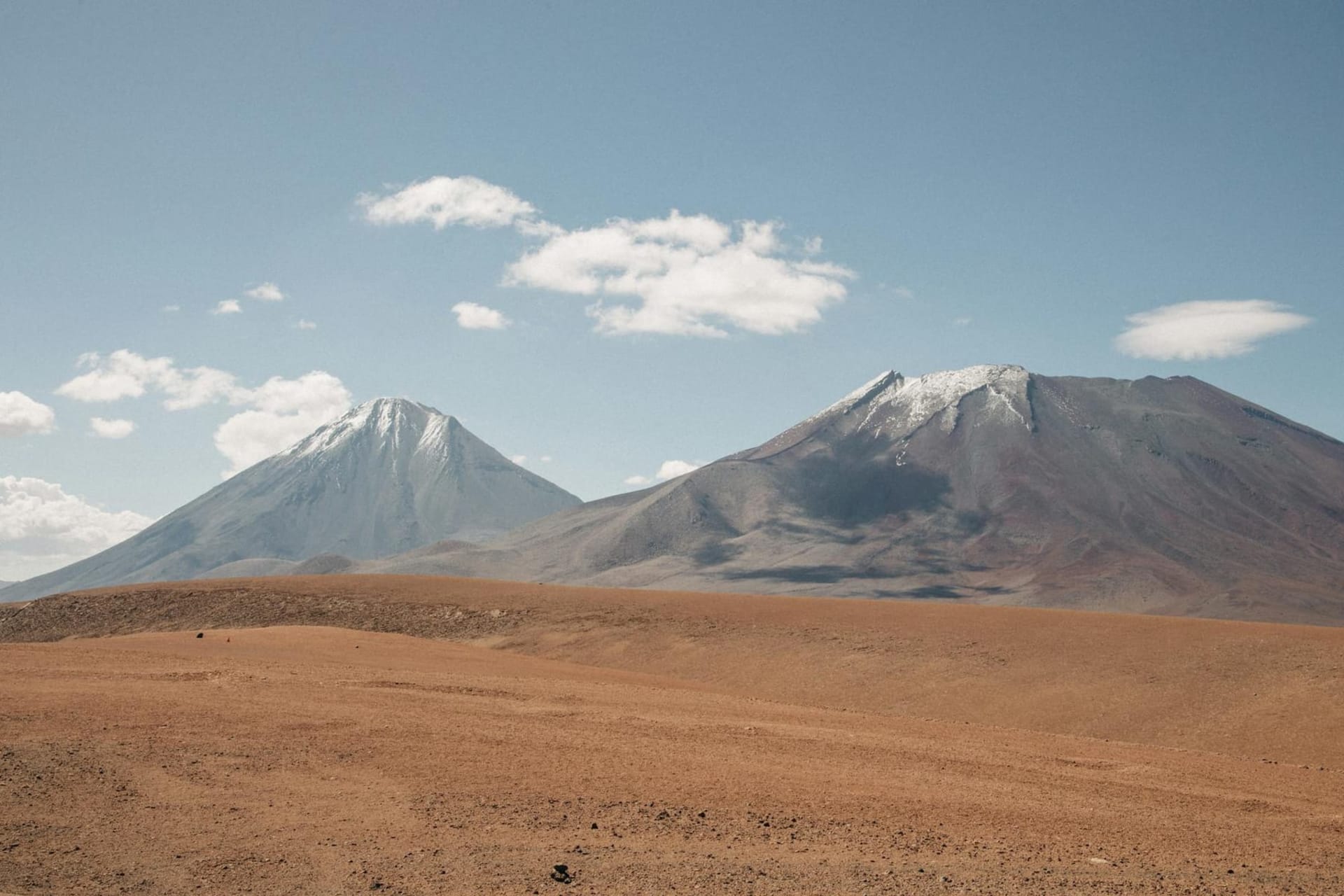
Atacama Desert
"In the Atacama the stars are not above you — they are so close they're around you."
Earth's driest non-polar desert, where salt flats, flamingos, and the clearest night skies on the planet coexist.
There is a specific quality of light in the Atacama at mid-morning that I had never encountered anywhere else — a white, almost surgical clarity that makes distant volcanoes look pasted onto the sky, too sharp, too near, like a backdrop someone forgot to blur. I stepped out of the guesthouse on Caracoles, the main drag in San Pedro de Atacama, and had to stop. The air smelled of nothing. Literally nothing. No soil, no moisture, no exhaust. Just altitude and cold mineral dryness at 2,400 metres above sea level.
The Salt and the Flamingos
We drove out to the Salar de Atacama on our second morning, Lia navigating from a paper map because the signal had died somewhere outside town. The salar — South America’s third-largest salt flat — doesn’t announce itself. The road simply ends at a crust of hexagonal white plates that creak faintly underfoot, and beyond them, shallow brine pools the colour of oxidised copper. Three species of flamingo feed in those pools: Chilean, Andean, Puna. I hadn’t expected flamingos in a desert. The contradiction felt almost comic — these improbable pink birds standing ankle-deep in hypersaline water with a snowcapped stratovolcano, the Licancabur, looming 5,916 metres behind them. Nobody warned me the Atacama is full of contradictions like this. I should have expected it.
Valle de la Luna After the Crowds Leave
The Valle de la Luna — Valley of the Moon — is on every itinerary, and for good reason its salt-and-clay formations do resemble a lunar surface. But the photographs lie by omission: they never show the wind. By late afternoon, when tour buses have retreated to San Pedro, the valley exhales a cold, constant gust that scours the crests of the dunes into curved ridges fine as brushstrokes. I climbed to one of those ridges alone at around 6 p.m. and watched the shadow of the Andes climb the valley floor below me, swallowing the ochre and the rust centimetre by centimetre. It took twenty minutes for the light to go, and every one of those minutes looked different.
The Night, Which Is the Point
Everyone says the stargazing. I nodded along politely until the first night I actually lay down on the salt flat outside our lodge, well past midnight, and understood it in my body rather than my head. The Milky Way was not a smear — it was textured, layered, dimensional. At 2,400 metres with zero humidity and zero light pollution for a hundred kilometres in every direction, the sky stops being background and becomes architecture. Lia didn’t say anything for a long time. Neither did I. There was nothing useful to add.
When to go: March through May offers mild days, cold but stable nights, and the lowest chance of the afternoon thunderstorms that roll through in summer — the so-called bolivian winter that can close altiplano roads between December and February. Avoid Chilean national holidays in September if crowds matter to you.